Saturday, August 14, 2021

DO Split the Party!

Boy Rused Into the Hall; Edmund Joseph Sullivan
Don't split the party. 

It's sage wisdom that is passed down from generation to generation of gamers. 

Of course it is - isn't it? 

In that - in the OSR sphere especially - encounters are not guaranteed to be balanced (almost guaranteed to be the opposite, in truth) splitting the party may not be a bad thing after all for a crafty party. Why shouldn't the characters with infravision scout ahead down the hall, making sure nothing is spying from the far side, while the Thief works on that door lock? Or, knowing that there is a back door to the Deep Dwarf's throne room, why not send the Assassins around behind while the party face distracts the guards at the main entrance?

Knowing that splitting the party, while not always the right solution, is definitely at times a viable if not a preferable strategy, at the end of the day - the biggest reason you don't split the party as a courtesy. It's an invitation to split the attention of the ref: who may not handle it - leaving the one part of the party out in the cold while keeping the grill hot on the other. In this post, I explore some of my own experiences with split parties, combined with some of the wisdom of other old-school enthusiasts I've either conversed with or with whom I've had the pleasure of gaming, in order to produce a guide: a handful of tricks and tips about how to handle a split party - how to, with procedures and practice, keep the players engaged, keep the game moving, and to buck the age-old adage.

Exploration

Exploration: the phase of the game where the party maps out un-mapped portions of the dungeon - dodges the traps and cracks the locks on treasure vaults while peering warily into the gloom just beyond their torch light! This phase of the game - both within the OSR sphere and out - is the easiest part of the experience to run with a split party.

An OSR game - defined here as a game in keeping with the tonal and mechanical tendencies of Gary-era TSR Dungeons & Dragons - will by necessity have procedural elements used for the tracking of time and the measurement of activity in the dungeon. Picking a lock? Takes a turn. Checking for traps? Takes a turn. In this manner - the referee is able to adequately measure when to check for wandering monsters, how long a torch lasts, and similar: producing a ticking clock and balance of urgency to the players. How long before resources run out - and how much deeper can we go to find that next gold piece? The key to running a split party in this context is to lean on those procedures: alternating turns as to who is up to bat the same as you would for a combat.

War Signal; Adolph Von Menzel

From my own dungeon-mastering past: a party once encountered a very trite shrine of elements - where a key to get into the center had to be obtained from two wings, pocket dimensions, one being arid and rocky - the other being marshy and wet. I forget why they were different - but the point is the party - being eight strong or so with some redundancy of roles - decided to break into groups of four and tackle both at the same time. Not a problem! Both wings of the map were relatively small "dungeon levels" - they had short maps, mostly corridors, maze theme - so I noted the movement rates of the two sub-parties and, every that number of feet they explored, I would cut scene back to the other party - turn by turn, working their way into the heart of the maze. By switching back and forth - by keeping both sub-parties involved and relevant in the current turn of events, the players remain invested and attentive... or, as attentive as they are wont to be, but player caliber is a separate consideration.

In a non-OSR game, you can accomplish the same thing with progress points: think milestones, except for in-dungeon tasks. If one sub-party is attempting to open a door and they successfully pick a lock? That would be a progress point - before the door swings open, switch over to the other sub-party. One sub-party moves down a corridor, coming to a junction where they must choose which way to go? Progress point.

Arguably, in the progress-point scenario, all we've really done is introduced a procedure where there was none before: albeit a more seat-of-pants or wish-wash version than the concrete procedures associated with a B/X or OSR style game. Also arguably - who, reading this blog of all things, isn't playing an OSR game? Food for thought, either way.

Additionally - consider a caller. A caller helps - either way you do it - when running a split party in an exploration mode in that it allows the sub-parties to discuss among themselves what they're doing. In voice chat - admittedly - this is difficult: as the cross-talk is level compared to the ability to cross-chat at a table, where it's directional - but in an online sphere, there's also nothing preventing the sub-party players from pinging each other in instant messages. I.M. is slower than voice, of course: but really, there likely won't be that much conversation going on between them between turns - as how much can you really discuss when you're orders are along the lines of "We move 80 feet down the corridor and the Thief taps the walls for secret entrances"?

Combat

What happens when one of two (or more) sub-parties then enters a combat encounter? Wandering monsters happen, rooms sometimes contain aggressive monsters; combat is part of the experience.

City of Immortality; Henry Justice Ford
To start with what not to do, do not simply run the combat, forcing the uninvolved sub-party to twiddle their thumbs until the encounter ends; second, do not try to mix turns: an exploration turn (which is what the other sub-party will be doing) is worth 10 combat rounds - so either you will have a twiddle-their-thumbs scenario for 10 rounds followed by a "what are we doing?" turn, iterate for the duration of the combat encounter. So, with those two out - what do you do? I have experienced with a few options, some of which work better than others.

The easiest thing to run - and unfortunately the least likely to occur without the use of quantum ogres or other railroad-esque mechanism - is to engage in two separate combats. However in a populous dungeon - it may be a viable option. In the same game from above, talking about one party going to an arid mini-dungeon and another going to a swampy one, there was a planned encounter - a guardian - in the swampy subdomain: an aquatic creature would follow the party and assess them, engaging when it felt appropriate or when the party spotted it. That contingency had started - it was following the characters who were exploring that half of the map - but it had not yet engaged: on the other side, the other half of the party got the drop on some elemental rock creatures. The sub-party engaged the elementals from range, starting a combat. At that time - it did not seem particularly quantum ogre of me to do so - but I said, "We'll do one exploration turn over here, before we start in on the combat, and will get back to it." In that one exploration turn, the guardian in the water engaged - the other sub-party embroiled in combat - and from there, I was able to go round by round with each side: with the exception that the two sub-parties could not help each other when things went south (which, for the swamp-party, they did), the experience played out like a normal combat. After the session, I expected to be accused of coercing the encounter - but I guess the players had enough fun during the session that, at our midnight Waffle House post-session follow-up, they were instead talking about plans as to what to do the next session - where they wanted to use the newly discovered key to delve into the main temple.

Alternatively, presuming the presence of henchmen as participants in the combat, there is always the option that missing players could take on the role of the henchmen for the duration of the combat encounter. This would keep the sub-party players relevant to the activity at hand - participating in the combat - while also keeping the split dynamics intact. I have not done this with a split party before - however I have done similar regarding the replacement of player characters. While it's long-standing tradition to step into the shoes of your henchman if your main character dies, what happens when you run out of henchmen? Well, git gud, obviously: but - from a more serious tone in play experience - my groups tend to lend henchmen around. "Is it OK for Soinso to take over Whosit?" "Sure - go ahead my man." And the game moves on. However - in those games - henchmen tended to be more a party resource than a player resource: it requires that the one player doesn't have an investment in those henchmen and it requires that the other takes care to act in kind with how the first played their henchman in the first place. So this solution may not work for all groups - especially if the henchman in question has leveled with the party rather than being a more one-off style NPC accompanying the group for a cut of the treasure.

A third option - my personal favorite: have the sub-party not engaged in the combat play the bad guys in the combat. I don't claim to have originated the idea: having read about someone else trying it having inspired this article - but I do know I've done it at least once; more specifically, having done it with a group while running the Lichway: one sub-party was a set of player characters, the other sub-party playing NPC bad guys including the Artist/Jailer in that central room. Save the champion or leader of the bad guys for yourself - if appropriate - as the ref and then tell the other party it's time to attack their friends. Again - this serves the goal of keeping the other players, the other sub-party, engaged during an assymetric fight. Admittedly, some parties may not like the idea - they may not enjoy a PvP aspect; and alternatively, some parties may try to take advantage of the situation - playing the monsters poorly to give their allies an advantage. From my experience, it was the opposite - the players being friends in real life relished the opportunity to beat each other up in game, going so far as to taunt one another pseudo-in-character all the while: but you will need to judge whether this approach is going to work for you - as to whether your players are going to enjoy it, to thrive in the spirit of it like mine did, or whether they won't. 

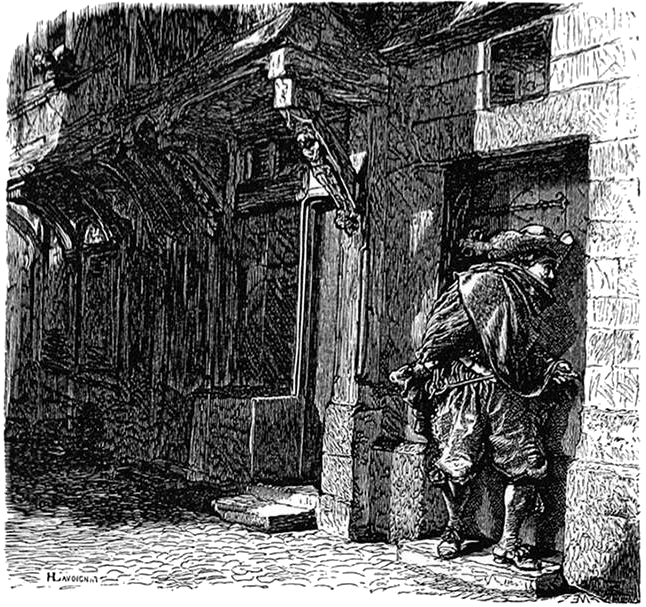
Death of Clopin Trouillefou; Louis-Henri Rudder

Could I just let the other party rejoin the combat? Sure. If the other side of the party is within a reasonable distance, I would have the roll to Hear Noise and - if they succeed - allow them to make the call to come to the aid of their fellows. If they are too far - so be it - but if they are close enough, go into combat rounds and have them charge through the halls (remembering to check for traps along the way) and come into combat. If it will take more than three rounds, however, I recommend one of the other steps above in the meantime - again, the name of the game being to keep the players - all of them - in the moment and engrossed in the game.

Role Play

Role play elements - elements which have less of a procedure, less framework around them - therein lies the most challenging to keep split parties engaged. But first - a definition:

Role play doesn't mean talking in your character's voice.

Role play doesn't mean making a bad decision because "that's what my character would do."

For the context of this conversation, role play is the injection of the self into the avatar of the character: your thoughts are their thoughts, your words are their words, and your actions are their actions. Thus, it does mean that you will speak the words your character is speaking - I joke that character voices aren't for me; that's true, but the joke is that I'm not everyone: if character voices work for you, use them! - it also means interacting with that puzzle room. It also means solving that intricate trap. Why depend on a Thief to produce a number on a percentile roll when you could interact with the environment?

That said - elements of in-character activity that involve intense or focused involvement by the player will, in a split party scenario, by necessity exclude the other sub-party. The key - however - in keeping that sub-party involved, keeping those players relevant to the action - is the same as during exploration: swapping turns. Recall that a game turn is generally 10 minutes: as such, in a role-play encounter, interacting with the environment or NPCs over the course of 10 minutes should constitute a full turn: entitling the other party to a turn of their own. 
By Love Advised; Ernest Meissonier

But 10 minutes is a long time to ask the party-splitters to pay attention. Yes - it is. And at this point, it's good to leverage the power of abstraction. Players not having necessarily the best sense of time - especially when immersed in the moment - you could start by aiming at the five minute mark. Five minutes is fair - it's within the realm of reason when keeping the attention of the split-party - but it's also close enough that you can point out, well - yes, 10 game minutes have taken 5 in-real-life ones, but the words exchanged, the gestures made - they may not have been one to one. In the same sense that a combat round takes far more time at the table than in the game, and in the same sense that an exploration turn takes far less time at the table than in the game, it tracks that this timetable doesn't need to track, itself, one to one with the passage of time in the game.

You will need to hone the time to your table. Some tables will handle 5 minutes well, but 7 minutes better; other tables may be able to go to the full 10. If your group can manage 10 minutes? Go for it! There is no reason not to if the players are engaged. What I would say - though - is be consistent. Once the cadence is established, stick to it: as it will help the players (and help you as the referee) fall into habit: creating and adhering to a procedure in an otherwise largely procedure-less circumstance. Radio Grognard recently had an episode - or, within the last month or so had an episode... - where Glen talked about having a timer at the table - an hourglass or other non-invasive type - to help with pacing. That's brilliant advice - for the new referee and the seasoned referee alike: for the newbie, helping to get to that pacing place; for the veteran, helping to keep to a rhythm.

In the meanwhile, don't forget - it is important to stay between 5 and 10 minutes. If you go outside of those bounds, if not only for engagement factor, you'll be cheating the players - either for or against - when it comes to wandering monsters appearing or for torches slowly running low.

Conclusion

And them's my two coppers.

Have you done it better? I'd like to hear about it! Drop me a line - a comment, an email, a Discord direct message, or a voicemail over on the podcast. But whatever you do - don't fail to keep exploring!

Delve on, readers.

Wassail-Bout; Mary Hallock Foote

Public domain artwork retrieved from OldBookIllustrations.com and the National Gallery of Art and adapted for thematic use. Attributions in alt text.

Saturday, August 7, 2021

Birthin' Babies in B/X

The endgame of the classic OSR game is in the establishment of a domain: the fighter builds their stronghold; the wizard their tower; the cleric, their monastic barony. A critical part of domains, in history - perhaps - rather than the common gaming implementation: succession. To whom will your dominion pass when you are no longer controlling it? Knowing that - why not produce your own heirs? Herein presented, the old rules I use to have - slightly adapted to fit better to B/X - regarding child-bearing in RPGs. 

Hold on - did this really ever come up in your games? No - not really.

Then why did you write it? Well, this houserule comes from an old heart-breaker I'd written in college and serves a twofold purpose: one, as a warning - showing the folly of too-much time on your hands coming up with convoluted and over-involved rule-sets, trying to emulate reality (I should write a ramble on that...) and two, as an announcement - a sort of state of the blog. The ultrasound used in the first picture is real - my wife and I passed our conception check: we are expecting a third child next spring.

Congrats... but what does that mean for the blog? In terms of gaming, this process has admittedly stymied my gaming. In terms of the blog - recall, the reason I started the blog was a creative outlet to allow me to express gaming in light of the birth of my twins. So - for that reason - I think - the blog shouldn't suffer: if I can handle twins and draw a map scenario by Saturday morning, I think I can handle a singleton. 

And in terms of the podcast? Well - still podcasting: same lack-of-schedule. I hope to maintain the quality of both: though there may be more "ramblings" and "reviews", knowing that those take less time to produce and proofread than modules or other, "bigger" content pages.

Delve on, readers; and without further ado, birthin' babies in B/X!

Cribs & Conceptions

Conception

A character with a partner, willing and able, is permitted to attempt to conceive a new prospective heir once per in-game month. For each attempt, there is a 2-in-8 chance - modified by the Constitution of the mother (thus, a mother with a Constitution of 14 would have a 3-in-8 chance to succeed, where a mother with a Constitution of 7 would have a 1-in-8) that the attempt will succeed.

Optionally, the referee may modify the chance of success by age: where each age category the mother is away from "Mature" increases the size of the die - thus, going by the table in the AD&D Dungeon Master's Guide, page 13: a Human at age 45 would have a 1-in-8 chance, where a Half-Elf at the same age would have 2-in-8.

The Laidly Worm; John Dickson Batten

Gestation & Birth

Gestation period is proportional to the life-span of the character. This is equivalent to a number of weeks equal to the maximum threshold of the "Mature" category of the newly conceived character: thus, a Human will gestate for 40 weeks, where a Half-Orc will gestate for 30 weeks and a Gray Elf will gestate for 650 weeks.

At the point when conception succeeds, the mother must roll a Save vs Death, which will determine the outcome as follows:

  • On Great Success - defined as passing by 8 or more - the pregnancy will result in a Success, as below, and also the offspring is considered gifted - detailed under Growth and Maturation.
  • On Success: the offspring will be born without consequence at the end of the gestation period.
  • On Failure: the offspring will be born, but with consequences. The rough experience causes the mother to age a proportional number of years equal to 2d6 percent of their "Old" maximum threshold.
  • On Severe Failure - defined as failing by 8 or more - a severe complication occurs; the mother must Save again - treating a success as "On Failure" above and treating a second failure as a maternal fatality.

Optionally, as in a world with abundant Cleric magic or with more advanced medical maternal care, the above may be a bit grim - the referee may optionally have the mother roll 2d20 on the Save vs Death above: taking the higher result.

Princesses in Plenty; William Heath Robinson

Growth and Maturation

Presuming heir survival, the heir should next roll their Ability scores. 

For normal heirs, rolling Ability scores should be 3d6 down the line. Then, select a parent the heir takes after: this can be done randomly, rolling odd or even - or it can be done along gender lines - at the discretion of the referee: for each Ability score that is 4 or more points different - higher or lower - roll 1d4, adjusting the Ability score in the direction of the parent. Thus, a Wizard of Intelligence 18 and Constitution 9 who sires an heir of Intelligence 13 and Constitution 16 would roll 2d4: one to adjust the Intelligence upwards, towards 18, and a second to adjust the Constitution downward, towards 9.

For gifted heirs, rolling Ability scores should be 4d6 drop lowest - again, down the line. Then, in adjusting the Ability scores, the 1d4 adjustments should only adjust upward. Thus, if the same Wizard had the same sired heir, but the heir was gifted - only 1d4 would be rolled, which would adjust Intelligence upwards.

Growth and maturation of the heir then follows naturally - with the heir bearing a fraction of their abilities proportional to their age until they hit Young Adult - at which point, they become eligible to play either as a henchman or hireling or as a replacement player character.


Death's Large Hothouse; Hans Tegner


Open license art, Battle Axe Medieval Middle Ages by user OpenClipart-Vectors and Helmet Vikings Noorman (sic?) History by user gllms retrieved from Pixabay and incorporated into ultrasound image as original content. Other artwork, public domain, retrieved from OldBookIllustrations.com and adapted for theme - attribution in alt text.

Saturday, July 31, 2021

Find the Dwarf!

 He's not got treasure or anything; but he's in there.

Scale: 10 ft.
Click here for a PDF version of this adventure!

As I've mentioned in the past, I am prone to long swaths of descriptive text or purple prose. Writing dungeons for OSR consumption - then - becomes a challenge: to make a dungeon adventure more usable, more suitable to a home sandbox, it's a service to the product and to the reader to be terse: to provide few notes so that the referee has enough material to build on, but likewise ample room to expand, to flavor, and to fit the adventure into their setting and tone. This adventure - thus - is an exercise in brevity: it is a fully inclusive adventure, runnable on its own, but also one of my shortest PDFs - clocking in only 6 pages at font size 12 despite having 19 keyed rooms. 

So - let me know what you think! Does this format work better, or do you prefer the more descriptive version - with set dressing peppered into the empty rooms?

Delve on, readers!


I) Stairs lead into the level in this room. They hover - supported by apparently nothing - and the underside of the stairs glow luminously - enough to light the space in a dim tone. If anything ferrous touches the glowing portion, it becomes magnetized: granting a +1 bonus to hit against armored opponents, but imposing a -1 penalty to hit if the wielder is wearing armor. On mundane equipment, the effect is permanent; magical equipment is affected only for 1d4 hours.

II) The secret door to the south has been discovered by 5 Goblins (B36), who are trying to pry it open.

III) A metal cage encloses a pedestal with a resplendent black orb. Inside, several dry-mummified bodies: all looking to have been geriatric when they died. If a character touches the metal cage - they must Save vs Spells or age 1d8 years. The door is locked.

The orb functions as Crystal Ball: but when looking underground or in a dark place, will function better - producing a clearer, more detailed picture - than in bright light: in which it will appear blurry.

IV) In the south of the room are two hives containing 7 Killer Bees (B37). In the one can be found 2 doses of the Killer Bees' curative honey; in the other can be found a satchel containing 200sp in addition to a further 500gp.

V) In the hall here is a pit trap, 10' wide by 10' long by 20' deep. Characters in the area of the trap if it activates must Save vs Paralysis or fall - taking 2d6 damage and stranding them at the bottom of the pit.

Duel of Two Dwarfs; Stefano Della Bella

VI) In the center of this chamber, iron bars block half the hall - three times - in sequence, such that a character might have to zig-zag while walking to get around. Phantom bars block the other half of each - translucent and intangible, but visible. A character has no ill effect from walking through the phantom bars.

VII) Several Elf-like, but not Elf, figures are dancing, floating around a foot off the ground, as though in a ballroom. When the party enters, they will dissipate.

VIII) Hanging in the narrow, central to the room, is a massive nest containing 10 Killer Bees (B37). Inside the nest can be found 4 doses of their curative honey: likewise entombed in part of the nest - such that if it is opened or removed, the hive will be damaged - is a large wooden chest with iron straps. Inside the chest can be found 800 sp, 100 gp, two zircon stones worth 10 gp each, and an oval diamond worth 100 gp.

IX) Against the south wall of this space is a barred section protecting a pool, rippling despite the stillness of the room, and glowing slightly - as though back-lit underneath. If the party finds a way into the space and dips an item into the pool, it will glow like a torch for 2d4 turns. If a character immerses themselves in it, the character's skin will glow - as a candle: not enough to light the way - for 1d4 turns: but at the end of the adventure, the character will benefit from a 10% bonus to XP earned for the adventure. Immersing one character or immersing up to 1d6 items will cause the magic to fade, the slight glow of the pool going dark. The pool will refresh its magic at midnight of the next full moon.

X) Trapped in this room are 4 Normal Wolves (B44). A mostly-eaten beastmaster lies on the floor. His armor is ruined, his rations consumed, but he has some miscellaneous survival gear and a pouch containing 400 sp and 100 gp.

XI) A candelabra with no candles - rusted and heavy - hangs in this space. The candelabra is trapped. If a trigger plate is stepped on while traversing the room, the candelabra falls: roll to hit any character underneath - THAC0 14 - for 1d8 damage. The trap resets itself after one turn has passed.

A Lady Greeted by a Dwarf; Stefano Della Bella

XII) An idol head hangs from a pillar in the ceiling, suspended over the floor. It faces North. It will turn on a pivot freely and - if pointed to face either of the two secret doors, an audible unlocking noise can be heard. If either door is unlocked, it can be pushed inwards and will slide down. If either door is locked, it will not budge - appearing simply a section of wall. If one door is open, the idol cannot be turned to face away from it. 

XIII) A lone Dwarf (B35) - dazed and bereft - is hiding in this space, their party having been defeated and themselves having fled. The door to the east is locked; the door to the west, the Dwarf has spiked shut.

XIV) In the center of the room is a stone circle, on which lie 700 silver pieces. Surrounding the stone circle, a concentric circular depression, roughly two inches deep, filled with a seemingly innocuous liquid. A character can walk through the liquid - no problem - however, the floors of this room, if a part of the character wet by the liquid comes into contact with them, will stick fast and can only be pulled loose on 1-in-6, modified by Strength. Additionally, when a character stands on the center circle, it will depress slightly. There is a cumulative chance - X-in-6, where X is the number of characters on the circle, that the circle falls through, sinking suddenly to a 10 foot depth, filling with the liquid and potentially drowning any character stuck to the circle by aforementioned contact with the glue liquid.

XV) A shrine has been tucked into the corner of this space. If a character touches the idol in the shrine, its eyes will flare and a path will illuminate on the walls leading to XII.

XVI) This room is separated from the hall by iron bars. The door to this space is locked. Along the south and east walls are tables - for surgery or for torture: it's not clear. On further investigation, a pouch containing 600 sp and 500 gp has been slipped into a sluice under a metal drain.

XVII) A clutch of 9 Kobolds (B37) have made a home in the northern section here. Among their possessions is a key to the door to room 16. There is a snare in the hallway leading to this area which will raise a bladed net - ensnaring one character within it. When the net triggers, roll to hit, THAC0 18, to deal 1d6 damage, of the netted character. Regardless of hit, that one target is ensnared. If an ensnared character breaks out of the net without assistance, they will take 1d6 damage. 

Dwarf Musicians of Granada; Gustave Dore

XVIII) Chuckling in this dead end are 13 Halflings (B36). They have just entered the dungeon via the stairwell in room 20, seeking the Dwarf in room 13, and have followed the corridor to the dead end - the anti-climactic nature of which has struck them as funny.

XIX) Stairs lead into this room from outside the level. The south wall to this space is comprised of iron bars. The door to the east is locked; the door to the west is ajar. In the center of the barred wall is a wrought iron face with pursed lips. The face is trapped - it is sensitive to heat and a character drawing close enough to inspect it may trigger a cloud of material to blow out of the face's lips. Save vs Breath or be blinded for 1d4 hours. The mechanism is controlled by an electrum modulation coil, accessible from underneath the mask. The coil is work 90 gp.

Wednesday, July 28, 2021

Horror in my Home Game: Part 2


Anchor.fm/Clerics-Wear-Ringmail: Episode 3 -
Horror in my Home Game: Part 2!

Description

How can you successfully integrate horror into your home game? This episode continues looking into the pillars of horror - focusing on Revulsion - and answers some call-ins: both regarding the horror subject and regarding the podcast, in general. 

Some segments of rough audio - but again, having learned from the experience, it's better than it was and will continue to improve.

Theme Music by XTaKeRux, Free Music Archive: https://freemusicarchive.org/music/XTaKeRuX

Show Notes

  • 00:00 - Intro
  • 00:29 - Theme
  • 00:48 - Call In: Joe Richter from Hindsightless
  • 05:14 - Call In: Jason from Nerd's Variety RPG Podcast
  • 06:57 - Revulsion!
  • 16:45 - Audio Quality Apology and Segway into More Call Ins!
  • 17:20 - Call In: B.J. from the Arcane Alienist
  • 18:27 - Call In: More Joe Richter from Hindsightless
  • 19:31 - Call In: More Jason from Nerd's Variety RPG Podcast
  • 20:25 - Outro and Teaser for Next Episode
  • 21:21 - Theme & Legalese

Links

Hindsightless (https://anchor.fm/joe-richter9)

Nerd's Variety RPG Podcast (https://anchor.fm/jason376)

Arcane Alienist (https://anchor.fm/arcanealienist)

Grizzly Peaks Radio (https://anchor.fm/andy-goodman9/)

...and Expedition To the Grizzly Peaks (https://anchor.fm/andy-goodman8/)

Saturday, July 24, 2021

Nightmare Dragons

Dragon Head Myth Legend 3D Render; Pixabay user ractapopulous
"Where am I?" she thought as the spinning darkness slowly lost its momentum. 

Her skin beneath the thief's leathers was prickled at the cold black. Sitting up, a headache: some soreness in the muscle - but ... unharmed? Was her dagger missing? No... neither her pack. The lantern? The lantern!

A sudden urgency worked its way into her rib cage. Rummaging into her pack, she fumbled at the buckle - a clatter as something fell - a curse at herself: where was her flint? She needed the flint.

"Maejea."

It wasn't a question - more an observation, the Dwarf's voice in the darkness.

"Radovan!"

Clutching the pack closed to her stomach, Maejea felt her way over to the voice's point of origin.

"I've a torch beside me," the Dwarf said, his voice forced, deliberate, "but I'm not sure you want to light it. I've got a nasty break in the leg it'd be like to show."

"You've got a working mouth in your beard, though, Radovan," she replied, "That's a start."

The torch was in her hand in a moment; her heartbeat again regular, the flint soon followed. It was in the small pouch she'd stitched to the pack's flap, near the strap. Steeling herself, she went to work on the torch.

And a click.

She paused. Silence to her left. An inquiring grunt in a Dwarfish tone. Back to work - the torch was fresh; alight - trailing smoke upwards. She held it aloft; removing herself from the billows, offering them instead to the distant cavern ceiling.

A click in the darkness. This time, to her right. Then silence.

"We'd best double back," she said, "I haven't heard Bogdana or Erluf - we'll need to get out if we're apt to get our bearings." 

Radovan was heavy - it helped... she pulled his hand over her shoulder... that he could put part of the combined weight of Dwarf and armor on his good leg. They dragged a few steps together. Her foot slipped - she shifted, looking down, caught herself. Looking up again...

A hiss - not a hiss, a cacophonous whisper: a voice in the sound of molten steel quenching in a pool.

"Don't forget to write."

From above, a neck came into view - the length of a man, the thickness of his thigh - atop it came the head, a smiling loaf: a row of daggers on daggers - taunting. Smiling.

A scream.

People Travel Adventure Cave Light; Pixabay user StockSnap

Her own scream.

An exclamation of pain and the thump of flesh and steel on flagstones - and the fleeting light of a torch, flickering, its flame fighting against a quenching faux wind, bypassing with rapidity the still cavern air: bound to a fleeing, clutching hand.

Laughter.

Why We Fear the Dark

Nightmare Dragons are the beast in the dark - the monster in the sweltering depths. Their scales are jet black and have a reflective quality to them, as though polished: enough to glimmer in torchlight if caught at the right distance. Their wings are bat-like, their tails terminating in a triangular bone prong, usable as a barbed whip. Their snouts are long - like a gharial - and lined with long teeth standing side by side in almost machine-like precision of their order and orientation. 

Combination: dragon fantasy animal fairytale by Pixabay user AnnettePendlebury, against Fantastic Underground by Robert Caney

Nightmare Dragons are found in deep caves within a few hours flight of civil settlement: or in the deep places where they might creep on under-dwellers. They are only encountered outside of these caverns at night, hiding from the moonlight.

Encountering Nightmare Dragons

Nightmare Dragon
Armor Class: 1
No. Appearing: 1
Hit Dice: 7 Save As: Elf 7
Move: Std: 90' (30')
Fly: 240' (80')

Morale: 11
Attacks: Claw / Claw / Bite
Treasure Type: ~ (H)
Damage: 1-6 / 1-6 / 2-24
Alignment: Chaotic
Frequency: Rare Chance In Lair: 70%
  • Chance of Talking: 40%
  • Chance of Being Asleep: 30%
  • Spells by Level (1/2/3): 3/1/~

Highly intelligent, Nightmare Dragons will intentionally con their prey (and see everything with the concept of terror as prey items!) Their voices are sibilant, their pitch varied, and they are fond of speaking to those able to speak with them - aggrandizing themselves within a shroud of mystery, seeking awe and fear from the onlooker.

Nightmare Dragons have the ability to Hide in Shadows as a Thief of level equal to half again the Dragon's hit dice - so, an HD 7 Nightmare Dragon would have a 75% chance - equivalent to a level 10 Thief. Similarly, Nightmare Dragons have the ability to Move Silently as a Thief of level equal to the Dragon's hit dice - so, an HD 7 Nightmare Dragon would have a 55% chance to Move Silently.

Using their tail, a Nightmare Dragon may make a whip attack in lieu of their two claw attacks. This attack deals 1-8 damage, but also benefits from a bonus to hit against armored targets, the bone spur serving as a puncturing implement:

  • Against AC 6 or greater, the whip attack gains no bonus to hit.
  • Against AC 3 to 5, the whip attack gains a +1 bonus to hit.
  • Against AC 2 or less, the whip attack gains  a +3 bonus to hit.

Nightmare Dragons have perfect sight in darkness - including magical darkness - out to 120 feet.

Breath Weapon

  • Template: Cone
  • Range: 80' x 30'

The breath weapon of a Nightmare Dragon does not deal damage. 

Instead - it emits a pungent, choking gas of a dark color - ranging in color from gray-black to purple, varying from dragon to dragon - which has an extreme anesthetic or narcotic effect on living beings exposed to it. 

Any character hit by the breath weapon must immediately Save. Characters of fewer hit dice to the dragon breathing are affected as follows:

St. George; William Thomas Horton

  • On a success, the character is affected as though by the Cause Fear spell.
  • On a failure, the character falls into a deep slumber - unable to be woken but by the most extreme stimuli (e.g., sudden submersion in ice water). This slumber will last a number of turns equal to 1d4 times the difference in hit dice: thus, a HD 7 Nightmare Dragon breathing on a level 5 character would put them to sleep for 2d4 turns.

Characters of hit dice equal to or greater than the dragon are subjected to a lesser effect as follows:

  • On a success, the character is shaken, suffering a -1 penalty to hit and to Saves made against the dragon which breathed on the character to elicit the save.
  • On a failure, the character is affected as though by the Cause Fear spell.

Characters of any hit dice comparison - if subjected to the same dragon's breath attack a second time within 24 hours - may re-roll their save if the first fails. Dragons who put characters to sleep tend not to kill them - but revel in taking some captive, leaving others; in moving the characters into an unfamiliar part of the dungeon; or other tricks designed not to kill, but instead to inspire a stress response.

Lair and Treasure

Nightmare Dragons make their lairs in rocky places - places where they can hide in darkness, but still prey after nightfall on surface dwelling sentient peoples. Alternatively, Nightmare Dragons have also been known to roost in the deep places of the earth - preying on dwellers under the mountain instead. They are prideful things, prone to hubris - collecting treasures and trinkets from defeated foes out of vanity as much as anything else - and take pleasure in arraying that horde in a way as to tempt, to lure, the unsuspecting.

Resistances and Immunities

Nightmare Dragons are immune to fear-based, sleep-like, and similar mind-influencing effects.

Nightmare Dragons resist raw magic - such as Magic Missile - taking half damage therefrom.

Spoiler Alert!
The Deeper Lore section contains some notes to help a GM (me) to run the Nightmare Dragon in a way consistent with the archetype they are supposed to fill and some of the inspirations behind their creation. If you play in (or want to play in!) a game GM'ed by me, beyond this point will ruin some of the mystery for you for both Nightmare Dragon and for most of the sentient races: having some impact in the game world that isn't immediately available outside of player character discoveries.

Deeper Lore

Fear feeds the Nightmare Dragon.

Spawned from the chaos and tumult in the spirit sea by the countless worries and terrors thrashing and resonating like ripples proceeding from a stone thrown into still waters, Nightmare Dragons are a plague on the world imposed by the Lords of Entropy so as, to their ends, to unintentionally destabilize the societies on which they prey by sowing fear, by reaping dread and consternation, in order to satisfy their natural, insatiable appetites.

The size of the dragon is proportional to the society on which it is able to prey - as such, the largest, most dangerous of them tend to be hidden in plain sight - or underneath plain sight, as it may be - in metropolitan areas. Some live in the labyrinthine sewers of ancient metropolises - causing discord and fright in the shadows: Animal Beast Creature Dragon Drake; Pixabay user OpenClipart-Vectors others live in crags surrounded by many small villages - sustaining themselves by insinuation, by turning the suspicions of the villages against one another.

Nightmare Dragons are not prone to wanton violence - understanding that death is the final terror: a delicacy, surely, but an end to the meal: the throat slit on the goose with the golden egg. They may injure their prey - they may resort to violence, may resort to more blunt appearances - in situations where the atmosphere of a place is insufficient to sustain them: however it is not typically a first choice for the reasoning provided. Younger dragons will be less aware of this fact - and older dragons far more clever from experience.


Public domain artwork retrieved from Pixabay and OldBookIllustrations.com and adapted for thematic use. Attributions in alt text.

Saturday, July 17, 2021

10 More Hex Locations from the Caanish Archipelago

In the spirit of hexploration, and as a sequel to my previous post, 10 Hex Locations from the Caanish Archipelago, I took some time this week to revisit and document another 10 interesting, inspirational locations from my home setting - focusing on the rolling plains, where the nomads patrol migration patterns and the great herds roam free.

How did my players interact with (or react to!) them?

Immaterial! How will yours? Hexward-ho, readers!

1.      Justice Mound
Rising from a sea of grass miles in every direction - a rectangular mound rises where the river curves, north-east to north-west: housing a temple of marble: guarded and maintained by the Mahlu - vicious men with the heads and hinds of lions - sworn to the service of the Lord of Justice.

From the river to the east, a masonry road is laid, leading to the eastern gate; on which a golden crest depicts the dawn - visible from without the structure, facing west, a stairwell rises - carved of the same stone - into the heavens westward: culminating in a gate, open to the air, bearing another seal: a gold disc with the face of a bearded man - glimmering wings protruding from the left and right of the disc and a feathered tail flowing downward.

2.      Sand Kelp Forest
The grass grows deeply here - a valley nestled into a nook in the hills to the south: approaching from the south, one might mistake it simply for a rise - but from the north, especially - it's a forest of sand-colored stems: as kelp rises from the sea bottom, so also does the grass here, dancing subtly along its length as invisible currents wash between the blades - the tallest of which range to over 20 feet in height.

Enormous Crab Spider; Alphonse De Neuville

Sages say there is the hint of magic about it - and locals claim that, with the coming of the moon, you can hear the voice of a Grass Dragon whispering lullabies throughout the glade - but there's no way to predict or confirm such a song... is there?

3.     The Horse Graveyard
Sacred to the Khiami, a native pastoral people to the Caanish plains, this site is situated in the northern part of a grassy island, where the grain gives way to scrub and brush. In it are a dozen dozens of stone tophets: sacrificial structures where horses were slain and burned, offered to Odakon - the Lord of Hoof and Waves.

Centuries of history have mixed to the soil here - and with them, it is said, tarax spirits prowl in the twilight hours.

4.      Tortoise Valley
Sunken a hundred yards into the earth, this hollow is accessible from a treacherous collapsed section to the south-east, forming a stair and ramp. Within is a section of table-shaped stones - worn smooth - almost primitive megaliths to mushrooms - varying in height from four to twelve feet and always a diameter double so much.

The valley is named after the fauna - large tortoises with  shells prized for use in jewelry and utensils - but none have entered yet who have not wondered about the table stones under which the tortoises repine.

5.      Birthing Grounds of the Gud-Alim
A Bull Sleeping; Johann Heinrich Roos
The Gud-Alim, cattle to the Autumn Lord: the mystic bison whose shaggy fur will stop blades, whose fetid breath can cause a man to wither, can be found in their hundreds here - in the Spring and Summer - having come to this place to calf. Taking shelter among the bracken, rearing young among the savanna trees, here they are born: and here they are vulnerable - if only for this first season.

6.      Spiderweb Pass
Flanked by hills on either side, this defile - from a distance - seems soft and motionless, the lowland being smooth and dead compared to the waist-high grasses that grace the hills: however, upon closer experience, this seeming shortcut is no road - but a veritable carpet of spiderwebs.

Spiders ranging from a fingernail to a hand to the size of a man prowl beneath and among the concealing, impeding web: predators, first, but unwitting guardians, second, to the treasures of the bold (or foolish?) merchants and travelers who sought to shave a day from their journey by taking a shortcut through the spiders.

7.     Shrine of the Lightning Ray
By the seaside on a small island rising from the shallows within eyesight of the shore on a clear day stands a granite structure - within, a saltwater bath oriented to face south-east: a rivulet cut in the far face to allow a trickling current to wash out to the sea. The bath never runs dry - and it is said that, underground, there must be several places where years and cracks in the rock allow the sea to wash into the bath with the tide. Pilgrims are known to throw coins or other offerings into the pool - where they are swept away and around (or perhaps even ingested) by a shoal of electric rays who make their home in the bath.

8.      The City Forgotten
A massive location - with outsized architecture and furnishing to match - the city occupies three distinct areas, each of which as large as 2 1/2 square miles:
  • The Outskirts
    Outside the crumbling walls of the city, a township had once sprung up - perhaps to do business, as sprawl-towns do today, with the then thriving denizens of the city within. The buildings were made of mud brick - a curious mechanism of reeds and dirt to lend integrity to the structure - but are largely crumbling, their ilk not meant to stand against the ages. Within is said to be dust and broken, antiquated tools and implements - but there is evidence of defensive berms having been constructed as well... do they belong as well - or have they been constructed by new residents? Further - are they truly designed to keep invaders out... or might they have been placed to hem something in?

    Ancient City; Gustave Dore

  • The Palisade
    A city of medium size, construction has been made of sterner stuff than the Outskirts. Concrete is mixed with gravel to form solid, multi-story structures - crammed against one another to save space - standing against time and of size equivalent to any of the Caanish port towns of the region: each of which, however, standing half again as tall as that which a man might have constructed. There is evidence of feet moving - but no sound or sight of feet; there is evidence of food eaten, but no smell nor taste to be had - despite the comings and goings, there is curiously little sign of who has come or gone...

    Free Fight; Albert Robida

  • The Palace
    The Palace - a fortified series of estates, massive homes of the elite and powerful set on three tiers, three overpasses with limited accessibility between each other: the Palace, itself accessible only from the Palisade across three grand bridges: of which, only one is still safe. To the south, the bridge has collapsed wholly - a victim of time; to the center - the tallest of the three bridges, elevated as though to provide an exclusive passage for those only interested in the upper levels, is missing a single span, almost as though it had been cut. But to the north, the dark stone still hangs over the a river, lazily separating the shadows of the low from the shadows of the high.

    An enterprising adventurer might find their way across through the sewers if they so dared.
9.      Scorpion Ridge
Where the hills to the west fall into the flatland, coursing into the sea of grain, the ground rebels as though on a rocky shore: with stone tables, outcroppings, and plateaus posing as wave breakers against the encroachment of grass.

These flats, these badlands, are infested with scorpions of all types - this place being the epicenter, the capitol of the kingdom of the Scorpion Men - arachnid centaurs quick on their claws and quick of wit, making their lairs between the crags.

10.     The Lost City of the Sand Giants
Fireplace Drawings 02; Unknown Artist
The legends of the Khiami speak of a time in the past where men were giants - twice as tall, twice as wise, and twice as virtuous. However those times - as all times - had come to an end - with that lost race of giants since having gone extinct: but having left their possessions to weather beyond their bones.

This was their capitol - this was the center of their civilization - its sprawling acreage sitting across a sea of sand at the base of a dead volcano, as dead as the hands that built the city. The buildings are said to be twice as grand as would be implied of a creature twice a man; the treasures are said to be twice as rich - and the secrets, who knows how much deeper?


Public domain art retrieved from OldBookIllustrations.com, ReusableArt.com, or the National Gallery of Art and adapted for thematic use. Attributions in alt text.

Saturday, July 10, 2021

Fluff, Flavor, and Lore

Everyone has elements of conversation or certain opinions expressed which test their ability to suppress a telltale grimace: points of contention that - most times - are not actually contentious, but more simply a difference of understanding on a community-defined concept. Because everyone loves a good old declarative and opinionated "What Is X" article - here's one of mine: what the difference is between Fluff, Flavor, and Lore in your game and game setting.

Fluff

What is Fluff? Fluff is the cruft that inspires gamists to decry narrativists and world-builders as false gamers, referees intent not to ref a true game, but instead failed novelists attempting to force the players to live through the epic that publishers and readers alike simply weren't on the level to understand.

4,419 years before the current era, Aenarion - protecting Caledor while completing a ritual to disperse the chaos magic sustaining demonic incursions into Uthuan - flew to the Shrine of Khaine upon his dragon mount, Indraugnir, to return the Godslayer to the Black Altar, sacrificing himself and saving the kingdom of the Elves, but simultaneously setting the stage for the Age of Betrayal and civil strife regarding the succession of the Phoenix Kings. [1]

This is an example of Fluff.

Why is that? Is it bad writing? No - quite the opposite: this is a great story which draws on classic themes and archetypes - the hero and the fall; honor and hubris; sacrifice and betrayal. What makes it Fluff is that it will never come up in game. Does the fall of Aenarion change how many retainers the party is bringing along for their trek into the wilds? No. Sure, the presence of evil Elves in an area would - you would, in the presence of a hostile enemy, most assuredly hire more mercenaries to protect you, bring supplies to deal with the wiles of the enemy (in the case of evil Elves, perhaps magical defenses and countermeasures to concealment and surprise) - but that's not Lore; that's not Flavor: that's weighting on a wilderness encounter table entry. It doesn't matter what happened 4,419 years ago to cause those elves to be evil - only that they are evil presently, in the aforementioned circumstance.

Story like that - expository history - has a place in world-building: but unless your players are actively reading your Encyclopedia Yourworldica, doing a text-dump on them will take them out of the moment, detract from the game experience, and possibly derail the tone or atmosphere while the players take notes (or drift off), pretending to be back in school again at the lecture hall.

To put it more politely, this kind of writing does have a place in the industry - but that place is in a novel, in a short story, in a setting wiki where its purpose is better served: not at the table.

Flavor

What is Flavor? Flavor is - in the context of an RPG - a short, often pithy or evocative text or image the purpose of which is to color or inform otherwise textbook material in keeping with the theme or tone of the material in question. Flavor is best used - hence its name - as a spice: to keep the reader's palate interested while discussing mechanics or concepts: which keeps the reader engrossed by providing structural and syntactic variation, helps the material to stick by creating a mnemonic mechanism, and maintains the atmosphere being created through its imagery.

What is the difference between Flavor and Fluff? Fluff adds no value other than color to the world. Flavor has meaning. Flavor serves no purpose other than to showcase how deeply the author has considered their setting. Flavor informs the game. (The same might be said of actual creative writing: that is, wherein Flavor would inform the narrative or help shape the reader's perspective in order to understand the narrative - but such is immaterial to the current discussion and gaming context.)

When looking for an example of Flavor, one needs look no further than Monster descriptions. Consider the following from the 1981 Expert set regarding Blink Dogs:

Blink dogs look like Australian wild dogs. They are highly intelligent, travel in packs, and use a limited teleportation ability: they can "blink out" of one spot and immediately appear ("blink in") at another. When attacking, they "blink" close to an enemy, attack, and then reappear 10 to 40 feet away. On any round in which they have the initiative, they can attack without risking a counterattack by the defender, by "blinking" away. Their instincts prevent blink dogs from "blinking" into solid objects. If seriously threatened, an entire pack will "blink" out and not reappear. Blink dogs always attack displacer beasts, their natural enemies. [2]

What makes this Flavor and not Fluff - or just rules? Admittedly, in the text, there are rules - the description section being used to clarify how, mechanically, the creature works. However, looking closer reveals several key Flavor qualities:

  1. It is short. The text is short enough that the reader - presumably the referee - can parse it quickly, even potentially parsing it at the table, encountering the creature in an unprepared wandering monster encounter. This separates it from Lore, which would normally be longer form or longer in explanation, as detailed below.
  2. It colors the subject. A real-world analogy is created to describe the creature - providing a basis for the appearance and behavior of the monster. This enables the players to picture the creature - or allows the referee to draw on that mental picture for descriptions of the creature to the players - and helps to create the visualization.
  3. It informs the game. The paragraph discusses the way that the creature engages with the players and engages with the world. The paragraph provides no information that will not come up at the table: including tactics, appearance, and even a relationship with another creature in the book.
  4. It creates (or reinforces) a mnemonic. The "blink" monster uses its "blink" ability! While there are spells that imitate the same effect the Blink Dog makes use of as its primary combat and escape mechanism, the text does not reference a spell: instead, it describes the ability and provides a quick mechanism that will help the reader (and the players) to remember how the creature works when working with one in play.

This under consideration, the description of a Blink Dog - or most monsters, truthfully, though Blink Dog is under scrutiny here - represents a good example of Flavor and how it can be applied to enhance the game, both in reading and in playing.

Lore

What is Lore? Lore is - in the context of an RPG - longer text, but not necessarily long form, the purpose of which is to elucidate larger world-building, to expose the players to the deeper elements of the milieu, to the end of informing player decision making. Lore is best injected into the campaign as needed - that is, composed in part or wholesale beforehand, but presented to the game in paragraph sized chunks or - even better - in consistent, iterative but not oppressive game events - such that the players understand it, consider it, and retain it, building their ability to understand and interact with the wider world.

In a recent conversation with an internet friend, said friend describing to me his return to in-person gaming, mentioned to me that his acting party was a mixed group: not in terms of characters or character races, but in terms of players - some of the players were veterans of his campaigns past; others were not. Delving into the dungeon, several rooms in, the party came across a skeleton bearing a bejeweled dagger - as is wont of players, the neophyte reached to retrieve it, but in that moment, the sourdough grasped his hand - be wary of items held in the possession of the dead - they often come with curses!

Did the tyro take it, and was it after all cursed? 

Oh absolutely - to both. 

But this is an absolutely brilliant example of lore and to the best way to introduce and ingrain that lore into a campaign world. Part of his milieu is that the dead carry curses with them - and robbing the dead is akin to signing on the dotted line to grasp that monkey's paw: he did not tell the players this, they simply experienced it, and in subsequent games, when the theme was reinforced, character by character and instance by instance, they developed a tribal knowledge among the players that to steal from the dead is an affront to those departed ancestors: something that must be done only with care and in a state of absolute necessity. The lore existed in the background before they experienced it - it remained in the background while they experienced it - and it would remain whether they wrote it down and passed it to future generations of players, regardless. 

That's how you do lore. In small, consistent chunks; hinting at the bigger picture - empowering the players to either take it to heart or not: and benefit (or suffer) accordingly.

Should This Affect My Writing?

Waving his Armed Hand; Mary Hallock Foote

The terminology? Probably not. The concepts? I think so - yes.

Consider when presenting information - either in a game, in a game product, in fiction, or in conversation - that the purpose of language is to communicate ideas. If the words being used to communicate the idea don't further understanding of the idea, if the text being written fail to form and frame the idea in the mind's eye of the reader, then the words are likely the wrong words to be using.

At the same time, while it is true that it's not always about the destination - but about the journey by which we reach it - in the context of a game session or game campaign, the journey is the destination: the journey is not what happens along the way, the journey is the collective experience of cataloging what happens: the emergence of the emergent story. The same can be said of most fiction - when you watch a movie, you don't fast forward to the end to see how it wraps up: you experience the full length as it unravels - but that's another rambling.

And Them's My Two Coppers.

Delve on, readers!


Citations and Fair Use Disclaimer

Public domain artwork retrieved from OldBookIllustrations.com and cropped for use. Attributions in alt text.

Screen captures of term definitions retrieved from the Merriam Webster online dictionary, copyright 2021 Merriam-Webster, Incorporated; a subsidiary of Encyclopædia Britannica, Incorporated; with adaptation to some captures, themselves, to highlight the relevant definition. Definitions included for reference and elucidatory purpose.

[1] Aenarion, Caledor, Khaine, and et cetera are intellectual property of Games Workshop and the respective authors of Black Library titles and codices from which the lore is derived and is included in this article for illustrative, educational purposes. Aforementioned lore retrieved and referenced from Warhammer Fantasy Fandom, provided under Creative Commons: Share Alike. Section cited is paraphrased - it is not a direct, block quote - for the interest of margin.

[2] Bink Dog descriptive text quoted from Dungeons & Dragons Expert Rulebook:

Cook, D., & Marsh, S. (1980). Dungeons & Dragons: Fantasy Adventure Game - Expert Rulebook (1st Edition). TSR Hobbies.

Blink Dog, Dungeons & Dragons, D&D, and et cetera are intellectual property of Wizards of the Coast L.L.C., a subsidiary of Hasbro, Incorporated, and are governed by the Wizards of the Coast Open Game License, Version 1.0a.

Frieren: Beyond Journey's End

N-Spiration - Frieren: Beyond Journey's End About Frieren The saga that is Frieren  started (and continues) as a serialized ...