Saturday, May 1, 2021

May Day Adventure: Temple of the Golden Citrus

The Prima Macchina for the Chinea of 1774: Hercules and the Dragon in the Garden of the Hesperides; Giuseppe Vasi, Giuseppe Palazzi, and Paolo Posi

Marble columns braced from the sea; carved statuary keeping watch! The walls of stone, they never green; the brazen gilding never tarnished - silent keeping which needs no keeper!

Herein lies the blessings of the goddess - herein lies her garden. 

Herein grows the tree of  life - herein falls its golden fruit: the tree, the fruit from which heaven's ambrosia is made: a delicacy reserved for gods. ...or, perhaps, the bold!

The Temple of the Golden Citrus

Scale: 10 ft.
Click here for a PDF version of this adventure!

This Temple is located along a rocky coastline - the frontage and upper level standing high on a bluff looking inland; the lower levels being only just above the pebbly beach, jutting into the surf to one side and having been carved into the rock on the other; in between, a sheathed stairwell and courtyard, overlooking the landscape.

Unless otherwise specified, the lower section areas are supported by pillars driven into the ground, elevating their floors 15 feet above the pebble beach or the water line, as appropriate. 

A - Portico

This curved portico is five feet elevated from the ground, no walls - open to the air - and its foundation is concrete. Two staircases curve up from the ground level, bringing a climber onto surface. In the center is a pomegranate tree, sprouting through the brick floor. It is stuck in perpetual autumn: leaves always colorful, never fruiting.

The doors to section B are heavy, but not locked nor stuck.

B - Outer Courtyard

This interior space is an open courtyard. A roof extends 10' from each wall, covering part of the interior. The room is 30 feet tall.

To the north and south are 10x20 rectangular spaces cut into the floor - one foot down from the floor and apparently filled with topsoil. Small fronds loosely cover the floor of these niches alongside a few mastic trees somewhat clumped together.

Ash Trees, Woburn Abbey; Henry William Burgess
In the center of the room is a raised dome - its circular base held 20 feet aloft by four columns in the non-cardinal directions. From the base, a dome ceiling is held aloft a further 20 feet up by four additional columns continuing on the same footprint as the first.

The base for this space is four feet thick and houses a massive blue jacaranda in a circular grass patch ringed by brickwork. The tree reaches all the way to the ceiling of the dome and extends laurels outward. The four columns are ringed by what appear to be wisteria - blooming - which is thick enough that a character might attempt to climb. The referee may require a roll as they deign appropriate, especially for armored or otherwise encumbered characters. Hanging from the branches are five pouches tied with ribbon - each pouch contains 100 gold pieces. Additionally, 100 silver pieces can be found scattered around in the grass.

The vines on the columns - more precisely, the pollen from the flowers - are narcotic. A character climbing the columns, for each turn spent doing so, must Save vs Poison or be affected. An affected character suddenly feels numb and happy, losing interest in the adventure. Mechanically, this is represented as unwillingness to fight, cast spells, or use skills (in the case of a thief) for 1d4 turns. Additionally, during this intoxication, the character will want to revel in the vines: requiring a Save vs Spells to break away.

If a so affected characters fail a second save, they will fall unconscious for 1d4 hours.

If an unconscious character so affected fails a third save, they will die.

The door to D has no nob nor handle and does not open. On it is inscribed the following:

The willing blind may enter;
and once they leave, they see.
Speak it - and enter.

Clerics of an appropriate deity likewise can see, in a curved text border around the main riddle, the following additional stanza:

Their sight restored by hearing;
Their sight returned to read.

This is a reference to academia, to the enlightenment of philosophy. Any answer to that effect will have the effect of opening the door.

Exit from the space - that is, from D to B, is free - the door will push open effortlessly. A Knock spell will open the door as normal - but it will seal itself again at the next moon-rise. Alternatively, the party may simply try to scale the cliff face and break into the lower compound: which is intrinsically hazardous, but will also likely draw the attention of keepers unless added precautions are taken.

Statue Garden Greek Sculpture; fotshot

C - Gardens

Ci - North Garden

The east and west ends of this space are open, overlooking the bluff and the coast, respectively. The north boundary is curtained by stone walls and conifers - several statues of humans, some missing pieces, as though damaged, but still clean, adorn the space.

The doors to B are neither locked nor stuck.

Cii - South Garden

The east and west ends, like Ci, are open, overlooking the surrounding space. The south boundary is curtained by stone walls and conifers. However, in the center grows a single olive tree. A character which plucks and devours an olive - once per month - will experience one of six effects, a result of favor of the patron goddess:

  1.  Infravision, 2d3 hours.
  2.  Automatically pass all Save vs Poison checks, 2d3 days.
  3.  Vision of the Furies - as the spell Contact Higher Plane, 3rd plane for most characters - up to 5th plane for a character capable of casting spells - divine or arcane.
  4. Automatically pass all Save vs Spells checks, 2d3 hours.
  5. No need to eat for 2d3 days.
  6. Freedom to open the door to section D, no strings attached.

The doors to B are neither locked nor stuck.

D - The Long Stair

The stairs down are shallow - around 30 degrees. Both upper and lower stair are covered and cross-barred, allowing in light, but making it difficult to see in from the exterior. In the center of the two stairwells, a circular portico is more open - with a series of larger windows above the cross-bar lattice: such that a character above the line - around 8 feet - can easily see the surrounding landscape. The portico is supported by a single thick pillar in the center, extending from the rock face. 

In the center of the space is a concentric circular pattern - a mosaic of rough tile, slate in color - much like the rocks themselves. This is a trap. A character walking across the center of the space may activate a trapdoor - ten feet in diameter - which will dump any on it into the pillar below, which is revealed to be hollow. This results in a fall of 40 feet onto rocks, dealing 4d8 damage.

E - Lower Laurels

The floor to this space is tiled - large tiles, four feet across, of a lightly colored slate material. The ceiling is 10 feet tall, extending 10 feet from the walls: open, otherwise.

In the center, section F floats 20 feet above the floor - which transitions into a mosaic, white background with red trim, depicting harvest deities and their servitors. Down from section F hang a curtain of vines and laurels, pink and gold flowers blooming on them. These vines are thin - unable to support the weight of an adventurer: giving way between 5 and 15 feet worth of climbing - potentially excepting an unencumbered Halfling, at the discretion of the referee.

From outside, this section is supported by four thick pillars corresponding to the four corners of section F.

F - Shrine of the Tree

This floor hovers 20 feet above section E. The floor is tile, excepting a circular inner section, which is soil, overgrown by the laurels rooted here and hanging down, and out of which grows the Golden Citrus. At any given moment, there are 2d8 fruits ready and growing on the tree as well as 2d4 buds and 2d6 flowers.

Of the fruits, their skin is a thin layer of gold which can be peeled off: worth 150 gold pieces per fruit, weighing 15 coin weight. Inside is a purple, juicy pulp full of small seeds. 

A character who eats the fruit is affected as follows:

  •  On each ingestion, the character feels invigorated and the day seems brighter. The character will not need to eat anything else on the day they eat the fruit, the effect fading when the character next sleeps.
  • Once per week, the character's age is adjusted 1d6 years towards their age of "physical prime": around 24 for humans. A character of that age is not affected.
  • Once per year, the character is benefited by an XP bonus. This bonus is equal to 1% of the required threshold to their next experience level. Thus, a Fighter of level 3 would, once per year, gain 800 XP; where a Thief of level 2 would gain 240 XP.
  • The taste resembles grapefruit.

The seeds, if taken out, resemble the pebbles along the beach below the temple compound. They will not germinate without divine intervention: as the tree is a pet project of a harvest deity; they do not harm nor benefit a character if eaten.

Of the buds, their skin is solid gold - thicker than that of the fruits, relative to their size. Their core, a black, grainy putty. The gold element is worth 100 gold pieces, though weighs 10 coin-weight. The putty begins to smell off after a few days - if eaten, it is poisonous: a character must roll a Save vs Poison:

  • On success, the character is sickened, taking a -1 penalty on all d20 rolls and a -5% on all skill checks or suffering a 10% spell failure rate, as applicable, for 3d6 hours.
  • On a failure, the character is violently sickened and is unable to take normal actions: but may move at half speed. The character will die after 3d6 hours unless healed via magic or appropriate medical intervention.

The flowers smell sweet and have an oil-slick sheen to their pink and gold coloration - though otherwise are mundane. They preserve well and can be sold for around 10 gold pieces each, if plucked.

G - Keepers' Hall

Gi - Keepers' Foyer

The causeway to this section has no windows and is enclosed: most of this space is inside the cliff face, having been carved into the bluff.

Room Gi is enclosed, but a light is shining in from a hole in the ceiling, forming an oblong triangle on the floor that moves based on the time of the day. 300 silver pieces can be found piled in the center of the room, along the path that the triangular light takes. Hanging from the entrance is an icon of autumn, gold, which is worth 100 gp if detached.

Gii - Adept Bunkhouse

Bunks are aligned against the west wall; prayer-mats against the east. Seven retainers occupy the space - guardians and caretakers of the compound. Stats as Noble (B39). Between them, they have 100 silver pieces.

Giii - Sacrament Room

A font and two slabs align to the south wall. The font is slightly stained, as though wine had been poured on it. Otherwise empty.

Giv - Window Room

Mosaics line the curved wall, creating false windows: showing the ocean outside as it appeared to the artist. The roof is conical - with a foot of separation between the a top tier and a bottom tier - the top tier being of five foot radius. This allows in dim lighting from outside, but serves to ventilate more than to illuminate.

In each of the mosaic windows is a box along the pane - as a flowerbed might be. In them can be found floral-scented incense, valued at 80 gold pieces total, a coin purse with 400 gold pieces in it, and two opals worth 50 gp each.

H - Collapsed Hall

Hi - Fallen Foyer

The pathway to this section of the temple has collapsed: the causeway to this section has some damage to the superstructure, but is safe to traverse. 

Below, some construction debris rests on a "sand bar" of pebbles, navigable by foot, ranging from 1 to 3 feet in depth throughout the space. 

There is a ten foot drop to the water's surface. A character will be able to see around 15 feet ahead of them, as to where the berm is present - allowing continuing non-swimming traversal.

Hii - Serpent Sanctum

Fifteen feet off the water's surface, a pylon still supports this room. The door is partially open. Inside resides an Oil Beetle (B31) - scuttling around a stone dais housing a sculpture of a tree - five feet in height. Nestled in the tree is a Snake Staff (B50) and about its base are scattered 1,000 silver pieces.

Hiii - Sinking Berm

In the center of this area is a loose end of the pebble berm. A character making it this far into the spur has a chance of slipping, sliding down into the deeper water. Characters thus affected must Save vs Paralysis or slip - putting themselves at risk for drowning: proportional, of course, to the nature of their armor and encumbrance.

Hiv - Cleansing Room

Fifteen feet above the water line, the door to this room is locked. Inside is a bath chamber - still functioning perfectly, complete with running hot water. A character who enters this space may note that - after leaving - stains, rust, or other tarnishes on their equipment has vanished, as though polishing, scrubbing, or thematically appropriate care has been taken on it: despite said care not being taken.

Hv - Pixie Beach House

Hovering above the water line - a foot or two in the air - here are two birdhouse-sized constructions: swaying slowly with the waves. Four Pixies (B41) are flitting about; between them, they carry 28 electrum and 32 gold pieces.

Hvi - Cursed Berm

Jutting out of the water in this space is the remains of a pylon of comparable size to those holding aloft the rest of the temple. It is broken off. Nearby can be found a chest - locked and stuck, expanded from sea water, in which can be found 800 silver pieces. Embedded in the pylon is a sword - Cursed (-1) - which has a skull on the crossbar. In the pouch of a skeleton, clad in tattered white robes, nearby is 200 gold pieces.

I - Seaward Hall

Ii - Salt Foyer

The causeway to this space is enclosed - the floor, tile; the walls, wood. Along the wall is a wicker lattice - openings around 6 inches in size allowing breezes and light into the space.

On the floor are four 8x8 foot panels aligned vaguely with the four corners, but not extending to the walls. From within the room, these panels are solid - a character can walk over them with no fear of falling through - and transparent: allowing the character to look beneath the room and into the water, which is surprisingly clear.

The door on the north wall appears to have been forced.

The door on the west wall is locked.

Iii - Leeward Ward

Up a short stairwell, this space is 25 feet above the ground level. There are wicker meshes over windows which allow allow light in on the non-cardinal direction walls; on the cardinal direction walls, there are standard windows. The floor has a 15 foot octagonal rug in it - red in color, with gold patterns along the border - and a wooden candelabra resembling a root system hangs from the 15 foot domed ceiling.

Iiii - Guardian Room

There are three end-tables aligned to the non-cardinal directional walls in this room. They were holding amphora - empty - one of which has been broken. Three Hobgoblins (B36) are hauling 1,500 gold pieces, three golden masks (one worth 500 gold pieces, the others worth 250 each), and a pouch of 10 pearls - a navy blue color - worth 50 gp each.

The door to Iiv has a lock mechanism, but is not locked.

Iiv - Windward Ward

Three wicker chests and two tall candle holders adorn this space. The chests have been opened. 100 silver pieces lie on the floor. There are no windows.
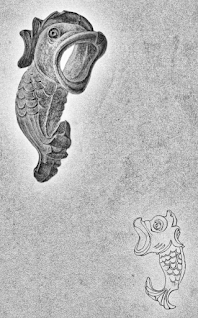
Dolphin Ornament; Albert Geuppert
Iv - Dolphin Room

This door is separated from Ii by a decorative metal grate, containing some sculpture of sea life and waves. The door has no handle nor hinges - but there are two dolphins in the grating, left and right of the door, facing one another: if the characters interact with the dolphins, they will turn - and if the two dolphins are turned to face away from each other, the door will open, sliding upwards.

Inside the space is a rack shaped like a rising water-spout designed to hold a bow. Two quivers hang on the far wall. The quivers contain 12 arrows each - ornate in design, these arrows bestow no mechanical benefit, but will sell for 2 gold pieces each. 

The rack - if a character places a ranged weapon on it, the rack will flash a blue light and bestow a bless effect on the weapon - granting +1 to hit and damage with that weapon for 1d4 hours (1d6 for unaligned characters) - once per month, recharging at the full moon.

J - Hero's Hall

Ji - Main Hall

The causeway to this area is enclosed, as the enclosure to Gi. To the north is an open, curving stairwell to Jii; in other cardinal directions are nooks that curve out, away from the floor of the space. Each nook is five feet deep, dropping abruptly from the floor.

  •  The south nook contains a six by two bed in which soil - fallow and barren - sits.
  • The west nook contains a coffin - inside is a pile of ash. 
  • The east nook is open to the exterior. It is otherwise empty.

Two spears are standing, propped against the wall, in the south-west corner. The walls of this space are built from the same stone of the bluff - half of the space is carved into the rock.

Jii - Perch

A short, curved stairwell leads up to a niche in the rock. It is separated from Ji by a sturdy banister. In the north wall is an ornate sarcophagus with no seam. Occupying the space are four keepers  - stats as Noble (B39) - accompanied by two Acolytes (B30).

Wandering Monsters

A wandering monster occurs on a 2-in-6 during the day or 1-in-6 at night, rolled every other turn. If a wandering monster is encountered, roll on 2d6 to determine its nature.

Roll Result
2
2-8 Pixies (B41)
3-4
1-4 Oil Beetle (B31)
5-6 2-6 Acolytes (B30)
For the result of 6, accompanied by a Priest (Cleric 3)
7 2-8 keepers, stat as Noble (B39)
8-9 Crystal Statue (B37)
10-11 1-4 Sea Snake (B41)
12 1-3 Horned Chameleon (B38)


Indian Chameleon; Leopold Joseph Franz Johann Fitzinger

Public domain or open license artwork retrieved from the National Gallery of Art, OldBookIllustrations.com, or Pixabay and adapted for thematic use. Attributions in alt text.

Saturday, April 24, 2021

Basalt Dragons

Break the Silence of the Sea; Gerald Fenwick Metcalfe
I watch the snow fall - the evidence of your passing and going: the sign of life, of motion. I feel it as it succumbs to my depths: as the drifts form, their silent sinking coming to rest on my ocean floor. I watch it from my perch; from my hiding place. I am the salt.

I see your ships, your harbors. I see the rock jetties where the sand grows; I see the new harbors, their breakwaters, brick: lifted by your hands - a contrast, as I float above the clouds, stark and angular, un-living: unlike the rolling shores, the barriers, the coral seas. I am the rock.

Wooden ships - they cannot reach me.

Sorcerers and seekers - they look in the wrong places. The shallow places.

I am the deeps - I am the life's bed - where creation was born and where creation has ended. It is my watch to have the world turn, but to turn with it, to move as the world moves, to breathe only as it breathes. As is creation, so am I. Where the surface rises and falls, where the surface ebbs and flows, where even the mountains wash outward - outward to me - here, I will be: as I was.

As is creation, so I will be.

With Scales of Stone and Salt

Basalt Dragons emerge from the deeps - shadows at first, growing rapidly as the sunlight penetrates the haze of fathoms and fathoms of water - until the creature either veers, revealing its length, or explodes from the waves in a storm of spray. Reptile with Spawn Abundant; Gustave Dore Their scales are smooth to the touch - dark gray to gray-blue in color - while hard and cold as stone. When swimming, the move like an iguana - side to side, their wings and appendages held close to maintain their streamlining - on land, or in the air, they take on a regal bearing, standing tall and presenting a wide front to project their dominance.

Basalt Dragons are found in the deep ocean. Rarely - very rarely - they might be found in shallow seas: anywhere with sufficient depth to slake their thirst for peace under the waves and anywhere with sufficient salinity to speak to their connection to the primordial ocean.

Encountering Basalt Dragons

Basalt Dragon
Armor Class:-4
No. Appearing:1
Hit Dice:12Save As:Fighter 11
Move:Std: 90' (30')
Swim: 135' (45')
Fly: 180' (60')
Morale:11
Attacks:Claw / Claw / Bite
Treasure Type:~ (H)
Damage:2d6 / 2d6 / 6d8
Alignment:Law
Frequency:Very Rare
Chance In Lair:5%*
Chance of Talking: 40%
Chance of Being Asleep: 10%
Spells by Level (1/2/3): 3/3/3

Basalt Dragons are huge - and they know it. They are proud and courageous - a bravery bought by confidence. Their voices - if they speak - are low and resonating, shaking the core of the listener: but they speak little, themselves convinced that they are above the lesser, younger creatures making up the sentient (and thus player) races.

Basalt Dragons are not territorial - tolerating other dragons and other creatures within their range: some - pairs or bonded covens - will have extended conversations with one another, extending for months in draconic discussion. Many consider themselves natural philosophers - their perspectives colored by their lives spent below the waves, often beyond the reach of sunlight.

In the ocean, Basalt Dragons are never surprised - however surprise explorers as normal. While the common tactic of the Basalt Dragon when engaging an unwanted visitor is to hide beneath, swimming in vertical ascent towards a target in ambush, the dice chance represents either the dragon's confidence - I don't need to surprise these creatures, they are no match for me - or its curiosity, in the case of a favorable reaction.

Basalt Dragons are able to breathe with equal facility in salt water and in the air.

Regarding No. Appearing, if the dragon is not asleep and encountered in lair, there is a 1-in-4 chance of a group of the dragons congregating together to contemplate the depths. If such an encounter occurs, the dragons will surprise normally - their minds preoccupied - however they will number between 2 and 6, with preference to fewer. This can be accomplished by rolling 3d3 and summing the result of the lower two in order to determine the number of Basalt Dragons present.

Breath Weapon

  • Template: Line
  • Range*: 120' x 10'

The breath attack of a Basalt Dragon is a stream of elemental deep: a spiraling mass, almost like a helix of several continuous bubbles rotating around a frighteningly cold core of heavy water. Underwater, the breath weapon functions normally: however, if the breath effect leaves the water, its remaining range is halved: that is, a Basalt Dragon, submerged 20 feet beneath the waves, when breathing towards a row of harpooners perched across the bow of a vessel would extend the breath weapon a total of 70' from its point of origin: 20' normally from the submerged dragon to the surface and then 50' further above the water, those 50' counting as 100' above the waves.

Coque d'un navire porté par un dragon, vus de profil, et esquisse du dragon; Pisanello

The damage from a breath attack of a Basalt Dragon is half elemental ice and half bludgeoning. Creatures which resist ice suffer half damage only on a failed save and no damage at all on a successful save; creatures which are immune to ice may re-roll if they fail their save against it on the first attempt.

A target of Ogre size or smaller struck by the breath attack of a Basalt Dragon that does not succeed its Save vs Breath is buffeted backwards, along the path of the stream, a number of feet equal to the damage suffered.

Lair and Treasure

Basalt Dragons lair in the bedrock of the sea - deep into the far reaches of the oceanic twilight zone. They will collect treasure and goods taken from ships of the surface-dwellers, from the coffers of the under-sea peoples, or from sacrifices made by primitives from both. They are partial to organic gemstones - pearls, aragonite, etc. - and metals that do not corrode with the salt.

Resistances and Immunities

Basalt Dragons are immune to Cold and Ice and resist Fire or effects targeting breathing - such as a poison cloud: taking half damage or half effect therefrom.

Basalt Dragons are vulnerable to Lightning, taking double-damage therefrom.

In subduing a Basalt Dragon, they are half as likely as normal to be subdued, in terms of percentiles.

Spoiler Alert!
The Deeper Lore section contains some notes to help a GM (me) to run Basalt Dragons in a way consistent with the archetype they are supposed to fill and some of the inspirations behind their creation. If you play in (or want to play in!) a game GM'ed by me, beyond this point will ruin some of the mystery for you for both Basalt Dragons and for most of the sentient races: having some impact in the game world that isn't immediately available outside of player character discoveries.

Deeper Lore

Basalt Dragons are sustained by rhythm - the tranquil predictability of the thermohaline conveyor, the frigid stillness of the waters beneath the currents and of the sleeping bedrock. The undersea is vast in three-dimensional space - as such, the Basalt Dragon requires fewer hexes of space than might be implied. This is likewise influenced by how active the space is - in cool climates, or deep into the far cracks of the midnight zone, where currents are weaker and the world stands still, the Basalt Dragon's needs are satisfied more readily than in shallower, warmer, or populated waters. Basalt Dragons will sleep naturally for 2 to 8 weeks at a time, waking to survey their world around them for a few days: often times staying in the deeps, far away from Human activities; though they will be woken if their tranquility is broken, either by natural activity (like an earthquake or perhaps powerful storm in a shallower region) or by an increase in the activity of the sentient races, sufficient to disrupt the rhythms of the dragon's territory - thus "starving" them - as normal for a creature sustained by esoteric means.

Flying Monster; Robert Caney
The inspiration for the Basalt Dragon is Lotan, or Leviathan - great monsters in the deep places of the world, associated with creation itself: Lotan being of the sea before the creation - recall, Lotan, or Tiamat the Chaos Serpent: "chaos" to the ancients was in reference to the state of being before the imposition of order, of civilization, and of law at the hands of the Gods - the Basalt Dragon is representative of a state beyond the reach of civilization, beyond the scale and scope of man. They are a vestige of nature - a note to remind mankind that the sea is always larger, always foreign, and always the master in its own domain.

Basalt Dragons are birthed from the bedrock - rather than reproducing in a traditional sense. When a place has been quiet long enough that the quiet has become part of its essence - then might one of these terrifying creatures be formed. The hatching is typically sudden and monumental - an earthquake beneath the waves, believed to be the cause of tsunami style floods along low coasts in the target range. It seems that the noise, the commotion of this process would be out of tune with the nature of the beast - and likewise, it would seem a cause to wake any nearby Basalt Dragons within hearing distance. Scholars say - however - that this may be an attribute of the social nature of these dragons: an adaptation that allow the creatures to commune with one another, passing their culture and their perspective through to generations - an alien form of parenting where the parents did not bear their children.


Public domain artwork retrieved from OldBookIllustrations.com, Wikimedia Commons, and the National Gallery of Art and adapted for use. Attributions in at text.

Saturday, April 17, 2021

Rolling Red Dice

Play-Cast Name: Smoke & Snow
Where I Listened: Red Dice Diaries, YouTube
Where It's Available: RedDiceDiaries.com,
"The Red Dice Diaries"
    on your preferred
    podcast platform.
System: Old School Essentials
Plate
   

Thoughts and Review

Smoke & Snow is a traditional campaign played in Old School Essentials, with some elements mixed in from Lamentations of the Flame Princess - namely, firearms - following the expansion of civilization into a newly uncovered ancestral continent. The actual play melds elements of traditional fantasy adventure with deep world-building, the exploration thereof by the player group, as well as themes reminiscent to the Age of Discovery, with the players - based out of a pilgrim-esque colony - akin to Lewis and Clark, or perhaps the like of John Cabot or the brothers Corte Real, penetrating into the cold depths of a new land.

    For Further Listening
The Red Dice Diaries YouTube channel - as might be inferred from my "plethora of content" comment - serves as a platform not only for John's actual plays, but also for the content produced for his Red Dice Diaries podcast.

This content is available on YouTube - as well as episodically in your preferred podcast player - but on the YouTube, is organized in playlists by content and subject material. While I am more a fan of auditory media - meaning that I tend to listen to these podcasts rather than watch them - if you enjoy what you're seeing when watching Smoke & Snow, you may like what you're hearing if you head over to the other playlists - or subscribe to the feed - to listen to the DM, John Alan Large, speak to his experience and insight.

Further, Smoke & Snow is a home game of John Alan Large - primary author and content creator for the Red Dice Diaries media network - RedDiceDiaries.com. John publishes a plethora of additional content available on the Red Dice Diaries page, peripheral services documented therein, and published via a handful of social media outlets.

What I Like

Hex maps! At this point in my reviewing career, I can count on one hand the number of actual plays that include player-facing (or audience facing) hex maps - by association, I can count the number of APs in the same manner that are useful to the viewer to learn how to run, or what to expect, when playing a hex crawl. Big kudos to John on this front. One, in his seamless execution: accommodating lower level or smaller party hex crawling; transitioning between different hex scales to account for different areas or different objectives, zooming in and out according to the theme of exposure; the way he uses fog of war to hide and reveal portions of the map as the players uncover it - and two, for the style of play that it fosters. A theme of exploration - and the resulting combats, parlays, alliances, and enemies that arise for the party therefrom - runs consistently through this actual play: something that defines the vision for why hex crawls were created.

Encounters for the characters are mixed between Theater of the Mind and VTT battle-mat. Primarily, if an encounter goes friendly - or if a random encounter is somewhat nondescript: such as fighting off a pack of wolves that happened upon the camp at night - the group uses Theater of the Mind; whereas if an encounter is bigger, a location that the players would do well to remember, or a gang of enemies tied to the objective at hand - a battle mat with tokens and more rigid structure is used. I like this because it shows adaptability for when things come up, first, and second, it highlights that combat can be abstract - that combat doesn't have to be the focus of a game: while it's in the game, it's an element of the game, and a player should expect to run into it: it's only one piece of the puzzle, one tile in the mosaic, that defines the old-school experience.

    For Further Watching
In addition to Smoke & Snow, available on the Red Dice Diaries YouTube are several additional playlists for several other games:

Vampire: The Masquerade (5th)
Blades in the Dark
Scum & Villainy
Index Card RPG

Full disclosure, I have not watched these playlists - and as such, I cannot speak to their content nor quality - and of note, the systems used are not OSR systems: thus, they may not be to your taste, if you are looking for an OSR actual-play. However, if you are curious about any of the above systems, or if you are looking for an entertainment experience rather than an OSR-educational one - you may find more content to your liking by the same creator.

Regarding role-playing and play-acting, the players do on occasion ham it up a bit: however they seem to know what the limit is: they seem to know the level at which role-playing adds to the ambiance, adds to character development, as opposed to the point at which it detracts: the point at which it changes the spirit of the experience from an adventure into an improv. They stay flawlessly within the realm of additive role play: on no occasion did I feel the need to fast forward the videos with the exception of - being a non-live viewer - exploiting my YouTube advantage of skipping mid-session breaks to stay in the action. An example of this balance is especially of value to aspiring old-schoolers who came to the hobby from more "RP-heavy" groups - or, to be more explicit, folks who have come into actual-plays via more popular streams who focus on character soap-opera rather than actually playing the game. It shows how banter can (and should!) happen and that in-character conversation and in-character development can (and should!) occur - that it is part of the experience, but that - like combat - it's a single tile in the mosaic that is the old-school experience.

Lastly - and this might be a cultural thing, a difference from my North American experience compared to John's European, specifically UK, one - I love how polite, reserved, and nominally stoic most of the characters are. It's a very muted counterpoint to the loud, blunt presentation of a great deal of other actual plays I've viewed - a phenomenon of YouTube culture, perhaps? It's refreshing - and it's simultaneously beneficial to the viewer as it seems to focus the stream on the game and not on the players: a key element to understand in an OSR game. The story doesn't star the characters, it stars the party; and the story isn't about the party - it's about blood, gold, and the charting of the unknown - the extension of Humanity's reach at the tip of a sword: one torch's radius at a time.

    For Further Riddling
What has a mouth and never eats,
has a bed and never sleeps,
always runs and never walks,
laughs and rages, never talks?

        Red Dice Diaries RPG Podcast
        Season 2, Episode 20
        The Ultimate Encounter

I know the answer is "a river" - but the description fits one of my toddlers, honestly.

What I Don't Like

Truly, I can't think of anything that I dislike about this stream. The audio is occasionally louder for some players than for the referee - but that's true for virtually all streams and is hardly something to complain about: in this case, it's not intrusive to the experience unless you're using headphones (in which case, I found myself straining a bit to hear on some exchanges, as I couldn't adjust the volume fast enough between speakers) - but also, audio issues... because of the aforementioned prevalence, I've stopped judging actual plays for having technical difficulties. It happens to professional broadcasters, it can happen to us little guys too. 

So congrats - John! I need you to mess up somehow so I can have something to complain about.

In Conclusion

Smoke & Snow is tempting me to go back through other APs I've reviewed and review them with a harsher standard. It is an interesting story - one of discovery, of friends and foes, of loss and victory - and it is a good mechanical exposé of the rules. It is a traditional campaign, where the characters and players grow and develop: a story lies under the surface that's waiting to be told, but in OSR format, the players help to build this story - to forge this narrative - by providing the experience by which the tale is told. An aspiring OSR referee seeking to understand how the game is (or should be) played, I highly recommend watch Smoke & Snow.

Solid Plate rating. Keep rolling those red dice, guys!

Saturday, April 10, 2021

08.02 - Watchtower Compound Standalone PDF!

Leper's Tower near Aosta; Karl Giradet and Rodolphe Topffer
Watchtower on the Indigo River:
The Watchtower Compound


At long last, the PDF version of the Watchtower dungeon promised three times now! Though the announcement post is shorter than the usual post - the PDF linked sure isn't: 143 stocked & keyed rooms, interconnected by a central theme, with several "new" monsters and with special care to try to make the PDF more usable: both in print or at your computer - as part of the larger Indigo River series or stand-alone, as with the Floundered Cog last year.

One step closer to completing a full-formed hex adventure along the cursed shallows of the Indigo River flood plain.

Delve on, readers!

Saturday, April 3, 2021

Yellow Light for the Blue Box

Play-Cast Name: Greyhawk Awakening
Where I Listened: BlueBoxRPG
Channel Playlist

Where It's Available: BlueBoxRPG YouTube,
BlueBoxRPG Twitch
System: "3e"
Leather
 

Thoughts and Review

Grewhawk Awakening is the name of a series of videos, a playlist to be explicit, set in the World of Grewhawk, in and about the village of Hommlet, first made famous in the T-series for AD&D. The campaign runs in a traditional format, following the adventures and development of a mostly stable group of players and their characters. In terms of system, the stream describes itself as using 3e at the core, while "incorporating elements of AD&D and one mechanic from 5e," which is the Advantage / Disadvantage mechanic.

    A Companion Review
This review comes on the heels of a previous review, Lord Gosumba. In truth, I found this actual play series first between the two (and wrote this review before writing the review for Lord Gosumba) having learned about DM Jay from his guest appearance in the prologue episode to Greyhawk Awakening, Hallia's Betrayal. So - that's something to note: if the Episode 0 DM seems familiar, it's because he is - but on a second note, if the following, normal episodes feel and run different, it's because they are. While Lord Gosumba is called out routinely as a friend of Blue Box - his game is definitively a different experience than Greyhawk Awakening.

From that perspective, though - and from the understanding that I was consuming those two actual plays essentially side by side, some references are made, comparisons drawn, between the two - the intent is not to draw them into comparison into the reader's mind, as well, but a byproduct of the proximity of my own consumption.

In any case, game on, Jay; and game on, DM Neuromancer!

A Note to Start With

In addition to Greyhawk Awakening, the BlueBox RPG Twitch and YouTube channels produce several avenues of content: a great deal of which is content for 5th Edition. The purview of this blog being to talk Old School Renaissance - and the purpose of this review series being to help new and prospective OSR players and referees to understand what to expect in an OSR game - I did not review (nor do I intend to review) the 5e content offered.

Without doubt, its quality is on par with the Greyhawk content I did watch, without doubt its community engagement is similarly involved; as such, it's not to throw shade on those playlists: but, having not seen it, I can't vouch for it, personally.

What I Like

Like Lord Gosumba - and Swords of Jordoba - the first thing that stands out to me about this channel is its use of physical miniatures. I mention that Swords of Jordoba focuses primarily on the dungeon - with some scenes from town, etc. - and that Lord Gosumba then expands on this field, opening up outdoor spaces and expanding on in-town buildings. On that front, Greyhawk Awakening truly takes physical miniatures to another level. From the beginning to the end - every major event has a set. The characters delve into caves and dungeons; the characters trek through temperate grasslands, rocky spaces, or even snow-draped forest-scapes; the terrain, the miniatures, and the appropriateness of both to the campaign as presented is phenomenal in Greyhawk Awakening.

To continue on the subject of the production quality - the DM makes use of professional grade maps, music, and sound effects. In many APs I've seen, sound effects and music can be distracting - but that is not the case for Greyhawk Awakening. The music is unobtrusive, the sound effects appropriate, and on occasion, the DM uses music or sound effects to queue the players in to something that isn't in the verbal description. In my home game - I've had hit and miss music experiences, but I'd never mastered the art of context clues via ambiance: something that for which this stream deserves credit.

Lastly, to refocus on system - the stream "incorporates elements of AD&D": most notably, though they do use miniatures, the combat is abstracted - the players don't move tokens, but they are there to provide relative positioning to augment theater of the mind. Also group initiative. This, tacked on to 3/3.5 and I suspect either more from 5e than they admit or some elements from other games, a la Pathfinder or a miscellaneous d20 (they consistently refer to "stealth" or "perception" - where my old 3e PHBs call those "move silently" and "spot") - but where the rules come from is immaterial to the direction I want to take this point: the moral of the story, they are playing a Frankenbrew! 

They have a thousand Twitch followers and they are playing a Frankenbrew!

This is beautiful! If there was one thing that would embody, for me, the spirit of the OSR - wherein we seek to recreate the wonder and excitement of our earliest D&D experiences, the game as it was meant to be played - it's this: rulings over rules - homebrew melted over kosher product. Yes - AD&D was built to standardize: but the purpose of that standardization was to empower tournament play and to assist with conformity in supporting product. The message conveyed here - you don't have to run RAW to make a good game; you don't have to pass a purity test to have an engaging campaign. And with houserules coloring and fleshing out every home game I've ever played in, it provides a key lesson and key perspective - that it's OK to tweak the rules to fit your table: this providing an illustration of how those tweaks can (and ineluctably will) change game flow.

The Elephant in the Room

When talking about OSR games - part and parcel for many is TSR compatibility: specifically, compatibility with the Gary epoch. This AP runs a mishmash - but their self-proclaimed core, the engine around which the system they play is built, is D&D 3.5 - WotC. With that in mind - per my point regarding the inclusion of houserules changing how the game flows at the table - the core of WotC D&D brings to bear several central differences between the two generations.

  • There are elements of player skill, but there are converse elements of d20 character skill rolls.
  • There are long, exciting battle sequences! But there isn't really a focus on treasure, nor in carving your name into the bark of the living wild.

Remembering that the OSR began as a reaction against the changes 3e brought, powered by the OGL that 3e introduced - the nature of this AP is different than a game run using TSR compatible product (which you are, as an aspiring OSR player or referee, going to encounter). For that reason, this AP has a limited amount of OSR-specific lessons to impart.

Where those versed in old D&D will recognize mechanics and imports from OSR-friendly editions, watching it will teach those unversed in old D&D how to play new D&D: not old D&D. It teaches 3.5 well, truthfully: there are moments of player clarification where the DM explains the rule, which edition it's from, and how it differs from 5e, which is what the players are use to. And this is the crux of the review's rating. 

Excellent production, great story, wonderful community engagement - but it's not really OSR.

What I Didn't Like

Further - on another point - to the immersive ambiance used in the game, everyone at the table is very in-character. This is normally a good thing, but it's important to note there is a difference between drama and melodrama. While by and large, the game proceeds in a smooth narrative, there occur instances wherein, in building tension or complimenting the spirit of the scene - the table falls victim to over-acting. Be it responses exaggerated to the severity of the situation, be it in-character quips that border on action clips you'd find in video games - I found myself on occasion skipping forward along the stream to get out of the moment and back into the play.

Of Streams and Systems

As with most streaming actual-plays, the table at Greyhawk Awakening interacts with the stream, with the community. A lot. They give away prizes, they talk to and remember subscribers - which is great for building a following: for which they deserve kudos. But why isn't this in the "good things" section, CWR? Well, it's a good thing during the stream - and it's a great way to build community - but you have to skip past it when you're on YouTube. That said - they are very well telegraphed: as are breaks and the startup time, literally employing a countdown timer - it makes it very easy to skip forward; Plate XV - High Frequency Electric Currents in Medicine And Dentistry; Samuel Howard Monell very convenient to get back into the action on the prerecorded line.

As an aside, some of the earlier episodes have issues with user audio: some of the mics echo, some of the players are quieter than others - but after the first handful of episodes, those issues are largely resolved. It's a common thing for actual plays to have better audio and fewer glitches as the episodes proliferate: Greyhawk Awakening is no different - they consistently improve as they consistently work towards a better product. 

In Conclusion

Greyhawk Awakening is a well-produced, fun to watch actual play with some hints of old-school sensibility, with a primary selling point is in its production value, its narrative qualities, and its amazing support and cultivation of a community. It's purpose is not in teaching how to play OSR D&D. For that reason, I wanted to present it as an option for the entertainment-value watcher, or perhaps the errant 3.5 refugee with a yearning for home: I wasn't sure, then, how to rate it - so I settled on Leather.

Interested in learning how to play B/X? This is not the right place.

If you have fond memories of 3e? Does system not matter? This stream is the stream for you!


Delve on, readers!


Public domain image downloaded from The Public Domain Review and adapted for thematic use. Attribution in alt text.

Saturday, March 27, 2021

10 Hex Locations from the Caanish Archipelago

 Ask and ye (may) receive!

In a recent post of a blog I follow, BRINEHOUSE, posted an update including ten hex locations as preparation for being able to run an in-person game again. Inspired, I've checked my old notes and picked out some of the locations from my campaign map that I'd made notes about but that my players had not yet visited.

Provided below, a list of the 10 most interesting ones I saw. Steal, adapt, or allow to inspire - the adventure is yours!

1.     The Rut of the Ophinotaur
Just offshore, this shallow atoll - a couple sandy, scrub-grass protrusions barely floundering out of the clear sea - forms a maze of coral around a protected interior lagoon. It is here that the ophinotaur - thick aquatic creatures, eight to ten feet from tail to snout (up to two more to include the horns of an adult male) with the tail of a dolphin but the fore-body of a bull come to calf.

Many a merchantman has met their end here during the rutting season: might an enterprising type sneak through to recover their cargoes, or perhaps even tame one of the great beasts?

2.     Mancatcher Grove
A forested region, this hollow is overgrown with thick vines. In both spring and autumn, the vines bear sweet fruits the size of a man's head which can be plucked and consumed; rumored to grant a man renewed vigor and health. However - trekking is difficult, as the vines seem to each connect to one another: a massive interlinking of herbaceous cord; and hidden throughout, interspersed, are curious flowers - large ones - with a number of grasping buds concealed about them. These buds will catch and cling to a man-sized target, dragging them down and wrapping them up, numbing them with a thousand tiny anesthetic needles, and liquefying them: leeching their essence into the vine. Is this route worth a shortcut, the fruit worth the risk - to life and limb, or perhaps to the tarnishing of the soul?

Langsdorffia Hypogaea; Kerner von Marilaun
3.     Last Rest of Pen-Hebet
Rising modestly from an outcropping, this shrine - located on rocky island a stone's throw from the coastline - is maintained by three keepers, shaman mystics, sedentary here on rotation from the nomadic tribes on the mainland. These shaman are supported by offerings from those tribes - and the shrine, itself, is a site for gifts to Pen-Hebet, an ancestor thought to guide those who follow the old tradition, to be likewise offered.

The mystic keepers are wise and amicable to those who come in kind, but simultaneously mindful, knowing that a faithful type might come as a pilgrim - but that an enterprising type might come as a thief!

4.     Spinebrush Forest
Spinebrush plants are common to the scrub-lands: woody, scraggly plants festooned with razor-sharp spines known capable of piercing and tearing mail that grow in a circular pattern of branches around an open interior - like the eye of a storm - a common respite for flying creatures, small things that can navigate the thorns, or on occasion even the nimble adventurer. But this place - where the spinebrush are typically independent in their spacing, this land is absolutely littered with the stuff: plant after plant, ranging in size from a few feet across to a dozen meters - scattered capriciously among one another as though seeded atop a relic of elemental Chaos. All the while, in the distance looms the Grandfather Spine - the single largest spinebrush known to exist: almost 200 feet tall and over 300 feet at the base.

Or, believed to be, at least. It's not known if anyone has managed to penetrate that far into the Spinebrush Forest - though many have entered, never leaving, depositing their corpses and their treasures into this thorned wooden cemetery. Might you be the first?

5.     The Crashing Place
A section of savanna which has been trampled deeply by the Gud-Alim, who come here to do battle, to cross horns and to compete for mates and dominance within the great herd. That is... Gud-Alim - the semi-divine shaggy plague bulls, whose breath is death, whose wool is steel: six feet tall at the shoulder - the pets of the Great Lord of the Autumn. Two Bulls and the Frog; J. J. Grandville Their lowing and their ram-like clashes can be heard for miles off and the soil, itself, is infused by their offal - radiating a warmth even under a winter's moonlight that causes a tingling in the hands and feet, if handled.

Moving quickly while they rest, there may be much to learn here - or perhaps even more to harvest, when one of the great beasts falls: the crushed loser in their life and death exchange - might that quick runner evade being caught in the middle?

6.
    Sanctum of the Dolphin
In the briney shallows, a temple complex rises. Canals in lieu of roadways - and waterfalls and tiered pools in lieu of stairs - snake around a residential district to the south, a military-monastery to the north, and in the center, a set of four ziggurats: one larger in the center, three satellites, aligned north, south, and south-west. The compound is maintained by Icthyon Centaurs - half men, half dolphins: larger and stronger than a man, and air-breathing, but bound to the sea: the favored children of the Storm-Lord, Odakon.

Everything is half-submerged in the shallows, if not submerged entirely. It would take quite the planning effort to visit this place - quite the effort more to engage it - but the blessings it is said to bestow to those who curry the favor of the Icthyons, or the ancestral treasures visible - glittering in the sunlight atop the central mound - that they guard both might be ample temptation!

7.     Grasscrawler Hollow
A depression in the ground leading into hill country, where the grass grows tall: this route might be used as a shortcut, its low and flat topography being easy to traverse. But known to prowl the chest-high blades is a creature called the Aternae: a thick-bodied, thick-scaled creature with a ridge of hair along its spine colored to match the blooms of its native habitat. The creature walks low to the ground, its head shaped like a goat, but its muzzle not unlike a crocodile's. Its bite is strong and along its snout, a bone-ridge protrudes horizontally - the blade of a semi-circular saw - which it uses to gore its prey or to cut the legs out from under horses. Is time so precious as to risk an encounter? Or might a skilled hunter seek an encounter - to bag a prize envied by warriors and magicians alike?

8.     Glowshock Cavern
This littoral ingress, accessible during a low or receding tide, casts an eerie glow in darkness, a warm luminescence emanating from its depths accompanied by slight and irregular tremors palpable to swimmers nearby. It's said that the cavern is home to bomber worms - creatures up to a forearm's length that grow and house bio-weapons, orbs almost like eggs which explode with concussive force when vomited at would-be predators: but no one has been to the bottom to find what lies at the cavern's heart. An inquiring wizard might be curious to find the secrets hidden therein - or perhaps a warlord might be curious to harness the potential of the amphibious and explosive inhabitants: could a keen wit and a quick hand beat the tide to escape with a prize?

9. Ruined Stairs at Neuss; Johann Wilhelm Shirmer     The Cannibal Yard
Nested along the crossing of long-abandoned roads, a mid-sized township lies in ruins. The architecture is alien - old and advanced - and its symbology (at least, that which was carved deep enough to survive the ravages of time) is written in the script of Law, but a language which cannot be deciphered. Secrets have been scoured from the surface - but beneath, a great catacomb (a sewer, perhaps? Or subway?) snakes through the darkness.

The coughs of ghouls echo along these deep chambers - and the towns nearby seal their gates with the twilight. What secrets yet lie undiscovered, what forgotten wealth might yet be horded, beyond the bone-paved entryways?

10.     The Guardian Totem at Stillwater Bend
A lazy river makes a deep curve here, the water moving slowly - pooling a bit - pandering both to sleepy sunbathing and to waterborne insects. In the horseshoe formed by the river, an earthen mound has been assembled - fifty feet to a side - and from this mound rises a stone totem, facing the woodlands to the west. Here - the locals say - a coalition pushed back the hog-men from the plains, forcing them across the river and confining them to the dark of the wood: and this monument is both a tribute to their victory and a warning to their enemies, who surely lurk still beyond the far bank.

It's said that should visitors pay homage to the shrine, the spirits of the fallen will smile on them for as far as their ghost-eyes see.

Trajan's Kiosk; David Roberts

Delve on, readers!


Public domain art sourced from the Public Domain Review, the National Gallery of Art, or OldBookIllustrations.com and adapted for thematic use. Attributions in alt text.

Saturday, March 20, 2021

Grass Dragons

The rock bounced off of one branch and into the trunk of the scrub bush - producing a satisfying tap-tap. Aoide traded another of the slick stones from her left hand to her right; tossing it up to herself a few times, taking a bead - perhaps she could hit three...

"Be careful, Halfling."

The Elf's voice was stern, but simultaneously indifferent. Information, not warning.

"Throw too many of those things and you may disturb the spirit of the place."

Lily and the Lion; Robert Anning Bell

Aoide continued tossing the dusty stone to herself.

"There's naught but rocks, sticks, and what pass these parts for trees in this place," she replied, "I'm just moving one piece of spirit over next to the other."

The Elf's lip curled. It might have been a smile. Smoke curled likewise - along the meandering breeze into her nostrils. Good - the others had gotten the fire going; they'd be eating soon enough.

Then a crash.

A hillock - no, not a hillock - beneath the rise a hundred yards distant lurches upwards: first, a head the size of a horse's; then a barrel of a neck; then wings: snapping against gravity. A serpent - a 30 foot serpent - ascends rapidly to the south, away from the camp. Rush - rush in the campsite, dirt is kicked to the campfire, horses rounded up and led back - Aoide is transfixed.

The creature is in the air. Beneath it, behind it, streamers - four feet long - waiving in the wind like many tails from a kite. It gazes down, circles once - it is beautiful.

It turns - with a powerful thrust, it fades to the south.

"We should disturb spirits more often!"

The Hills are Alive

Grass Dragons are the lords of the plains - guardians of grain; sovereigns of the swaying steppe. Their coloration can vary from a sandy tan to light green, depending on the lands they occupy - however the defining characteristic to distinguish them from other beasts of similar ilk is the termination of their scales. An individual scale being leaf, or spade, shaped - at its pointed culmination, a less chitinous tendril forms, light and flexible along the stalk, but frayed at the top - like a reed. These stalks are naturally gravitate upwards, such that if the dragon is at rest, they will face the sky, moving with the breeze as would grass around them - however if the dragon moves, they will move with it: the base first, the shaft and head following in sequence as their inertia is broken.

Grotesque Strip with Dragon, Shields and Wild Men; Unknown Artist

Continual motion - such as flight - will largely have these shafts in conformity to form: that is, they do not point skyward if the beast is galloping across the plain, but instead trail behind as streamers in its slip-stream; but abrupt motion, such as the raising of its head to observe interlopers to its dominion, waking from its slumber, will cause a ripple effect along the moving lengths.

Grass Dragons are found in the plains - in the steppes or the savannas - places where grass grows tall and where the wind blows free.

Encountering Grass Dragons

Grass Dragon
Armor Class:2No. Appearing:1-3
Hit Dice:9Save As:Fighter 9
Move:Std: 90' (30')
Fly: 240' (80')
Morale:9
Attacks:Claw / Claw
Bite
Treasure Type:~ (H)
Damage:1-6 / 1-6
3-24
Alignment:Neutral
Frequency:RareChance In Lair:10%
  • Chance of Talking: 35%
  • Chance of Being Asleep: 35%
  • Spells by Level (1/2/3): 2/2/1

Grass Dragons, at a glance, seem more animalistic than a traditional dragon - which arises in part from a very feline demeanor. When able to speak, they speak little: they have more in common with the earth than they do with the creatures that walk it.

Grass Dragons are only weakly territorial - tolerating interlopers commonly with indifference, less commonly with curiosity - but will object viciously to destruction of their environment. They are anathema to fire and react negatively to smoke or things that smell of smoke.

Due to their shape and scale biology, Grass Dragons are easy to miss in a sea of grass. Thus, a dragon which is encountered outside its lair has a 4-in-6 chance to surprise - if the dragon is asleep, it is likely the party will not notice it at all: instead thinking it merely a shift of topography. Grass Dragons, if awake, cannot be surprised in a grassland environment (though underground, or in other biomes, surprise as normal).

Breath Weapon

  • Template: Cloud
  • Range: 40' x 40' x 20'

When a Grass Dragon breathes, it breathes a strong wind that is permeated by shrapnel: kernels, grain spikes, and chaff. It swirls in a vortex - following the physical imprint of a typical cloud breath effect. Watch the Sleepers; W. St. John Harper

Any character who takes damage from a Grass Dragon's breath attack is considered seeded. After 1d6 rounds if the dragon is still alive and in proximity (or 1d6 hours if the dragon has been killed or has departed) a seeded character must roll a Save vs Poison. On failure, they sprout tendrils akin to dogweed - which will impede them until removed. A seeded character as such suffers a -1 penalty on attack rolls only, a -1 penalty to Poison and Paralysis Saves, or a -2 penalty to any Save to negate a fire effect, such as a Fireball.

  • Magic akin to Remove Disease or Remove Curse will eliminate seeding.
  • Additionally, if the character takes fire damage, there is an X-in-6 chance (where X is the amount of damage taken), that the seeds will burn, removing the effect.
  • A referee may allow a character to attempt burning to remove the affect: which can typically be abbreviated as taking 1d6 flame damage.

Left untreated, the character may manually remove the stalks - which is unpleasant, but has no negative game effect: so doing will allow them to save the following morning: on success, they suffer no penalties on that day; on failure, they regrow tendrils again - impeded until they are yanked out or burned again.Manual removal of the stalks takes one turn.

After three such consecutive successes, the condition is lifted.

Seizan Bailong; Matsuura Seizan

Lair and Treasure

Grass Dragon lairs tend to be shallow hollows in the earth, filled with the odds and ends of interlopers who drew the dragon's ire, complimented by offerings from primitive peoples - perhaps from an older time - who saw them as harbingers of fertility.

Grass Dragons tend to have little interest in physical treasure - contrary to the nature of some other wyrms - but they will guard what they do have instinctively. They have been known, however, (as supported by the offertory portion of their hordes) to make trades.

Resistances and Immunities

Grass Dragons are immune to Poison and resist Cold or Ice: taking half damage therefrom.

Grass Dragons are vulnerable to Fire: taking double damage therefrom.

In subduing a Grass Dragon, they are half as likely as normal to be subdued, in terms of percentiles. However, if a credible threat is made to the grasslands, such as the positioning for starting large scale destruction of the habitat, these chances should be increased proportionally - up to but not exceeding double the normal chance.

Spoiler Alert!
The Deeper Lore section contains some notes to help a GM (me) to run the Grass Dragon in a way consistent with the archetype they are supposed to fill and some of the inspirations behind their creation. If you play in (or want to play in!) a game GM'ed by me, beyond this point will ruin some of the mystery for you for both Grass Dragons and for most of the bestiary: having some impact in the game world that isn't immediately available outside of player character discoveries.

Deeper Lore

Grass Dragons are sustained by the living steppe. Specifically, the impetus that drives graminoids to burst from their seed casings to bathe in the sunlight: then likewise the catharsis of their decay with the seasons - their purpose having been fulfilled and their ecology maintaining the eternal cycle. This process - this energy - is what sustains the dragon, who keeps watch over a territory to which they are innately connected.

The territory required for a dragon is proportional to its size: a copse in the woods, a break in the trees being sufficient for a hatchling - up to a day's full flight of hexes needed for an ancient sleeper.

A dragon being sustained by the life of the plains, itself, will thus sleep for as long as the natural balance is in order: often times, ancient wyrms residing in primordial spaces will curl up over their lairs, blocking the entry and becoming one with the earth. Because of this connection - if a Grass Dragon's range is damaged, such as by the building of a township, such as by wildfires, by mudslides, or other events diminishing the space, the dragon will wake through hunger - its reaction to the change will differ based on circumstances, but regardless, the larger the disturbance, the more likely and the more rapidly the creature will wake and act. 

Dragon Vector Art; "Mark" (samuraiagency)

Grass Dragons do not reproduce in the typical sense - instead, they are forces of nature which are created codependent with the growth of their habitat: untamed wild begets dragons; dragons advance untamed wilds. When groups are encountered, they are most frequently siblings - manifested together through the coalescence of being, bonded through their shared experience and affinities. And while a Grass Dragon shares kinship with other Grass Dragons - so long as their ranges are distinct enough to keep good neighbors - the relationship between siblings is different and strong: a Grass Dragon will defend its siblings viciously and without fear or intimidation.


Public domain artwork downloaded from OldBookIllustrations.com, the National Gallery of Art, or Wikimedia Commons and adapted for thematic use. Attributions in alt text.

The Black Cauldron

What Is The Black Cauldron ? The Black Cauldron  is a troubled film - a dark animation aimed at both children and adults - based on ...