Saturday, November 26, 2022

Proficiency Dice for 0e?

Lady Showed Up Without Fail; Albert Robida

When running any OSR system, especially one which is based on (or is) the original edition, it comes to head fairly quickly - how do you resolve situations that can't be role-played? Climbing a wall, for example: it's impractical to ask your players to demonstrate on your backyard fence or cliff overhang wall climbing in order to justify the character action. If one of you out there does run a table like that - I would like to participate at least once just to see - but that's beside the point. For Thief specialties, it's easy: there is a chart provided in Greyhawk or usually included by default in your system of choice. For other actions, precedent exists - the rules for kicking a door open, for example are X in 6, as are the rules for Surprise. Logically, it can follow that other things can be done X in 6. 

That's is the approach I had taken in Weapons, Wits, & Wizardry to start. I changed the six-sider to an eight-sider to allow for different growth rates and to facilitate modifying those chances by ability scores - a more agile character is more likely to walk a tightrope, etc. - but having written a post about dice pool resolution, and later having been edified that there's actually TSR precedent in The Forgotten Temple of Tharizdun for ability-based dice pool resolution, I started thinking - could dice pools rolling under abilities serve in the place of skills?

Here is the system that I have in mind and have bounced off my unfortunately sporadic home game:

Proficiency Dice

When advancing a character, the player should have an option to invest experience points into improving their capabilities in a given skill or task, defined as an action which is not role-playable nor directly derivative of another class or character feature, in the form of Proficiency Dice: at increasing cost for each successive as follows:

Die No. XP Cost
1st 600
2nd
1,800
3rd
5,500
4th
16,500
5th
50,000

Note, these are per die, per proficiency. So a character investing in two dice total - a first in, say, Hiding in Shadows and another first in, say, Climbing Sheer Surfaces, would pay 1,200 XP total - or two times 600: not 1,800.

When investing in dice, the current XP pool of the character is reduced by the amount invested - thus, a character with 5,800 XP which takes a second die in, for example, disabling traps would reduce this XP total from 5,800 to 4,000 and mark the Proficiency Die on its character sheet accordingly.

At the discretion of the referee, a character may not de-level in this manner - that is, a level three character may not invest experience sufficient to fall to level two - in order to advance a particularly expensive proficiency.

Task Resolution

Confluent with dice pool resolution, when executing a task in which the character has proficiency, the normal dice as prescribed by the referee are rolled. In addition, a number of D6 equal to the characters proficiency dice are likewise rolled. Of the net pool, only the lowest are retained. 

Thus, a character attempting to perform a task rated at 3d6 which has a 2 proficiency dice relevant to the task would roll 5d6 total, summing the lowest 3 in the pool, and comparing that result to the relevant Ability score:

  • If the result is equal or under the relevant Ability score, the task succeeds. 
  • If the result exceeds the relevant Ability score, the task fails.

Rainforest; Emile Bayard


In Practice

In practice, it works. Or, at my table, no one has complained.

However, this assigns more value to the attributes than they typically have in classic editions - understandably, some will be turned off by the idea. Regardless, for the sake of having tried it in play and liked how it felt, ability scores on 3d6 being fairly tightly in the middle, it felt worthwhile to explore the mathematics behind it and see how it balances against the traditional Thief. 

Why buy dice?

Buying Proficiency Dice allows a degree of customization on the part of the character without compromising two big benefits of a nominally class based system. This could be a blog post all its own (maybe a podcast episode?) but such will have to be another entry. 

First, one of the key elements of OSR gaming - defining "OSR gaming" as a romanticized emulation of the experience of the first 10 years of D&D's existence - is the dispensability of characters. You play multiple in a stable - sometimes multiple at a time, if your player group is too small - you generate them quickly and swap them out according to the adventure (or when one of them dies), and you can port them table to table: presuming that the campaigns are running compatible systems. This is why Thief skills in OSR games typically are not modified by anything apart from level. Level needs to be the important deciding factor - among the reasons for which is the interoperability of characters in a campaign. 

Sandboxes are essential to the movement.

Open tables, west marches: these styles of play have taken a forefront in public games.  

Pencroff Untied His Arms; Jules Ferat

With skill dice purchased with XP - you still have the same character on the same track with the same basic abilities - you just have an added bonus in very specific circumstances. Very easy to adjudicate.

Second, having an increasing cost associated with purchasing Proficiency Dice means that you continue to be bound within the level and fighting capability aspect. If I spend 600 XP on a die, it means I can do that thing better, but I sacrifice the rapidity with which I advance in my primary role. Fighting Men who are specialized in dungeoneering activities will fight less effectively than their brethren because they advance less quickly. The difference isn't necessarily that pronounced with the smaller dice, however to become a true specialist, the costs add up and the character noticeably slows down in terms of their contributions to the combats.

Similarly, this prevents the acquisition of too much skill for your level range. I physically can't afford a third Proficiency Die if I have not sufficiently leveled up that the bandwidth between now and next level is sufficient to cover it. In the same way that a level 1 Fighting Man is not going to be able to stand their ground against an Ogre with six hit dice, you know that a level one Thief character equivalent is not going to be picking the pockets of a passing name level Arch Wizard.

But how do I know my chances?

This is a fair criticism. Unless you are an avid statistician, you probably won't know precisely. However, for the sake of compatibility and intellectual honesty, I did a little math to figure out the answer. As follows are the chances of success at mid-range tasks at varying levels of skill as defined by proficiency dice pool:

  Proficiency Dice Added
  0 1 2 3 4 5
Pool: 3 7: 16% 36% 53% 66% 76% 83%
  10: 50% 73% 86% 93% 96% 98%
  13: 84% 94% 98% 99% 99% 99%
Pool: 4 7: 3% 9% 17% 26% 35% 45%
  10: 16% 34% 51% 65% 75% 83%
  13: 44% 67% 81% 89% 94% 96%
Pool: 5 7: 1% 1% 3% 6% 9% 49%
  10: 3% 10% 19% 29% 40% 81%
  13: 5% 32% 48% 62% 73% 96%

Truthfully, I did not do a lot of math - anydice.com did a lot of math - but that is beside the point. Please note, also, that the numbers are approximate and decimals are rounded according to how I was feeling at the moment.

For comparison, here are the Thief percentages as presented in Greyhawk - the initial implementation, compatibility with which I would be most concerned about when running an original edition game:

Thief Level Open Locks Remove Traps Pick Pocket Move Silently Hide in Shadows Hear Noise*
1 15% 10% 20% 20% 10% 33%
2
20% 15% 25% 25% 15% 33%
3
25% 20% 30% 30% 20% 50%
4
35% 30% 35% 35% 25% 50%
5
40% 35% 45% 45% 35% 50%
6
45% 40% 55% 55% 45% 50%
7
55% 50% 60% 60% 50% 66%
8
65% 60% 65% 65% 55% 66%
9
75% 70% 75% 75% 65% 66%
10 85% 80% 85% 85% 75% 66%
11 95% 90% 95% 95% 85% 83%
12 100% 95% 100% 100% 90% 83%
13 100% 100% 100% 100% 95% 100%
* Hear Noise is a chance in six - but a percentile is provided to approximate: e.g. 33% in lieu of 2-in-6.

At first glance, comparing the table, it immediately becomes evident that the dice pool strategy results in much more rapid advancement - in terms of success rates. With a pool of four dice, it looks parallel to start - assuming an ability score of 10, the 16% success rate mirrors the Apprentice (level 1) - however a first proficiency die brings the character in line with a Burglar (level 4)! Additionally, to think on it, a zero proficiency character does not imply Apprentice. Zero proficiency implies that you have not been trained, you have no experience in it, that you are going on instinct. Thus, comparing one Proficiency Die to the Apprentice rank would be more apt. Comparing thusly, 4 dice is entirely too generous, breaking adventures written with TSR numbers in mind by making those challenges far too likely to bypass.

Moving up to a pool of 5 dice, the prospects are bleak for a character with a ability score of 10. While the first Proficiency Die delivers a probability that is under the Apprentice - one third the likelihood for traps and locks, half for picking pockets and moving silently - the second Proficiency Die brings you into Footpad territory, a third into Robber, and the 4th into Cutpurse - giving Burglar a miss. That's not too bad: against a target of 10, five dice delivers - accounting for Proficiency Dice being added to the pool over time, percentage success chances increase proportionally to what would be expected by an 0e adventure. 

But - how many Thieves have a Dexterity of 10?

The classic Thief archetype implies agility. This is addressed in OSR games as a prime requisite bonus- the character will level faster as a Thief if they have a high dexterity. Reached Over; Louis Rhead Thus, we should bump ourselves to the success chances at the Ability target of 13: more in line with what we're likely to see at the table. The compatibility here is a bit bleaker - the first Proficiency Die  grants a whopping 32% - in line with a Burglar (again, fourth level Thief). The second Proficiency Die jumps to about a Sharper, the third to a Master Pilfer, on average. So, a character with a 13 Dexterity is going to advance more quickly with Proficiency Dice than a Thief would with a 13 Dexterity.

Come to think of it - though - who said that they have to be one to one?

The point of rescue for this system becomes in the experience balancing. How much experience does a Thief have to have in the original edition to hit those percentages? In all of them - the Thief advances more rapidly than other classes. Where a Fighting Man might require 2,500 XP to hit Level 2, at the same 2500 xp, a Thief has hit Level 3. This continues through the course of their advancement track. Thieves will have low chances to succeed, will have the smallest hit die, but will also hit the higher chances quickly and gain hit dice more rapidly than other party members - allowing them to "catch up" in terms of effectiveness. Hence comes the pricing model prescribed to the dice.

Each Proficiency Die, in invested experience, is adjusted assuming a target 13 Ability score to roll under with 5 dice. Yes, it starts off as a Burglar - but isn't a common complaint for the Thief class that they start off useless? Bumping them to one-in-three is hardly a game breaker and will make the character feel more useful, mechanically - and, as the player will be investing in multiple dice across the board in order to keep up with all of the functions (assuming the player is building a Thief to a T) the XP invested, sacrificed away from fighting capability and/or hit dice, will be proportional to a 4th level Thief: a net zero in terms of total difference.

After the first, each die purchased advances the skill Chance by about two levels - so, a character with a 13 Dexterity that invests in Proficiency Dice going forward will - to achieve the same percentile success rate - again, be parallel in terms of how much XP is needed to the classic Thief. 

Balance preserved

But what is to stop a character from maxing out? From investing entirely in one skill/ proficiency and thereby breaking that part of the adventure?

As mentioned above, the referee is encouraged to disallow de-leveling - thereby preventing too much investment in one place without first advancing in level to appropriately higher position. Will it eliminate all disparity? Will characters intentionally try to be better and one thing versus another? It's possible. But if the goal is to maintain compatibility - allow you to run an 0e, Thief-less game in an adventure that assumes a Thief's existence, this helps. It enables that end while also allowing a modicum of customization: which, for Weapons, Wits, & Wizardry, was a design objective all along.

To Conclude

I presently like where these numbers sit. 

I intend to present this to my players and allow them to try it - hammering out the kinks as we go. The numbers may change, I may or may not update this post, but you can bet that the final version will be in the Weapons, Wits, & Wizardry booklets - assuming it scales as well as it plays at low level.

There are disparities for higher abilities - I understand that - looking at the 16 target range, one Proficiency Die on a pool 5 task has a 90% chance to succeed - but I'm going to wait to see if that's actually a problem before I try to solve it. Though I get that other people who play the original edition enjoy that the Abilities offer very little to the character. That makes sense to me, too. If you desire, try this system out while retaining a static Target of 13 with 5 dice - call it the Lucky 13 rule - that way everyone will remember it. And the character having progressed, the equivalent of leveling up, as a Thief, will be preserved.

So - like it? Hate it? Would love to hear your thoughts- readers and players alike. 

In any case, delve on! 

A Sharp Lookout and Still Is Sitting; Albert Robida


Public domain artwork retrieved from OldBookIllustrations.com. Attributions in alt text.

Saturday, November 5, 2022

N-Spiration: The Mercenary

Paid by the mission, a hired killer - special operations for sale - comes across a secret brotherhood: one which serves order. Where will this charge lead, as he rides dragons across strange but familiar continents - uncovers ancient and forgotten wonders: knowledge of both the material and of the beyond? 

Presented to you - direct from Spain - The Mercenary.

N-Spiration: The Mercenary

(cover) - The Cult of the Sacred Flame; and The Formula

About the Book(s)

The Mercenary started as a serialized science fiction and fantasy series in Spanish periodical Cimoc, making its first appearance in 1980. Thereafter, between 1982 and 2003, the character, universe, and semi-episodic story has expanded into 13 volumes, graphic novels, translated into multiple languages and distributed widely outside its native nation.

Of these works, many can be found second hand in physical copy on Ebay, Amazon or as Kindle editions, in addition to on antique or out-of-print sources like Abe Books. Notably - perhaps as a result of the out-of-print nature of most of these editions - most of the English translations are also available freely online in sites where one might read comics online: however, while they are not particularly hard to find, the legality of them being in question, I am reluctant to provide an avenue here. The ethics (and legality) of that, I leave to the judgement of the reader.

Why The Mercenary?

First and foremost - why should you read at least one of The Mercenary stories?

Because they ooze pulp adventure.

 If the hallmark of Appendix N is its addiction to the fantastic - to adventurers, to treasure-hunters, to all of the classic elements of sword and sorcery: from: The Voyage The Mercenary comes out in spades. Every issue is an action-packed adventure - twists, turns, romance, mystery, and wonder. Rescuing the young wife of a porcine noble, only to have her betray you because she doesn't want to return? Bingo! Trudging through snow and torch-light in secret underground hallways to recover a radioactive laser weapon? Got it. Punching an evil wizard in the face after having been tipped off by a buxom harem captive set on her liberation? Seek no further.

The Mercenary is the wet-dream of an aspiring fantasy adventure referee. If you read through even one of the comic novels - I dare you to resist running an LBB frenzy thereafter.

A further quality of The Mercenary that I find appealing - it's artful mix of magic and science. There is not an Ebberon-esque integration of magic into technological application - nor is magic all simply ignorant earthlings misinterpreting super-science from ages past. The series mixes and matches - spoiler for the rest of the paragraph - by making it seem, initially, like super-science is what the land perceives as magic: but then, as issues drive on, magicians emerge - magic becomes more evident and distinct in its own right. Magicians and alchemists use both magic and science - which is refreshing and very in-character for Appendix-N: as it shows a three dimensional character who is willing and able to pursue multiple avenues to the same end.

The fantastic is immediately evident - the protagonist rides dragons and fights monsters, after all - but the fantastic is mixed between the mystical (some obvious, some implied) and the perceived as mystical: such that the reader, a 20th century mind (or 21st these days) will recognize scientific references while the characters muddle through them - sometimes, a sort of suspense occurs unbeknownst to the protagonists: unaware of the hazards of their situation, the reader leafs through the pages wondering whether their incidental decisions or instinct reactions will guide them to safety or to ruin. The implementation is never ham-fisted and the effect is always artful: something that can be a challenge for authors aiming to mix these themes - or for a referee trying to run a more gonzo setting.

from: The Black Globe

A final point to sell you on The Mercenary - you may have noticed already with the images presented: the books are gorgeous. Every single panel is a work of art - oil painting on canvas - transcribed into a comic format after: a technique that held true until 1998, when the artist began using a computer to touch up or tweak his traditional artwork. The Mercenary, thus, has a very distinct, very timeless appearance to it - which, combined with evocative subjects and dynamic action, serves as a spur to the emotion and imagination.

Vicente Segrelles has a very Frazetta-like vibe to him: the paintings hearken back to very Renaissance sense of scale and of color, while leveraging unapologetic appeal of characters as beautiful as the setting around them. Segrelles is a master of lighting and motion - something that is an incredible benefit in the kindling the fire under the table for your workaday adventure gamer.

Any Cons?

Nope - none.

from: The Trials

More seriously - to speak to considerations for the reader - an interesting couple elements to be aware of: the series is "low fantasy" in a literary sense: that is, it introduces elements of the fantastic into the actual world. In places, globes are shown portraying Earth - or references are made to cultural elements and folk tales that exist in real cultures seated in real regions.

One book is set in nondescript middle-ages Spain.

One book is has reference to Aladdin's lamp of The Book of One Thousand and One Nights.

from: Giants

For the casual reader, this can be fun. It's not intended to be a historical epic, nor is it intended to be necessarily chronologically consistent: it's not clear if it's alternative Earth, or if it's forgotten-history or hidden-history Earth, or if the author simply didn't care and wanted to create a fun story to tell using his characters and perspective. In either case, while some places The Mercenary goes would logically not be correlated - if this bothers you, you may find yourself skipping a couple of the books. However, internally the tomes are consistent. Each tale moves through large swaths of space and covers a full range of story - but that range, those spaces, they are within reason, within cinematic verisimilitude, and create a believable atmosphere.

Or, if not believable, one that feels within the realm of reason for a fantasy epic. 

Further Reading

The best part about the work of Vicente Segrelles is that he is mostly still at it! His home page - http://www.segrelles.com/ - last updated 2021 - contains references to his work, biography and contact information, and a series of advice articles about art based in his experience.

Segrelles - as an artist - was widely prolific in the 70s through the 90s: leaving a significant trail of credits as an artist and illustrator for those who like his style. Due to the age of much of the material - and due to its Eurocentric distribution compared to my linguistically stunted English - I cannot personally vouch for the content of the stories illustrated: but in the compilation of visual splendor, especially pieces made prior to the advent of computer illustration, it may serve as a deep portfolio.

A further bibliographical listing is provided on his home page - however I was unable to find links to direct prints or similar: so reader, you are on your own to track them down by title.

In Conclusion

I owe a debt of gratitude to the Discord friend who posted some random images from this tome and inadvertently led me to it. Skimming through it again in order to post this review, my desire re-kindles, my gaming ambitions arise, and new ideas spring into my head for more powerful, more challenging adventures. The Garimeter reading - or, at least, this Garimeter reading - for The Mercenary is a solid 1: OSR out the wazoo.

The Mercenary is epic, beautiful, and brimming with adventure. It would make a stunning addition to any coffee table or bookshelf - and its contents would inspire a stunning addition to any OSR home campaign.

Delve on, readers!


The Mercenary and all imagery thereof is property of Vicente Segrelles with English translation copyrighted under Nantier Beall Minoustchine of New York, NY. Images included in this article are included for review purposes under US Code Title 17, Chapter 107 - Clerics Wear Ringmail makes no claim of ownership of any sort.

Advanced Dungeons & Dragons and all imagery related to Advanced Dungeons & Dragons is property of Wizards of the Coast and is likewise referenced and used under US Code Title 17, Chapter 107 as a combination of review and parody.

The slide-in of Gary... I got from a meme.

Saturday, October 22, 2022

The Rule of Thirds

Chateau de Mehun Sur Yevre; Albert Robida

Plot hooks. Mysterious locations. Old maps.

A sandbox style game is not - as a physical sandbox - simply a blank slate on which players mold the world to their liking. Instead, there are adventure sites, factions, towns, landmarks, and wilderness for the party to experience and explore. The sand, so to speak, has been formed - it has an existing state - which the party can expect to discover at the table. Whether they re-form it or not will depend on how successful they are over the campaign - but in order to kick-start the adventure, in order to inspire the group to move out of the tavern and into the adventure, hints - incentives - have to drop.

One doesn't give the players a blank sheet, 3d6 down the line, and ask them where they are going: instead, they have to have leads - they have to have ideas which may guide them into the unknown. 

And this article talks about one of my favorite aspects of doing just that.

An Unreliable Narrator

Acne during pregnancy does not indicate a female child - though that doesn't stop certain relatives from telling you as much. Consider - not all rumors are true; not all maps are accurate. If that is true in real life, why wouldn't it be true in your campaign world as well? Some of the things that your party hears - be it carousing at the tavern, be it scrawled on the wall of a shallow crypt - will be valid information: but some of it will not.

Key word some.

What you don't want to do is to destroy the trust, to instill an instinct of unbelief, in your players whenever they come across information. If the bartender is always evil - the party will never trust the bartender; if the map is always inaccurate, the party will leave it where they found it in the hidden library. As such - you want to have some of the rumors and hooks lead true - bring the party where the party expects them to go - while other rumors and hooks do not. Of the hooks that do not lead where they say they will, it's also important to ground them: some of them will be total hogwash - perhaps intentionally perpetuated by other adventurers to throw off rival parties from the trail of a find; perhaps seeded by malign NPCs (living or long passed) who were seeking a particular end - but some of them will be based on truth. Some of them will have a hint at what was found before, only to have been lost in a game of telephone, ear to ear and embellishment to embellishment as the tale is passed around varied campfires. 

And it's up to you - the referee - to determine which is which so that the party can thereafter root out what's what.

El Castillo at Chichen Itza; Frederick Catherwood

One Third / One Third / One Third

When preparing rumors and hooks, I like to break out a table - typically 1d12 - to contain and randomize which ones the party finds or hears. These are divided into three, even in number, among the degree of their veracity:

  1. True - True rumors are hooks which are correct. The map says it goes through a cavern of scorpions and terminates in a well, at the bottom of which is a magic sword - and the party, following the map, finds a cavern, scorpions, and beyond that, a well containing a magic sword. Simple, easy, for a ref.

  2. Partially True - The partially true rumor is the tale inspired by a seed of fact germinating into a sprig of maybe. Fishermen tell tales of a cave visible at low tide where pirates and outlaws once stowed their gold - but upon arrival, the party may find a cave: but instead of pirate gold, a skeletal guard keeps watch over an ancient weapons cache from a fallen and advanced civilization (a dead pirate near the entrance, perhaps, as they may have not gotten as far as the fishermen thought).

    These can be the most fun to come up with, as they will throw the party a curve ball: test their skill at the game both from a resource planning and execution perspective but also from an adaptation perspective: or they can be used to introduce other elements of campaign lore or lead to more adventure.

  3. False - Lastly, a false rumor is one which has no basis on fact. The drunken veteran claims you should expect a pyramid on the far side of the vine-choked hills - but no pyramid looms. The sages say that a race of white apes inhabits the low pass but can be appeased with spiced fruits: but their tomes and records are old and the apes have been hunted to extinction by an insect species whose tastes have developed a fondness for flesh. There is an adventure to be had - surely - however it will not be the adventure that the party expects!

Why a 1d12 table? For me - it's easy to roll on the table and provide quickly what the party encounters without allowing myself a bias. If it's up to the dice, it's not going to be influenced by how pressed I am for time this month and want to get the adventure moving; it's not going to be changed because I happened to watch The 13th Warrior this week and feel the need to plagiarize the Horns of Power twist. Similarly - when I remove a false rumor, I can replace it with another false one for next time; or when I remove a true rumor, I can replace it with another true. This will keep it varied and - by law of averages - prevent a pattern from developing. Over time, the group will encounter a mix, they will not mistrust the rumors (or trust them blindly) because of me - the delivering ref - and thus, the group will see more role play. They will spend time investigating - they will interact with more elements of the world to help them figure out the likelihood of whether it's true, false, or somewhere in between. And then, planning accordingly, they can set off with the best possible odds their skill can stack. 

Man With a Scroll; Giovanni Benedetto Castiglione

Can I have my players roll on the table? Absolutely. Players love rolling dice. In so doing, however, it's important to change things up. You don't want them to see a 3 and think, "Well, this hook is going to be a lie - I keep carousing for another." Change up the numbers - maybe structure the table a bit differently - or maybe have three tables and you, the ref, determine which one is true/false/mixed in secret. It's good to have the players roll - when the players roll, they tend to own the result a lot more readily than if the result is "assigned" to them by the referee - however it's also important to reject the pattern: don't allow them to figure out the mechanism, the nature of the rumor, from the dice result: only give them the information that they receive. It will be up to them to pry for more in character.

What not to do: Regardless of rumor, regardless of hook - and I've been saying "rumor", but this same principle can be applied to anything you tell the players, any information that they find - regardless of the nature of the rumor encountered, it should always lead to adventure. A false rumor should never dump your players in a desert only to feel the fool for having followed a lead that led them astray. The point of the game is the adventure - and having lost one will leave a sour taste in the mouths of everyone at the table - you, the ref, included. No one benefits from a bad session. Thus - it's important to remember, all roads lead to adventure: it's simply the expectations of the party that are up in the air. A false rumor may take longer to reach, a false rumor may end up entangling the party in a web they did not intend, or a false rumor may end up empty: providing nothing more than a seed to another adventure - but whatever it does: it should do so with style: it should do so with encounters, maps, problems, and exploration. It should reinforce the experience the game is designed to produce, even if it expressly doesn't provide what the players were expecting.

And Them's My Two Coppers

Thank you for reading - and I hope it finds application to your game.

Delve on!

Long Arm Glided; Alphonse de Neuville

Public domain art retrieved from OldBookIllustrations.com and the National Gallery of Art and adapted for thematic use. Attribution in alt text.

Saturday, October 8, 2022

Gods of Caan: The Bladed Huntress

Queen Bedroom Fantasy Panther; Pixabay user, Victoria_rt

Anath - the Bladed Huntress, Mistress of the Quest

Themes and Domain

Anath is a war goddess - the lady of the hunt, and a protector of the young. Her clergy and paladins are mixed among their ranks: while not overwhelmingly female, bearing a much greater proportion of the feminine persuasion than among the other Caanish gods.

  • War
  • Love and Loyalty
  • Hunting and Searching
  • Adventure and Exploration
  • Sister to Astarte, the Soldier-Mother
  • Foe and Slayer to Mot, the Snapping Turtle
  • Favor to Bows and Blades
  • Embodied by Lions and Flowers

Sacraments and Taboos

Along the Ash Coast and all along of Caan, the gods require sacraments and sacrifice in order to earn their favor - Anath is no different! Behaviors and prescribed (and proscribed), the tenants of which must be obeyed, or the goddess will not grant her favor. For this purpose:

  • A Sacrament is a behavior that a Cleric of Anath must perform - rites, rituals, or lifestyles.
  • Conversely, a Taboo is a behavior that a Cleric of Anath must never perform.

If a Cleric fails to keep a Sacrament or Taboo, the Cleric stunts itself on the turning table and in spell-casting ability. Thus, for a Cleric of 5th level - when in combat with a group of opponents: most leather-clad and brandishing cheap weapons, but one opponent is in metal armor, giving orders to the others: showing signs of leadership: if the Cleric does not challenge the apparent sergeant, she will have failed in the 4th level Sacrament: thus, until the opportunity to atone presents itself, will cast spells and turn undead as though she was level 2. Hit dice, to-hit, and other factors are not affected.

Level Sacrament Taboo
1 Tithe, 6%; prayers at noon
Charity may be given; but not received
2
Ritual bath - each solstice and equinox - the most important of which, the solstice in the winter
Heavy armor may not be worn
4
Seek single combat with enemy champions and leaders
Procreation - no children of your own
6
Protect (and spare) children
May not wash while on campaign
7
Eat only what you kill or forage
Retreat - return with your shield or on it!

Meteor Shower, Etienne Leopold Trouvelot; and He Stopped to Drink, Charles Livingston Bull

The sacred number of Anath is 6. 

Her constellation is The Stag.

Blessings of Anath

All Clerics of Anath are permitted to use swords, bows, knives, and similar weapons: purpose built for the hunt or for battle. 

Clerics of Anath do not use axes, scythes, spears, or other "conscript weapons" - though they may continue to use blunt weapons, as normal.

In addition, Clerics of Anath which adhere to the Sacraments and Taboos of Anath listed above gain additional blessings based on experience level - the effects of which are described below:

Level Blessing
1      Mark of the Huntress
If using a Bow - not a Crossbow - the Cleric benefits from +1 to the attack roll.
2
     Long Stride
If wearing no armor or Light armor - the Cleric increases its movement speed by 3" (or 30').
4
     Lion Shape
Once every 6 days, the Cleric may shift form into that of a lion. The effect lasts up to 6 turns. When in this form, the Cleric may not cast spells nor communicate normally, but fights as a beast of equivalent HD to its level.
6
     Blessing of Blades
When fighting with two hands on a sword, the sword qualifies as Magic, +0.
At level 12, this increases to Magic, +1.
At level 18, this increases to Magic, +2.
7
     Skin of Bronze
All physical attacks made against the Cleric suffer a -2 penalty.

Miracles of Anath

In addition to the normal spells available to a Cleric, Anath is willing to grant additional miracles outside the normal purview of the divine domain. Any Cleric of Anath capable of casting a spell of the provided level may take one of the following spells as though it was part of the Cleric list.

Level Miracle
1
     Shield of Anath
Missile attacks made against the Cleric must, for the duration of the spell, roll 3d6 in lieu of 2d6 on their to-hit roll, keeping the low result. If using the Alternative Combat System, roll attacks at disadvantage.
Duration: 5 rounds / Cleric level
2
     Animal Friend
If a target animal (note, not a magical beast) fails a saving throw, the animal thereafter considers the Cleric to be its friend. The animal may be taught tricks - 1 for every 4 points of the Cleric's Intelligence - requiring 1 week of training each.
If the animal is left alone for 3 days or more, it returns to nature - the effect ending. A maximum number of HD may be affected at one time equal to half that of the Cleric.
3
     Great Strength
The Strength score of the spell's target is increased by 1d6 (or, if a servant of Order and Law, 1d8).
Duration: 1 hour / Cleric level
4
     Hold Animal
As Hold Person, except it may target animals and magical beasts.
5
     Speak with Monsters
For 1 turn, the Cleric may communicate clearly and flawlessly with any monster capable of communication.
6
     Resurrect
As Raise Dead, but the duration of time for how long the target may have been dead is measured in years rather than days.
May be reversed - in which case the target is destroyed and turns to dust.
After casting the spell, the Cleric must meditate for six days (twelve days, if the spell was reversed) in order to return to a state of connection to the material world. Prior to this meditation, the Cleric may not engage in any strenuous activity.

Jordan Valley; David Roberts


Open license or public domain artwork retrieved from Pixabay and OldBookIllustrations.com and adapted for use. Attribution in alt text.

Saturday, September 24, 2022

Charting the Sunken Temple of the Gilled Horror: Part 2

Accosted by the shambling dead; damp, cold, and bleeding - the party is joined by a few familiar faces and an emissary of Sachar, God of the Righteous Dawn as they plumb the dark and dripping corridors beneath the Sunken Temple of the Gilled Horror.

Watch below - or on YouTube!

Lessons learned: sleepy CWR is nice CWR. In the future, I'll need to announce target numbers before requiring a roll - as that'll keep me from being wishy washy about what was needed to succeed. Chainmail and the 2d6 combat system we're using - so far - continues to hold up under pressure. I will be excited to see how it handles as the players advance in level!

Delve on!

Saturday, September 17, 2022

Weapons, Wits, & Wizardry: Skirmish & Duel Combat

A Blow on the Head; Albert Robida
Updated: 10/9/2022

Man to Man

...with Multiples

The primary appeal of Chainmail resolution to me is twofold - first, its simplicity and its expeditiousness; and second, its utilization of concurrent hits to casualty larger than life figures. Where the traditional approach of hit points can be used to abstract both grit and skill - the lesser fighter will take a more grievous injury than the superior fighter who knows how to roll with the punches - it doesn't fit well in the context of the game: giving a character multiple attacks, but requiring multiple hits to "connect", better presents the target as defending itself and scaling that defense according to martial prowess: determined by level of experience.

So, with troop combat - there is speed of dice pool successes; and with man to man - there is the granularity of weapon versus armor: how to combine the two? 

To take a hint from Fantasy Combat resolution (and reverse an idea from Majestic Fantasy for Swords & Wizardry to make it fit!)

Man Equivalence and Attack Pool

Each character should consider its own offensive capability in terms of a pool: this pool is a number of attacks equal to the character’s Man Equivalence and is refreshed each round. During the appropriate phase - Missile or Melee - the attack sequence below is then executed.

Attack Sequence

  1. Assign: The character assigns a number of attacks from their pool to a given target, up to their remaining attack pool.

  2. Duellist with Sword and Dagger; Jacques  Callot Resolve: Dice are rolled – 2d6 – and the value, after modifiers, is compared to the target number of the weapon versus the armor (or armor equivalence) of the target.

    If the target number is met or exceeded, the target suffers a number of Hits equal to the number of attacks allocated in Step 1.

  3. Remove & Repeat: The number of attacks assigned in Step 1 are then – regardless of success or failure in Step 2 – deducted from the attack pool. If the character has additional attacks remaining, the controlling player may then repeat this process on the same or a new target.

Once the pool reaches 0, the character may make no further attacks until the following combat round.

Injuries

When a defender has accrued a number of Hits in one round (cumulative between all sources) equal to or greater than its own Man Equivalence, an Injury is suffered (or casualty inflicted, hit points lost, etc. - to taste).

Critical Blows

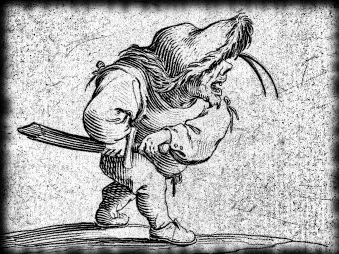
Man Preparing to Draw His Sword; Jacques Callot

For an attack which succeeds and on which doubles are rolled on the 2d6 attack roll, a Critical Blow is struck. When a Critical Blow occurs, the hits inflicted on the defender are equal to double the attacks assigned to the roll.

Additionally, hits against vulnerable targets - targets unaware they are under attack, targets which are prone on the field of battle, and so on - are likewise doubled.

This is designed to prevent characters of only slightly higher level than an adversary from being invincible to that adversary in man to man while still preserving the possibility of great warriors or powerful monsters only a hero could hope to tackle alone.


The Math: Hits and Crits

A hit on the Man to Man table can be achieved - depending on weapon vs armor - on between a 5 and 12 on 2d6: producing a wide variety of probabilities. To prove I've thought about it - for the purposes of illustration, we'll focus on target numbers of 6, 8, and 10 - an easy, a normal, and a challenging result.

Provided, a matrix of all possible combinations on 2d6 - with their respective result:

2d6 1 2 3 4 5 6
6 7 8 9 10 11 12
5 6 7 8
9 10 11
4 5 6 7 8 9 10
3 4 5
6 7 8 9
2 3 4 5 6 7 8
1 2 3 4 5 6 7
In red, a result which will miss all target numbers. In yellow, a result which would hit only the easiest target number, 6. In blue, a result which would hit both the easiest 6 and the moderate target number of 8. In green, a roll which would hit all target numbers.

In deeper highlight and italicized, a double: representing on hit a result which would indicate a critical result.

Observing the provided, there are 36 possible outcomes - with six possibilities for a double. Thus:

Target Number Chance for a Hit Chance for a Double
6 26-in-36, or around 72%.
4-in-36, or around 11%.
8 15-in-36, or around 42%.
3-in-36, or around 8%.
10 6-in-36, or just shy of 17%.
2-in-36, or just shy of 6%.

A character well armed - having a weapon appropriate to the enemy's defenses - may reasonably expect to hit frequently and hit above their pay-grade on a d20 equivalent of 19: whereas a character armed poorly relative to the enemy's defenses will have a difficult time hitting - and will hit above their pay-grade on a d20 equivalent to a natural 20.

Inspiration

The Hero can stand against a squad of normal men, holding his own; the Wizard stares down a fell beast which has laid waste to an army before it! Chainmail accomplishes this via the Fantasy Combat table - a solution to a problem where some units take many hits before going down: making them prime candidates to strategically lock down other units. Concurrent hits - as I describe above - are actually very uncommon: only Lycanthropes, Heroes, Super Heroes, and Wizards (implied) use them: however, this is an even more extreme example - as two Heroes who run into each other on the battlefield, using troop combat - have a statistically insignificant chance (almost 1 in 1,300) to end their conflict in anything other than a draw. Thus, the Fantasy Combat matrix is provided to pit Fantastic creatures and figures against one another - catering to the fiction from which they are drawn: Dragons cannot be killed in normal combat, but can be slain by a Hero with a bow and magic arrows (*cough* *Esgaroth* *cough*) with only a moderate degree of luck; Trolls are fearsome opponents, but are vulnerable to the magical weapons Elves carry (*cough* *The Broken Sword* *cough*). The key take-away here, however, is less the fiction: but from the gamist perspective, the rapidity of resolution. 

Chainmail is a wargame. The intent of Chainmail is not to imitate epic show-downs, but instead to allow armies to clash and to vie against one another for land, treasure, or honor. For that reason, it has to be quick - to bog the game down would result in the inability to utilize the rule in a tournament setting: and might inspire players to ban the Fantasy Supplement altogether - favoring the tight rules for more real-world military engagements. Baron Frederick Ran Me Down; Howard Pyle And it accomplishes this smoothness by pairing Fantastic adversaries against one another on a chart - requiring one roll only to decide the fray.

But how to accomplish the same result without ever and infinitely expanding a literature-based table?

An Equivalence Solution

I referenced Majestic Fantasy for Swords & Wizardry above. In reality, I should have referenced a blog post - Multiple Fighter attacks revisited for Swords & Wizardry: written by Rob Conley, proprietor of Bat in the Attic Games the author of the aforementioned Majestic Fantasy and a perennial figure in the OSR ecosystem. You're shilling him awfully hard  this post, CWR - what's up with that? I want to highlight Rob and his product line because - while, admittedly, I like some of it more than others - by and large he's a sharp cookie who has good insights into the experience of an OSR sandbox game. If you play Swords & Wizardry, or if you play OSE or any other TSR-friendly OSR system - I would encourage you to consider looking into his blog, checking out some of his work, and seeing if it's right for you. 

But - for the time being, we'll focus on what I saw that changed how I wanted to approach combat in Chainmail and Weapons, Wits, & Wizardry: namely, multiple attacks. In AD&D 1e, a Fighter gets multiple attacks - one per level - against enemies of 1 HD or less. This is an import from the Chainmail roots of the game, promoting the Name-Level-Fighter-As-A-Wrecking-Ball of mass combat. Encountering 40-400 Kobolds? No problem. You're taking out 10 at a time - plus, by that point, you're assumed to have retainers behind you: but that's another story. This didn't sit well with me - as I commented on Rob's post when I first read it - because a Fighter is a whirlwind of destruction against 1 HD enemies - skeletons, normal men, goblins - but then becomes no better than his own normal men troops immediately facing anything else - zombies, Elves, a freaking badger, etc. How Rob handles this - I recommend his blog post for a better explanation - but he counts down: the Fighter "spends" attacks according to the HD of the enemy - attacking, dealing damage, and so on as normal with each. It's a considerable boost - but one which is much needed for the character archetype that, though allegedly Gary's favorite, falls behind fellow classes in effectiveness as the levels accrue. Approaching it from a Chainmail perspective - I had the opposite problem: too many attacks and how to pare them down!

In the Spirit of Fantasy Combat

The resolution strategy of Fantasy Combat is solid - the problem comes with extensibility. In Chainmail, Fantasy Combat is a chart - depending on which figure engages which other figure, cross-referenced on the matrix. Knowing this, each new Fantastic monster would need to have a new entry on the list - and values determined for each potential opponent. To stick to literary inspiration - this would also pose a problem as some new monsters have no precedent to appear next to one another in the fiction: naturally providing a narrative limitation on the addition in addition to the margin limitation: that is, how big can the table get before it no longer fits in a book?

The Man to Man approach with a multiple-hits caveat solves this problem.

By treating the attack and defense of a Fantastic creature according to an equivalence on the Man to Man table - which can be extended indefinitely in rows, if the need arises - it provides a natural answer to "how would this monster affect this other monster?" and "how would a human heroic character overcome this monster?" Thus, say we create a Grue. The Grue - according to our own table - has 4 hit dice: a fighting man of normal bearing has no chance to hurt it. However - a Hero - armed accordingly - has a chance. A single success will strike the creature down - as would a Fantasy Combat entry - and also it allows the Hero to outfit himself for the occasion. We know that Grue attack by eating their foes: perhaps bulkier armor (Plate), preventing easy swallowing, will affect its ability to inflict that attack. Weapon and armor choice continues to matter - giving the Fighting Man more tools in the toolbox. But that's another story.

What about Monsters?

Ostensibly, monsters should receive multiple attacks. A cave troll crashing into the packed ranks of pikemen, rending left and right, throwing men asunder before coming face to face with a champion in its way - this is accomplished in Chainmail by troop combats followed by Fantasy Combat when the pair square off. In the same sense - combining the two under the Man to Man approach described above, the troll would - having a high Man Equivalence - be entitled to multiple attacks (the aforementioned left and right) and then few - perhaps one or two - against the hero, who likewise has an elevated Man Equivalence.

If it gets to the point where it's tedious? Say, rolling 2d6 three or four times in a row?

In that case - I may recommend defaulting to troop combat. Roll dice, on 6s - count a hit: appropriate to the light/heavy/armored spectrum - just in the name of speed. However: for the time being, the rule stands - and unless play-test proves a problem? We'll see how it goes!

Thanks for reading!

Death as Victor; Alfred Rethel

Public domain artwork retrieved from OldBookIllustrations.com and the National Gallery of Art and adapted for use. Attribution in alt text.

Frieren: Beyond Journey's End

N-Spiration - Frieren: Beyond Journey's End About Frieren The saga that is Frieren  started (and continues) as a serialized ...