Saturday, October 24, 2020

Double Trouble

Entered the Fray, Gustave Dore Two weapon fighting, or dual wielding, is a common trope in modern fantasy - ingrained by future editions, but absent from the original Basic line; likewise missing from many a retro-clone.

Commonly house-ruled, commonly back-ported, and commonly discussed - here are my rules for fighting with two weapons in a B/X-compatible game. This rule is designed for two-weapon fighters to provide versatility to the character at the cost of maximum effect: a parrying dagger will never be as effective as a kite shield; nor will a side sword empower you to strike as heavily as hefting a mighty zweihander.

Dual-Wielding, or Fighting with Two Weapons

When fighting with two weapons, a character may choose to fight in one of two positions: an offensive position (or, striking) or a defensive position (or, parrying).

  • When striking, a character is presumed to be attacking with both weapons: using one to feint and then the other to strike; using one to trip or engage the shield while looking for an opportunity with the other; or perhaps even coming down with both in haymaker swings. A character so positioned gains a +1 bonus to hit on their attacks.

  • When parrying, a character is presumed to be attacking with one weapon, but using the other to distract, to parry, or perhaps to ward off opponents, keeping distance between the two of them, such that they become more difficult to hit. A character so positioned gains a +1 bonus to their Armor Class against melee attacks only.

Corpse Candles, Gustav DoreA character which is surprised should benefit from neither during the surprise round, adopting a position, or stance, in the first combat round in which they are aware of their adversaries.

Note, a "bonus" of +1 in any sense should benefit the character to whom the bonus is applied. Specifically, when using descending armor class, a +1 bonus to armor class will, numerically, reduce the armor class value by 1 point: making the beneficiary more difficult to hit.

Optionally, when fighting with two weapons of mismatched size - that is, say, a sword dealing d8 and a dagger dealing d4 - the referee may rule that, on a hit exactly matching the armor class of the target, damage is dealt using the off-hand weapon. So, for the character with the sword and dagger striking an adversary of AC 6, a successful hit on AC 5, 4, 3, or so on would deal 1-8 damage; whereas a successful hit on an AC of 6, explicitly, would instead deal 1-4 - potentially making an exception if striking an adversary against whom a natural 20 is required to hit.

Optionally, when a character in an offensive stance scores a critical hit - that is, rolls a natural 20 on the attack roll or otherwise performs in a manner determined by the referee to constitute a critical success - the referee may allow the player to roll the damage dice of both weapons, either summing the result or taking the better of the two, depending on the referee's situational jurisprudence.

Optionally, when a character in a defensive stance is hit in melee exactly on their AC, the referee may allow them to disarm themselves of or to damage or destroy their off-hand weapon in order to negate the hit. So, for a character with an AC of 5 that is parrying against an Ogre, if the Ogre rolls to hit AC 6, 7, or so on, the character is safe; however if the Ogre rolls to hit AC 5, the referee may allow the player to declare that the force of the blow sends their parrying arm into the stone floor, snapping it in half - but dealing no damage to the character. Were the Ogre to hit AC 4, 3, or so on, the parrying character would be hit normally.

Why have "stances" as opposed to static bonuses? The objective is to produce versatility, not to grant an advantage. It is intended to be no more powerful, nor less powerful, than sword-and-board versus great-axe approach. By forcing a decision between two options, slightly less powerful than similar options that do not allow for the decision to be made, it grants different advantages under different circumstances: which is neutral, in terms of benefit to drawback.Scotch Soldiers, Lancelot SpeedTo grant static bonuses would, in my opinion, make the ability objectively better.

Why a to-hit bonus? There should be consequences of wielding two weapons. If it's all fluff, that is - your character has no changes, mechanically, to the game when fighting with two weapons - then they have no incentive to do it over using a two handed weapon. This is fine for some referees who don't want dual-wielding in their games, citing style or historical reasoning - for them, I say (though the historical reasoning is flawed) ignore this suggested ruling. For me, though, I want to include it - and for other referees who enjoy a bit of variety, a bit of agency, and a bit of cinematic verisimilitude over gritty realism, rule away!

To answer the question, however, the purpose for the bonus is to increase mean damage output: but not to increase mean damage output so much as a two-handed weapon would provide. When fighting with two weapons, thus, a bonus to the attack roll will offer a moderate increase to damage. Assuming standard THAC0 ranges or attack matrices, the chance of scoring a hit against various armor values are as follows, where the first percentage is wearing the armor, only and the second percentage is wearing the armor and carrying a shield:


Chance To Hit
Ftr. Tier THAC0 Clothing Leather Mail Plate
1-3 19 55% 50% 45% 40% 35% 30% 25% 20%
4-6 17 65% 60% 55% 50% 45% 40% 35% 30%
7-9 14 80% 75% 70% 65% 60% 55% 50% 45%
10-12 12 90% 85% 80% 75% 70% 65% 60% 55%
13-15 10 95% 95% 90% 85% 80% 75% 70% 65%

This will afford damage per round of combat as follows, assuming variable damage for weapons, again with the first damage per round value equating to the damage per round against that armor exclusively and the second equating to damage per round against that armor plus shield:


Damage per Round, D4
Ftr. Tier THAC0 Clothing Leather Mail Plate
1-3 19 1.375 1.25 1.125 1 0.875 0.75 0.625 0.5
4-6 17 1.625 1.5 1.375 1.25 1.125 1 0.875 0.75
7-9 14 2 1.875 1.75 1.625 1.5 1.375 1.25 1.125
10-12 12 2.25 2.125 2 1.875 1.75 1.625 1.5 1.375
13-15 10 2.375 2.375 2.25 2.125 2 1.875 1.75 1.625


Damage per Round, D6
1-3 19 1.925 1.75 1.575 1.4 1.225 1.05 0.875 0.7
4-6 17 2.275 2.1 1.925 1.75 1.575 1.4 1.225 1.05
7-9 14 2.8 2.625 2.45 2.275 2.1 1.925 1.75 1.575
10-12 12 3.15 2.975 2.8 2.625 2.45 2.275 2.1 1.925
13-15 10 3.325 3.325 3.15 2.975 2.8 2.625 2.45 2.275


Damage per Round, D8
1-3 19 2.475 2.25 2.025 1.8 1.575 1.35 1.125 0.9
4-6 17 2.925 2.7 2.475 2.25 2.025 1.8 1.575 1.35
7-9 14 3.6 3.375 3.15 2.925 2.7 2.475 2.25 2.025
10-12 12 4.05 3.825 3.6 3.375 3.15 2.925 2.7 2.475
13-15 10 4.275 4.275 4.05 3.825 3.6 3.375 3.15 2.925


Damage per Round, D10
1-3 19 3.025 2.75 2.475 2.2 1.925 1.65 1.375 1.1
4-6 17 3.575 3.3 3.025 2.75 2.475 2.2 1.925 1.65
7-9 14 4.4 4.125 3.85 3.575 3.3 3.025 2.75 2.475
10-12 12 4.95 4.675 4.4 4.125 3.85 3.575 3.3 3.025
13-15 10 5.225 5.225 4.95 4.675 4.4 4.125 3.85 3.575

The above excludes the mismatched weapons provision for the one-in-twenty chance of altered damage range for a hit; as that makes for much more complex to calculate math.

Thus, a level 4 (tier two) character striking a target with chainmail armor will - wielding a one handed sword that deals d8 damage - inflict an average of 2.025 damage per round or - wielding a two-handed sword that deals d10 damage - inflict an average of 2.475 damage per round: a net difference of 0.45 damage per round: or about 18%. Grey Dolphin, Unknown Artist Knowing, however, that shields separate armor class by 1 point and that each tier of armor is separated by two points, this provides us a linear progression: to compare how much damage you would have with a +1 bonus to hit, you can shift your gaze left one cell in the above tables. So, comparing a level 4 (tier two) character striking a target with chainmail, again, will still inflict an average of 2.475 damage per round using a two-handed sword, but using a one-handed sword at a +1 bonus to hit will instead inflict an average of 2.25 damage per round - the equivalent of striking leather armor with a shield - cutting the delta in half to 0.225 damage: or about 9%.

Using a d6 weapon, the difference compared to a two-handed sword is slightly less profound: 1.575 damage per round versus 1.75 damage per round with a +1 bonus to hit, compared to 2.475 damage per round with a two-handed sword, a 0.9 (~36%) and 0.725 (~29%) difference in damage output: or, about 7% improvement in the difference between the two. However, if you instead compare the d6 weapon against a d8 weapon - say, a two-handed battle axe - the change looks more familiar: 1.575 improves to 1.75 versus the two-handed axe at 2.025: 0.45 damage delta per round versus 0.275 damage delta per round: a difference of 0.175, or about 9%.

At each level of die progression, this is consistent, with +1 bonuses to hit resulting in an improvement to the damage per round as follows:


Pct. Damage Delta per +1
Ftr. Tier Clothing Leather Mail Plate
1-3 9.09% 10.00% 11.11% 12.50% 14.29% 16.67% 20.00% 25.00%
4-6 7.69% 8.33% 9.09% 10.00% 11.11% 12.50% 14.29% 16.67%
7-9 6.25% 6.67% 7.14% 7.69% 8.33% 9.09% 10.00% 11.11%
10-12 5.56% 5.88% 6.25% 6.67% 7.14% 7.69% 8.33% 9.09%
13-15 5.26% 0.00% 5.56% 5.88% 6.25% 6.67% 7.14% 7.69%

Interestingly, the value of the +1 is higher at lower levels versus higher AC and is lower at higher levels, in general, but also lower relatively at higher levels: an interesting data point being that no improvement at all occurs between a top-tier fighter striking a character with clothing only versus clothing and a shield, highlighted in italics: a phenomenon occurring because the fighter has, at that point, to roll a 2+ to hit clothing or clothing and shield, so a bonus to hit offers no benefit. But this is in scope for a different discussion.

Dice d6 and d8 being the most common among one-handed weapons, comparing d6 or d8 at a +1 bonus to each other and versus d10 results in the following breakdown, where the number represents the difference between damage per round of the higher die (the two-handed weapon) versus the lower die at plus one (the one handed weapon being used while two-weapon fighting):

Ftr. Tier Net Damage: D6 at +1 vs D8 at +0
1-3 -0.325 -0.275 -0.225 -0.175 -0.125 -0.075 -0.025 0.025
4-6 -0.425 -0.375 -0.325 -0.275 -0.225 -0.175 -0.125 -0.075
7-9 -0.575 -0.525 -0.475 -0.425 -0.375 -0.325 -0.275 -0.225
10-12 -0.675 -0.625 -0.575 -0.525 -0.475 -0.425 -0.375 -0.325
13-15 -0.95 -0.725 -0.675 -0.625 -0.575 -0.525 -0.475 -0.425

Net Damage: D6 at +1 vs D10 at +0
1-3 -0.825 -0.725 -0.625 -0.525 -0.425 -0.325 -0.225 -0.125
4-6 -1.025 -0.925 -0.825 -0.725 -0.625 -0.525 -0.425 -0.325
7-9 -1.325 -1.225 -1.125 -1.025 -0.925 -0.825 -0.725 -0.625
10-12 -1.525 -1.425 -1.325 -1.225 -1.125 -1.025 -0.925 -0.825
13-15 -1.9 -1.625 -1.525 -1.425 -1.325 -1.225 -1.125 -1.025

Net Damage: D8 at +1 vs D10 at +0
1-3 -0.275 -0.225 -0.175 -0.125 -0.075 -0.025 0.025 0.075
4-6 -0.375 -0.325 -0.275 -0.225 -0.175 -0.125 -0.075 -0.025
7-9 -0.525 -0.475 -0.425 -0.375 -0.325 -0.275 -0.225 -0.175
10-12 -0.625 -0.575 -0.525 -0.475 -0.425 -0.375 -0.325 -0.275
13-15 -0.95 -0.675 -0.625 -0.575 -0.525 -0.475 -0.425 -0.375

Again, some interesting data points occur, where tier-1 fighters will deal more damage per round to an extremely high AC, highlighted in italics - but again, speculation for another time, as without doubt, we are commonly sick of looking at tables by now.

Bout with a Stranger, Lancelot Speed

Why not simply attack twice? Attacking twice is the de-facto standard for most two-weapon rules. Commonly, to mitigate the damage increase, there is a corresponding accuracy penalty: -4 in some systems, -2 in others, or sometimes mixed penalties based on whether you're attacking with the primary hand or the off hand. However - in all cases - extra attacks slow down play. Rolling two attacks, adjudicating two damage rolls, it takes twice as long on a player's turn: a problem that gets exponentially more noticeable later, if working in a system that grants extra attacks based on level progression. Although you can mathematically make rolling two attacks add up, average out, the same way this rule does - in the interest of keeping the game as sleek and streamlined as possible, I try to eschew extra rolls if I don't need them.

Why the "parry" AC? The objective of the rule is to produce a middle ground. A two-weapon fighter should, as explained above, inflict more damage than a fighter with one weapon but less damage than a fighter with a large two-handed weapon. Similarly and conversely, a two-weapon fighter should have better defense than a fighter with a large two-handed weapon but worse defense than a fighter with a shield. This is reflected in the parry action, the defensive stance: a defensive boost at the cost of the offense, but not so useful as having a shield would be.

To support this, consider the table above indicating likelihood of hitting based on level and armor. Inverting the perspective, this can likewise be used as an indicator for getting hit. That is, if you are wearing chainmail, a low level (tier-1) attacker will deal ~14.29% damage less to you per round if you don a shield as well. This amounts to about the following, in terms of damage per round less than a character would have taken, per -1 to a character's armor class:


d4 d6 d8 d10
Dmg. Delta: -0.125 -0.175 -0.225 -0.275

Eighth-Century Foot Soldier, Eugene Emmanuel Viollet-le-DucAs such, a character with 10 hit points wearing leather armor will, if attacked by a tier-1 attacker using a 1d8 weapon, drop on the 5th round of combat: having taken 2.025 damage per round. This same character, if using a shield (or gaining equivalent bonus to AC in melee by fighting defensively with two weapons) would drop to the same opponent instead on the 6th round of combat: having taken an average of 1.8 damage per round, instead: the result of the opponent rolling more misses.

On a smaller weapon, this is proportionally less pronounced: the same character being attacked by the same tier-1 attacker using a 1d6 weapon instead of 1d8 would drop on the 7th round of combat, taking 1.575 damage per round; compared to dropping on the 8th round of combat after taking 1.4 damage per round on average. With a larger weapon, 1d10, the character would drop on the 5th and 6th rounds, respectively: same as a 1d8 weapon, to a tier-1 attacker.

Parrying offers the same protection of a shield in melee only - but to maintain the balance - leaves the two-weapon fighter vulnerable to missile attacks.

How about Shields Shall Be Sundered? Up to you: if you want to allow a two-weapon fighter in a parry stance to sunder his weapon to avoid a hit? Run it! And tell me how it goes!

May the dice smile on your ventures!


Public domain art lovingly pilfered from OldBookIllustrations.com in October of 2020 and adapted for thematic use. Attributions in alt text.

Saturday, October 17, 2020

The Sulak: Lurkers in the Dark

"Hanging these things is so much harder these days," she says, retrieving a bronze clasp from the two dozen in her bowl. She reaches upwards to pin the strip up to smoke.

Undine Illustrated Endpapers; Arthur Rackham"You are carrying more these days. The little one isn't getting any smaller!" He stuffs another bundle of straw into the kiln; having left his torc on the flat, sparing it his sweat. A child coos softly in a sling, softly sleeping, rocking suspended from over her shoulder. She retrieves another one of her sixteen bronze clasps.

"He is; he needs to get tall enough to hang them himself!" She stretches her back as he steps out of the smoke-hut, walking to the moist bundles, kept distant to protect the kindling. 'He will one day wear a torc like yours,' she thinks, 'Where did you leave that thing?' putting down the clasp she had been holding back among the twelve in her bowl. 'Did it fall beneath the kiln?'

Bending down, peering under the kiln...

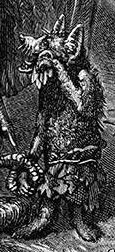
A rat! A horned rat's head the size of her own - snapping; leaping out - sandy fur and a curved knife leading furious eyes!

The front door explodes open. Screaming.

The back door slinks. Closes.

Under the outhouse, a short - but thick - body splats into the muck; its satchel clanking, metal against metal inside. Two rat-faces in the darkness watching. "You were careless," their language - shrill and grating - yet a whisper, "You should have killed them!"

The slinking rat face snaps its teeth; snarls. Its helmet slinks to one side. 

It extends a claw. The two fat rats reach down and hoist it - and its satchel - onto a ledge. The three start into the tunnel - west. "See what you've gotten," chittering in the growing dark, "When we have gotten back in the Underway. When we are back in the Underway..."

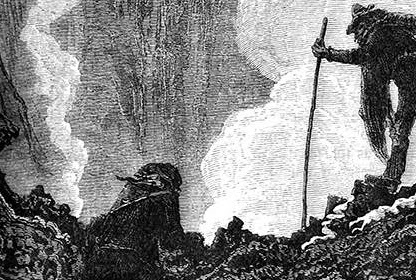
Looking Into the Crater; Unknown Artist

They Make their Home in the Crags

The Sulak are small in stature - no larger than a child - but mothers use them to scare their children into being careful in new places: and many a Caanish will sleep at mooring rather than enter an unfamiliar town for fear that they might be lurking. They are thick set, with almost feline features, sandy colored fur resembling that of a rock hyrax, and knees that bend backward. They make their home in dark places - hiding in cracks and crevices - guardians of an underway hidden in the rocky badlands allowing them to sneak into and out of land-bound communities.

In dark places, in places where a man might be vulnerable - there, the Sulak wait: their eyes on his coin, their eyes on his jewelry - with prejudice, they will claw and hoard: returning to where ever it was they came from, having crippled their target and made off with more that glitters.

Encountering the Sulak

Sulak are light of foot and preternaturally quiet. They lurk in dark places, in rocky places, and in infrequent corners - avoiding direct sunlight (it makes them sleepy).

Sulak
Armor Class:7No. Appearing:1-8 (8-64)
Hit Dice:1-1Save As:Normal Man
Move:90' (30')Morale:8
Attacks:1 weaponTreasure Type:Q (C)
Damage:1-6 or
by weapon
Alignment:Chaotic
Frequency:CommonChance In Lair:10%
Sulak are between 33 and 39 inches in height, tending to weigh around 40 pounds. Their fur protects them somewhat - though they rely on stealth for the majority of their safeguards. Preferred weapons tend to be ranged - crossbows, thrown weapons - but in a close fight, they are known to carry kris-styled daggers.
The Eagle and the Fox; Ernest Griset
As a whole, the Sulak tend to be greedy - they take more than they need, they steal from those who have more and those who have less, and they hoard what they have behind traps, locks, and other deterrents. They prefer to sneak around rather than engage in a fight - but if they do, they will engage on terms as unfair to their adversaries as they are capable of arranging. After all, you can't eat your stolen tart if you're gutted in the stealing.

Backbite - the Sulak, knowing their size limitations, work diligently to avoid a fair fight. Representing this affinity, a Sulak which attacks from surprise deals double damage and, when withdrawing from a melee, may roll a Save vs Death to move at their full speed. Additionally, pads in their feet make them preternaturally quiet when the move - increasing their chance to surprise an enemy to 4-in-6.

Cave Climbers - the Sulak are expert climbers and benefit from the Thief's Climb Sheer Surfaces skill, of level according to their hit die. Additionally, they benefit from infravision out to 60 feet.

Spoiler Alert!
The Deeper Lore section contains some notes to help a GM (me) to run the Sulak in a way consistent with the archetype they are supposed to fill and some of the inspirations behind their creation. If you play in (or want to play in!) a game GM'ed by me, beyond this point will ruin some of the mystery for you for both Sulak and for most of the sentient races: having some impact in the game world that isn't immediately available outside of player character discoveries.

Deeper Lore

Being called a "lurker" by the Caanish is somewhat of a mistaken understanding - in that they don't tend to lurk and wait for a human to ambush. Instead, they are most commonly encountered by accident: when they are in the middle of some other misdeed.

The natural life span of a Sulak is much shorter than that of a Human: reaching full maturity at 6 years and rarely living past 30. They reproduce in litters of 3-12 and, though they do care for their young - said young being seen as an extension, property in a sense, of the parent - the survivability is lower than other races. Sulak are untrustworthy and routinely betray one another in pursuit of personal gain. Their loyalties are based on blood - so, a sibling or offspring is closer than a cousin or clan-mate, which is in turn closer than a non-clan colleague in simple proximity or association: but at the end of the day, the individual Sulak is still number one.

Fox Screamed; Arthur Rackham
The Sulak are a Vice Race - an embodiment of Greed. They are thus conniving and covetous, moderately impatient - always looking for ways to obtain more for themselves and their own. They are natural thieves and will avoid conflict, if possible, unless their odds are totally overwhelming and said conflict would serve their interests more quickly than stealth. The Chaos Seed of the Sulak was bestowed by the Rabisu - a semi-corporeal demon which feeds on the life-blood of living beings as a vampire to survive and a peer of the Akhkhazu in the celestial order, but bound to the Peccata Clamantia of Fraud, or Defrauding. They were charged with the corruption of mankind by a Lord of Chaos, Namar - who seeds plague where he steps.

A Sulak may, as a Vice Race, be redeemed - unbeknownst to the larger world, as usual. If such redeeming occurs, the Sulak - regardless of its own life-stage (youth, adulthood, decrepitude, etc.) it will return as a Human of the same age. Thus, a Sulak of an established adult age - say, 9 - will morph into a mere child.


Public domain artwork respectfully pilfered from OldBookIllustrations.com on or about 9/23/2020 and edited for thematic use. Attributions in alt text.

Saturday, October 10, 2020

Ooze and Fire: a Dungeon of Fourth Level

Scale: 10 ft.
Click here for a PDF version of this adventure!


X - Entrance

A spiral staircase leads into this room from above. Entrances to W1 and E1 are barred barriers that appear to be carved from stone. Doors in both are locked. Door to N1 is stuck. Two Giant Weasels (X42) are rooting around in a pile of wooden crates to the south. Inside one of the crates is a lockbox containing 94 platinum pieces. 

 Under the crates is a floor-grate, three by six feet, akin to a street drain: it can be removed by the strong or dedicated to gain access to H1: into which it’s an eight foot drop to a moist stone floor.

West Wing

W1 - The Humming Hall

The walls of this hallway have solid-color pieces hanging on the walls, each around 8 by 10 feet. Characters walking through this hall hear music faintly playing somewhere in the dark - but will not be able to tell from where it originates. The door to N2 is locked. The door to W2 is not.
 

W2 - Control Room

Doors to W1 and W7 are not locked. The barrier to W4 and W3, like the exits from X, is made of worked stone: barred, such that a character can see through. The doors have no handle and no hinge: sliding down into the floor in order to open.

In the center of the room, there is a raised platform - two inches off the ground - that has a fixed lectern projecting from it. There are two holes in the top of the lectern. If a player stands on the platform, it sinks down - two inches below the ground level - causing two knobs to rise out of the holes in the lectern. If a knob is turned, a clunking noise can be heard and a corresponding door opens: when the south knob is turned, the door to W3 opens; when the north knob is turned, the door to W4 opens. The knob can be turned back the other way, closing the door again, but only after the corresponding door has fully opened. If the player leaves the lectern without applying a counterbalance, it will rise again - concealing the knobs and closing the doors, regardless of configuration.
 

W3 - South Cell

This circular room has a drain in the center - five feet diameter, removable by a strong or determined party - partly made of iron. It has been corroded and eaten by four Rust Monsters (B41) who are sniffing about the room. The bars to W2 cannot be corroded, being stone; but the monsters can see anyone who enters W2. Also visible in this room is a low trough which appears to be filled with specie - 400 gold pieces, 1,500 electrum pieces, and 2,000 silver pieces, to be exact. Beneath the drain is an 8 foot drop into the Maze section.
 

W4 - North Cell

This room has a low trough, broken on one side, with nothing in it. An off-putting stain marks the floor on the eastern side of the room. The door to W5 is locked; the door to W2 can only be opened from W2.
 

W5 - Scriptoriulum

Dusty furniture - a card table, chair, and stool - stand unused in this small space. An Ochre Jelly (B40) is under the table.
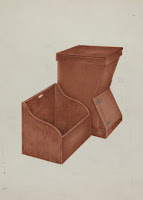
Shaker Wood Box and Kindling Box; George V Vezolles

W6 - Burned Tiles

 
The doors to W5 and W8 are locked; the door to W7 is not.
 
The north-east and north-west angled walls in this space have inset mosaics in them depicting figures in armor. Age and what appears to be fire damage makes it hard to make out the subjects.
 
Norman Armor, Bayeux Tapestry

 W7 - The Torch Room

The doors out of this room are not locked. In the inset in the center-east, there are two amphora, three feet tall each, that have faux flora in them: specifically, five foot sticks with black-purple material at the top resembling 2 feet of Wisteria.

The material is flammable and will function as a torch - but requires two hands to carry safely.
 

W8 - Blocks and Cobble

The floor in this room is comprised of uneven blocks that shift slightly when stepped upon; it does not constitute difficult terrain, but a character without boots might have discomfort walking across quickly due to the edges. Around the perimeters except door thresholds, protruding six inches from the wall, is a clean and even baseboard.

The door to W6 is not locked. 
 
The door to N7 is stuck - obviously so - as the base of it seems flush with the floor: the blocks having crammed up against it. If the door is opened, the blocks in W8 fall through, dropping anyone inside into a 10 foot pit with fungus growing at the bottom - a character may save, at referee discretion, to avoid the fall. Any character that does fall takes 1d6 damage from the fall - but then must also, due to spores, Save vs Poison or grow dizzy - suffering -2 to any checks made requiring visual focus or manual dexterity for the next 1d4 turns.

The trap will not reset on its own.
 

North Wing

N1 - North Hall

The floor of this room has a concentric square - roughly five feet wide by five feet less than the length of the room, north to south - made of burnished marble. Doors to N2 and N3 are stuck, but not locked; doors to N4 and N5 are locked; the door to N7 is unlocked and not stuck. Six Hellhounds (X33) are patrolling southbound.

The secret door to N6, if exposed to flame, slides open smoothly and effortlessly.
 

N2 - West Globe

The inside of this room is spherical, less five feet from the radius of the room: that is, on the ceiling is a concave, circular shape above a matching concave, circular indentation on the floor, the perimeter of which rings the room, five feel from the walls. There are four sconces for torches - only one has a torch in it, and it has long since burned out - on the corners where cardinal directions meet: north-east, north-west, south-east, and south-west. The hemisphere in the floor is slick to the touch.
 

N3 - East Globe

The inside of this room is likewise spherical, less five feet from the radius of the room, as is N2. Likewise, there are four sconces. Hidden in the hemisphere in the ceiling is a single Gray Ooze (B36). Lying in the hemisphere on the floor is a half-eaten humanoid, dead, slumped over a chest. Inside the chest - which is locked - can be found 1,000 silver pieces and a porcelain figurine worth 200 gold pieces.
 

N4 - Shrine of the Star

This space is claustrophobic - the ceiling only six feet high. In the west corner is a small votive space in which there is a bowl with a dried Alstroemeria flower, with six iron spikes arranged in a circle around it, pointing outward like a star.
 

N5 - Shrine of Growing

This space seems claustrophobic at first, the ceiling being only six feet high at the door. However, if a character steps into the space, they find it to be larger than it appeared - from an outside observer, they appear to be shrinking as they enter: such that the five foot space could be treated as 25 feet deep.

A similar votive table to N4 sits on the far corner: with a bowl - upturned, such that it serves as a convex protrusion from the table - surrounded by four silver spikes, upturned, point facing the ceiling. Beneath the bowl is a dried Bellflower. The table appears to be 3 feet off the ground from the door, but is 15 feet off the floor when a character stands directly next to it. The silver spikes are six inches long, but if retrieved, shrink as they are removed - such that they are the size of thimbles - worth around 6 silver pieces - when removed from the space.

Time is likewise dilated when a party is in this room. For each turn the party takes, 5 turns pass outside the room. This becomes evident to an outside observer on a successful Save vs Spells, as the movements are not quite right for characters inside the room.
 

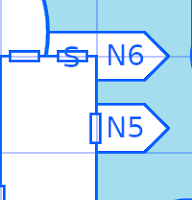
N6 - Shrine of the Statue

This space is very tight - the ceiling is six feet off the ground, but requiring a step down - six inches - to enter. In the far corner is a stone pyramid, three feet tall, the top of which cut off into a step - above it is a cylinder, hanging down, a plug into which is being held up by a golden statue, perched on the stone pyramid step. The statue is worth 1,200 gold pieces - weighing 400 coins - but if removed, the seal falls with it and a torrent of acid spills into the room, filling the room and spilling out 2d6 feet into N1 under the door. The acid deals 1d6 damage per round a character is exposed to it - plus 1d4 damage per round for 1d4 rounds after, unless neutralized.
 

N7 - The Hemisphere

The ceiling for this large space is concave - like the top of a globe from the inside - beyond a five foot wall, as a cylinder, from the floor. There are five bands - as latitude - that slowly spin, with adjacent bands spinning the opposite direction. In the center is a candelabra - 25 feet off the ground - which is enchanted with magical flames that burn cold and will never go out; emitting light as a lantern. The door to N1 is not locked; the door to W8 is stuck.
 

East Wing

E1 - East Hall

This hallway is lined with aged heraldry on the walls. An odd smell can be detected, stronger as the party approaches room E5. 
 
The door to N3 is locked; the door to E2 is not.
 

E2 - Fountain Foyer

In the center of this room is a small fountain - a gray-green algae covering the water and slowly colonizing the stone. Around it is a circular rug - a circle cut in the center such that the stone fountain, and a stone floor, is haloed on the floor. No doors are locked.

If the characters reach into the water, the algae is harmless, they will find a handle. When pulled, this hidden handle will open the door to H16.

E3 - Ring Basin

On the diagonal walls to this room - that is, on the northern side, the walls facing north-east and north-west, respectively - have triangular windows in them, six inches deep. 
 
There are stone statues - ovaloid, eight inches tall - suspended in the space by a small granite column. In the base of each are small basins full of copper rings: approximately 150 of them total, worth approximately 15 silver pieces if melted down.
 

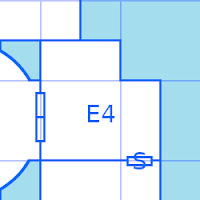
E4 - Bone Room

The northern five foot alcove in this room is full of bones, some of which are partially dissolved. In the south-east corner is a barrel with 6 torches and 4 pints of oil. 
 
The secret door to H14 will open smooth and effortlessly if exposed to flame.
 

E5 - The Chessboard

The floor of this room is covered in a square tile grid of alternating colors, black and dingy white, about three feet to the side. The the room thus, being 20 feet deep and 40 feet wide, will be 7 tiles deep and 14 tiles wide. The black tiles give off a dim light, enough to see by - as a candle. Flanking the room's entrance are two statues of horses, rearing.


On the northern wall in the 7th and 8th tiles, east to west, are two thrones on which a regal male and female statue sit. The throne seat is six feet off the ground, the figure extending an additional four feet in height.
  • The male statue wears a cloak in-lined with platinum threads - when worn, it grants +2 to all Saving Throws and +1 to Armor Class - and carries a sword. The sword is decorative - counts as silvered, but suffers a -1 penalty to hit, as it's made of combat-inappropriate metals which are worth 250 gold pieces to a collector. The figure wears a helmet on which a single red gemstone is embedded: if pried loose, this gem is worth 600 gold pieces.

  • The female statue wears a broach - platinum inlaid - worth 400 gold pieces as well as a tiara worth 600 gold pieces and a Ring of Spell Storing. The ring is on a finger which connects back to the statue, however: presenting a challenge as to how it may be removed.
Characters walking into the room must move according to the permitted movement of a Knight from a game of chess. The exception to this rule - characters under the influence of a Divine spell, such as Bless, may instead move diagonally, as a Bishop. The tile on which a character is presently standing - if black - ceases to emit light; if white - starts to: again, at lumens equivalent to a candle. Any character which missteps, not conforming to the movement prescribed, is subjected to a negative consequence:
  • If miss-stepping into a white space, the character is affected by a blast of cold - 2d8 damage. A successful Save vs Dragon's Breath is allowed for half effect.

  • If miss-stepping into a black space, the character is affected by a noxious cloud. The character must Save vs Poison - on a success, they vomit profusely, taking 1d8 damage; on a failure, they pass unconscious for 1d4 hours after having suffered the first effect. An ally may minister to them creatively to try to wake them.

Monstrous Mini-Maze

M1 - Reading Nook

A stone table and stool - both acid-washed - sit by an empty candle holder, propped in the corner at this end of the maze hall. An Ochre Jelly (B40) is lurking behind.
 

M2 - Urn Junction


Six Hellhounds (X33) have overturned two of five large urns at this junction. The urns are largely empty, though there is an odd stale smell that escapes if they are opened.
 

M3 - Storage Rack

Around this corner are stains on the floor. An empty weapon rack is beset by four Rust Monsters (B41) who are rather cramped in the space.
 

M4 - The Ribbon Room

Wide white ribbons of varying length hang from slits in the ceiling through this alcove. They are surprisingly sturdy and can be tied together as rope, but must be cut down in order to be of use.
 

M5 - The Prize of the Maze

A small chest is chained to the floor at the end of this narrow. The lock and three of the chains have been eroded off; the chest is empty.
 

M6 - Former Denizen

A skeleton in an alien cuirass and helmet has been shot with six silver arrows here. It is crumpled on the floor, sitting against the east wall with its arms crossed: one hand pointing north; the other pointing south.

Hidden Wing

H1 - Hidden Foyer

There is an eight foot drop from the secret entrance in X to the floor in this room. None of the doors adjoining this room are locked.


H2 - Blade Idol

In the center of this room is a pedestal on which stands a chrome idol, the value of which is 400 gold pieces. Circling it are several hanging bladed apparati - slowly rotating on a track recessed into the ceiling. The closer a character gets to the idol, the more quickly the blades spin - requiring a successful Dexterity check - or save, at referee discretion, to bypass.

The door to H1 is not locked.
 

H3 - Wash Closet

The door to H3 is operated, from the inside, by a simple latch; from the outside, there is a slider hidden in the stone of the wall, seven feet off the floor which, if slid, will allow the door to glide open effortlessly.

Inside is a single skeleton, facing down, an empty washbasin, and a pile of dusty and faded robes, once purple with red trim.
 

H4 - The Slick

This room is ringed by three steps, taking it down three feet from all the doors. The floor is wet and slick with algae. 
 
The double door to H10 is barred from the other side; the other two doors are not locked.
 

H5 - The Crushing Atrium

The doors to this room open inward; neither of them are locked. There are a couple old polearms, two helmets, and a decayed leather hauberk on the floor. The polearms and leather are thin enough not to warrant concern - but the helmets appear to have been crushed. There are two large rollers on both the east and west walls, inlaid to a groove in the wall. There are several points of light shining down from the ceiling onto the floor.

If a character enters the light at all - such that the beam is broken and part or all of it can no longer reach the floor - there is a grinding sound and the floor starts to roll upwards: preventing the doors from opening. It will take 2d4 rounds to roll flush with the ceiling - not wholly so, but within a few inches: entirely close enough to crush and kill anything larger than a rat that is in the room.

After reaching the ceiling, the trap lingers for a few seconds before rolling back into place, resetting after a further 2d4 rounds.
 

H6 - Center Stage

In the center of this octagonal room is an equilateral octagon, raised off the floor by about a foot. On each of the corners is a post, wood, from which hang tattered cloth - as though curtains once hung here. A couple still string between the posts, but not many.

The doors on the west corners are embedded in stone grates - which can be seen through, similar to the exits to X, and are locked. 
 

The door north is not locked; the door to H11 is stuck.
 

H7 - Bishop's Tomb

A crypt occupies this space behind a door with no hinges nor handle. In the east and west corners are braziers - long unlit - and in the center, a covered sarcophagus: square in shape, rather than rectangular. Atop the lid is a supine statue of a handsome knight; inside is a skeleton, malformed, such that it has no pelvis and has four arms instead of two arms and two legs. Its skull is slightly oblong, but still humanoid. It is buried with a helmet - decorative, but of no more value than a standard helmet - and a sword, likewise decorative, which grants a +1 bonus to Initiative when wielded. It will sell for double the price of a normal sword.
 

H8 - Guardian Tomb

Three sarcophagi occupy this space - rectangular, all three, as a normal coffin might be. On the first, a carving of a woman in armor; the second, a carving of a man likewise in armor - bearing a mace; the third, a carving that is slight of frame, but has since been defaced, such that its original nature is lost. The center sarcophagus' head is slightly south of the others, such that they are arranged in formation. Between each pair is a brazier, long unlit. Inside each sarcophagus is naught more than bones and dust.

If any of the sarcophagi are opened, three Wraiths (X42) form - emerging from the sarcophagi individually, regardless of which one is opened. If a brazier is lit, the Wraiths each suffer a cumulative -1 penalty on To Hit rolls (so, -2 if both braziers are lit) and become strike-able with non-magical weapons: albeit with a 50% chance of total miss (rolled before or after the player's to-hit roll, depending on the generosity of the referee) if using a normal weapon due to partial corporeality.
 

H9 - Tapestry Room

The east wall of this room has two large tapestries in it: one to the north, depicting a cavalryman with a purple plume and red trappings about his heraldry, hanging; one to the south, depicting a countryside township overshadowed by a tower bearing a purple and red flag, having come loose and piled on the floor. 
 
Bugs scramble out of the fallen tapestry, if disturbed.
 

H10 - Flower Hall

Along the west wall of this room is a set of plants growing. In the center of the east wall is a relief statue of a star with a face; from its eyes and mouth emanate light, shining on the plants. If the light is broken - that part or all of it cannot reach the plants, the flowering part of the plants whip, throwing poisoned spurs at anyone between them and the light source. A Save vs Wands avoids: if hit, a target suffers 1 point of damage and must Save vs Poison or die. A crafty character can harvest poison spurs - the effect and risk of which is at the discretion of the referee.

There is a bar across the double door to the north. The door to the south is locked.
 

H11 - Forgotten Guard Station

The door to H10 is locked; the door to H12 is not; the door to H6 is stuck. Standing guard in this room are two skeletons wearing chainmail armor and armed with a spear and shield. The skeletons are not animate nor undead - just regular skeletons standing there. Their bones have been vitrified, shimmering with a glassy sheen.
 
Still Life with a Skull and a Vase of Roses; Jean Morin

H12 - The Unguent Altar

In the northern alcove of this hallway can be seen an end table with a cloth across it. Also sitting are three poultices which, if applied to a victim of poison, will allow a re-roll of a failed Save vs Poisons, as well as a lantern, unlit, with six hours worth of oil in it.
 

H13 - Scriptorium Proper

Two rows of illuminator benches and easels run north to south in this room. Between them can be found illumination supplies - that is, rare colored pigments, application media, etc. - worth 500 gold pieces. In addition, against the west wall, near the north corner, is a relief statue of the moon, as a face. In its mouth flickers a pink gemstone before several neatly stacked rows of gold coins flanked by several small piles of sand.

Whenever light passes through the pink gemstone - as it would have to in order to illuminate the gold coins - it refracts an odd radiation on the other side such that any organic matter coming into contact with said light is subject to a disintegration effect. Non-metallic items must save or be destroyed; living material - such as a player - will immediately take 1d6 damage and must Save vs Spells: on a failure the point of exposure, such as a hand reaching for coins, is destroyed - turning to sand. If no light is passing through the gem, the effect does not occur.

There are 600 gold pieces inside the face of the moon's mouth. The gemstone - sans effect - is worth a further 1,000 gold pieces if sold due to its odd color and large, oblong cut.
 

H14 - Entry at Waking

The secret door to E4 is obvious and easy to open from this side. In the south-west corner of the room, the ceiling is very low - only four feet - but if a character climbs under, they will come to the entrance of H15 and a four foot drop to a junction allowing passage to H4 and H5. The first time a character enters this space, they feel an odd "buzzing" feeling in this room that will cause hair on the arm or leg to stand on end, as goose-pimples. A character having spent time in this room will find, later, that any non-magical food-type items in their possession (rations, herbs, unguents, etc.) have increased in size by one-half, but their flavor is now slightly distasteful. There is no change to the effect of the item - so, if a character had 5 days rations, leaving the room, they will now have 7 - apart from, as mentioned, the flavor.
 

H15 - Dome of the Magician

Four narrow and short passages lead to a junction, above which is an ovaloid hole in the ceiling. Climbing through this hole reveals the larger ovaloid chamber - wherein statues depicting figures in armor face the center from cardinal directions and four additional statues wearing robes face outward from the non-cardinal directions. 
 
 
The ceiling is embossed with a relief carving of the vernal firmament as it was approximately 1,200 years in the past, however if any spell with a defined duration is cast in this room, its duration is doubled for this instance only. Spells with one-off effects, or permanent effects, have those effects instead increased by 20% if cast expressly in this room.

Two Owlbear (B40) have taken up residence in the space.

H16 - Evening Entry

A Carrion Crawler (B32) is scuttling around this otherwise empty room. The secret door to E2 is obvious and easy to open from this direction. To the south, the ceiling is dramatically low - four feet only - but at the entrance to H15, drops four feet at the junction leading to H4 and H5.


Public domain art respectfully pilfered from the National Gallery of Art and from ReusableArt.com on the week of October 4th, 2020, and adapted for thematic use. Attribution in alt text.

Saturday, October 3, 2020

Bandit's Keep YouTube

Podcast Name: Bandit's Keep
Where I Listened: YouTube
Where It's Available: YouTube,
Facebook
System: Various
Chainmail

Thoughts and Review

Bandit's Keep is a YouTube content repository hosted and maintained by Daniel Norton - a professional photographer with a very popular photography YouTube channel in addition to his side gig as an old-school referee. Update - 2021-05-19
As of this update (or sometime before, truth be told) Daniel has cleft the Bandit's Keep channel in twain: The original channel, linked in the original review, will contain musings, instructional videos, polls, community interaction, etc. pertaining to dungeon-mastering; where the new channel will house actual play media.

The content of this review is based on the older material - though while I don't plan on updating the review based on the newer material: I have continued to watch it and have continued to enjoy it: in particular, his AS&SH game. Thus, per the conclusion below, I recommend the new actual play channel as highly as I did the original.

Delve on, readers!

While not as prolific as the Dungeon Muser, Bandit's Keep houses and hosts a number of different old school game actual plays - including games like Boot Hill and Coriolis RPG in addition to the more commonly encountered B/X, Swords & Wizardry, and OSE: in both one-shot and traditional campaign form - in addition to some vlog elements where he muses on the Dungeon-Mastering experience.

What I Like

Although it's easy to say that Norton is versed and capable as a GM, DM, or Referee - arbitrating where appropriate and presenting an educated view of the systems he employs - that's easy to be said of any OSR stream worth visiting. Instead - I want to focus on what brings Bandit's Keep alive: what sets Bandit's Keep apart from other streams, other channels, that propose they offer the same service - one thing coming to mind immediately is the way Daniel is able to seamlessly and consistently incorporate Theater of the Mind in his encounters.

While it's no secret that the original D&D was developed as a supplement to a miniatures wargame, Chainmail, in large part, the beginning of the hobby did not include the mandatory use of miniatures - several big names in the history of the product eschewing them in favor of utilizing the imagination. This was one of the big reasons I was able to get into D&D when I started playing in '97 - I couldn't afford minis then (not being able to afford them now either being a moot point), but being able to participate in a game which primarily utilized the power of the imagination: that was the deciding factor for, at least, this (then) little boy. Consider, then, this inclusion and embrace of Theater of the Mind as a particular aspect of OSR gaming that is frequently missed in actual-plays and frequently mishandled by novice Referees in an age of VTTs and tokens a testament to the resilience of old school gaming, its ability to operate without the support provided by many gaming services and products, and something to consider, knowing that the pictures painted by the mind are always more vivid than the pictures we paint on paper.

That said, despite my fondness for the astuteness of Bandit's Keep at Theater of the Mind combats, the first thing that actually stood out to me while watching the backlog was the penchant of the players to learn. Routinely - especially in the one-shots - you hear players say things like, "Oh! Rookie move!" or "I deserve this," when bad things happen. This is a verbal acknowledgement of developing player skill. Players learn lessons like combat is not always the solution (but can be); players learn that improvising based on your environment can be used to your advantage to overcome situations that seem unwinnable based on character sheet alone. This supplements a common element of OSR games that stands in stark contrast to new school games: failure is an option. It is possible for your character to die. It is possible for your party to lose. This option for failure is a hallmark of OSR gameplay, but a lost art for the new school.

On occasion - players will ask to clarify how something works, or how something would work if it's not outlined in the book: this, again, is learning to play the game in an old school spirit: the Referee is expected to rule on the matter fairly and consistently, and working with them to describe the situation such that an outcome can be reached is an aspect of the game that builds the collaborative experience. The Referee is the final arbiter - of course - but this touches on something key: the game is not referee versus players; the GM is expected to be impartial, an engine to the game presenting a challenge. "Adversarial DMs" are a hallmark of poor DMs; the equivalent of "That Guy" stories regarding problem players. Daniel has a good rapport with his players - and though he's not liable to Nerf it for their benefit, he likewise gives the players a fair shot and will amend the circumstances, or call for special rolls, if the situation dictates based on the nature of the action the player is attempting to describe. This is important: as the game is collaborative - both players and ref - and Bandit's Keep exemplifies this oft-overlooked truth.

What I Don't Like

A listener should be mindful, the sessions recorded on Bandit's Keep can be very RP-heavy. This isn't intrinsically a bad thing - it builds characters you can follow, it builds ambiance (especially in his Dolmenwood streams: where the feel of a fairy tale - something that is implicit to Dolmenwood and to a great deal of OSE games, indeed - is relentlessly reinforced) - but the byproduct is that on occasion it can feel over-done for a listener: especially a casual one who is consuming the media as audio (elaboration below). On occasion, a largely mundane activity such as eating breakfast or buying supplies for a delve can take as long as 45 minutes or an hour. It builds character, and RP is without question an element of the OSR and of RPGs in general (it's almost like they share two letters in their acronyms...) - but done to excess, it can drown out the educational value of the stream and can derail the viewer's sense of the progressing plot outside of RP, their immersion being vicarious to the immersion of the players.

What I'm Neutral About

The majority of the listening I've done to date of Bandit's Keep has been as background noise at work. The games and commentaries translate very well to audio - and it makes me wonder about the choice of YouTube as a platform. Knowing about Daniel's other YouTube, and knowing about some friends who - upon converting from an exclusively audio medium to having a YouTube component - dramatically widened their audience, the choice surely makes sense: but I would welcome entirely a Bandit's Keep podcast. To clarify, between when this comment was initially observed and its publication - having been working on this review for a few weeks listening to the actual plays - the referee, Daniel Norton, has indeed released a podcast on Anchor!

Said podcast does not contain actual plays - but is focusing instead on rules, creative implementation, and their impact on player mindset in the game, but it's worth mentioning as a "For Further Listening" note, as well - in case you, the reader, was interested.
Most folks can link it in their car, I guess - for audio only - but the inconvenience of the YouTube app (I do know I can pay them to remediate this... but I don't want to) where it forces me to keep the screen open to listen to the video makes it a challenge to do YouTube on my commute - which is when I tend to listen most heavily. Knowing others listen heavily to podcasts and APs during other activities where their hands and eyes are occupied, but perhaps not their ears - this is less an observation and more of a wish-list. I would subscribe to and listen to a Bandit's Keep podcast.

Bandit's Keep runs both traditional campaigns and one-shot or otherwise short-campaign demos for various products in various systems. In the short games, it makes sense that the focus would be on the adventure and on the characters - but in the long games, this focus is maintained. There is nothing wrong with that - of course - but what that implies, it doesn't seem that these games progress into domains and domain management. This does not detract from the value of the channel - truthfully, very few APs make it into domain play, as the dungeon is more interesting - but knowing that, I would be curious as to how Daniel would run (or even how he might reflect) on the inclusion and effects of domains on a classic D&D game.

In Conclusion

All in all, I like Bandit's Keep and I like how it both shows games in the realm of the OSR and also how it muses on them unobtrusively to the stories being told. It provides an exposé into some oft neglected elements of old school gaming without losing the staying power of stories and characters that the listener can follow. For these reasons, I'm giving Bandit's Keep a rating of Chainmail. Some elements of old school play don't make it into the channel - or haven't made it in, to the subset of the total content mass that I've consumed, as of this post - however those elements are commonly the ones that are the heavy focus of other streams: meaning that this stream, in addition to standing on its own merits, serves as a very good compliment to other listening, other AP consumption, that you, the listener, may do.

In short, subscribe to Bandit's Keep - and thanks for reading!

Frieren: Beyond Journey's End

N-Spiration - Frieren: Beyond Journey's End About Frieren The saga that is Frieren  started (and continues) as a serialized ...