Saturday, March 26, 2022

N-Spiration: Hawk the Slayer

Rewind to the 2000s. I'm in college, the OSR is (unbeknownst yet to me) just beginning to take shape, and the world is a mildly younger place - one in which Netflix still sends you DVDs in the mail instead of streaming its own original content. The fortunate we - that is, my house-mates and I: one knew how to cook, one had a Netflix account, and I had a working vehicle; by our powers combined, I'm told, forming a functioning adult - were to receive one such DVD to watch around the old idiot box together. Admittedly, we might have ordered the Mystery Science Theater 3000 version, but the film about which I'm talking - the sword and sorcery "classic," Hawk the Slayer.

N-Spiration: Hawn the Slayer

About the Film

Originally intended as a historical fiction, 1980's Hawk the Slayer is the brain child of Terry Marcel and Harry Robertson - who, after learning of their shared affinity for the Sword & Sorcery genre, added the title character, Hawk's, magical sword - and from there, the story evolved into an inescapably fantasy experience. Be it the Elf, "Giant", or Dwarf who accompany Hawk on his mission, the witch that he uses to re-unite them and who assists the party in their mission, or the central conflict - a brother's envy over a mystic imbued sword - this movie is quintessentially a D&D experience: as a party of adventurers use their might and their wits to navigate through a semi-episodic series of events, culminating in a cohesive narrative and cinematic climax.

For those interested in seeing Hawk the Slayer, it's available to stream online:

It's likewise available on DVD or VHS for those interested enough to search it out.

Why Hawk?

First and foremost, to be clear, Hawk the Slayer is not what one would call a "good" movie. This might come as somewhat of a surprise considering the casting and participation of Jack Palance, perennially acclaimed and recipient of decades of cinematic awards and accolades. However - for those with a taste for the hokey - Hawk the Slayer delivers a fun experience with its low-budget camera "techniques" (reversing footage of a thrown object to simulate telekinesis; at least one entire fight sequence shot in slow motion; cutting back and re-playing firing sequences to present rapid-fire archery; ...), its 70's classic soundboard (an Elfish accent reminiscent of 2-XL; sorcery signaled by synthesizers; ...), and its somewhat cardboard-cutout characters, and character motivations. The film is rated PG despite a body count, according to IMDb, of 116 - making it a fairly good fit for a younger audience: one too young to start asking too many questions or drawing too many conclusions based on better produced or better written franchises.

So, if it's a bad movie, why are you recommending I watch it? I didn't say it was a bad movie - only a movie that falls into what I lovingly refer to as the Mystery Science Theater Category. Its a film that comes off as unintentionally funny and makes a good inebriated romp with your friends and, on top of that, may serve to inspire encounters and scenes for a beer-and-pretzels game.

To speak to the merits of the film for the budding OSR player or referee, Hawk the Slayer has two main elements going for it - the first of which being party dynamics. The core group supporting Hawk in his quest consists of two ranged fighters - the bow-master Elf and the crossbowman (with a rapid fire crossbow: but we're beyond the point where I poke fun at the film's B-movie qualities) - and two melee fighters: Hawk, himself, and Gort, the Giant. The Dwarf, Baldin, fills the role of quintessential Thief - being aware of his own stature, he takes advantage where he can - hiding, ducking, flanking, and I believe engaging both at range and in melee. This is important, as it recognizes his core competency is outside the brawl. Further, a sixth party member - a sorceress (read, Magic User) - helps outside of combat by teleporting party members, by divining the location of sought foes or other elements, and similar magic. But don't M-Us throw fireballs in real D&D? Yes - they do - but the sorceress is important for a couple reasons: first, she doesn't fight in combat! The Magic User knows her limits and avoids battle. Second, not all magic users have the flashy spells - in procedurally stocked dungeons, there is no guarantee you will find the flashy spells you're looking for, and more so, it highlights that other spells: read, the divination in particular - can be more useful. If your party knows what to expect when going into an adventure - if they have scouted the location safely via a scrying pool - they are going to encounter a lot more success, know to bring the right equipment, and anticipate challenges that they can then plan to overcome. Player. Skill.

Finally and furthermore (and, warning, a spoiler is to follow: if you have not seen the movie and have been inspired to see the movie due to this glowing review, skip to the next heading) Hawk the Slayer offers an interesting perspective relevant to some modern OSR experiences: life without a Cleric. While the sorceress is helpful and essential - as discussed above - there is no divine magic, to my knowledge, in the film. There is an Abbess and nuns, holy women, but they are either all 1st level or equivalent limitation because there is no divine magic - no miracles - in the film. The residents of the abbey are helpful (and a hindrance) in their own regards, but nothing to the extent of the "Call healing from the heavens!" that we've come to expect of the Cleric archetype. In the final battle - when the Elf is injured - he afterward must stay with them, bed-rest, in order to heal while other survivors go on to further adventure. (Strict time records, anyone?) 

And why I say this is relevant to the contemporary OSR is twofold: in the blogosphere/podcast ecosystem, there has been some talk about the removal of Clerics - the Lamentations second edition playtest/preview famously removed Clerics as they did not fit the intended esthetic of the game; and secondly - what happens if you just don't roll a good Wisdom between the four of you at the table? You obviously can play a low Wisdom Cleric: old school editions of the game don't preclude spellcasting (though they reward a high prime requisite), one of the key elements of old school play is to think on your feet. While some party compositions can make encounters of different types easier or harder, the biggest impact they have is how you approach the problem. A group that's heavy on Fighters will have a different approach to a dungeon than one that's heavy on Thieves or Magic Users: the balanced party, though helpful, is not mandatory like it is in more modern games: and Hawk the Slayer illustrates this by showing how a party comprised of Fighting Men and Rangers would approach the problem: making use of what he has: a lesson aspiring OSR players would be apt to learn.

For Further Consumption

Not much, sadly.

In 1980, following the film's release, the director - Terry Marcel - was excited enough to be planning a sequel, Hawk the Destroyer, however - as far as I am aware - the sequel never materialized. Further, in 2015, another product, Hawk the Hunter, was attempted on Kickstarter, but met with failure. The Mystery Science Theater version that I alluded to was made in 2014 in the guise of RiffTrax (so, same voices, but different IP) - which is well worth the investment; but, in that half the leads have died, it may be a challenge for the creators to stoke the old flame on celluloid.

That said - as of this year (2022) - Judge Dredd Megazine in its January through April editions, contains a sequel story to Hawk the Slayer in comic form. I have not picked up a copy - physical or virtual - of the issues available to date: as such, I can't comment to their quality or applicability to the gaming mind. If you, dead reader, were to be interested in them - however - I wouldn't fault you for looking them up - and I wouldn't discourage you from letting me know how they read to help me and other readers in our determinations, as well!

In Conclusion

Having revisited the film, researched some on the side, and given detailed consideration - the Garimeter reading for Hawk the Slayer as it pertains to inspire your OSR campaign is 2.

Hawk is sword and sorcery to the bone and hits multiple tropes and expectations within the genre. Additionally, it's set in a faux medieval milieu that would make a fair match for many traditional home brew and published settings, alike. However, the quality of the over-all production - the writing, the cinematography, the acting: the film viewed holistically - is firmly likewise a cult film, a B-movie, and as such, is not for everyone. I have watched it - multiple times - and I have enjoyed it: so, if you, like me, enjoy both old school fantasy adventure and B-tier cinematic experiences, this film is for you.

Delve on, readers!


Hawk the Slayer and all imagery thereof is property of ITC Entertainment and is included in this article for review purposes under US Code Title 17, Chapter 107.

Advanced Dungeons & Dragons and all imagery related to Advanced Dungeons & Dragons is property of Wizards of the Coast and is likewise referenced and used under US Code Title 17, Chapter 107 as a combination of review and parody.

The slide-in of Gary... I got from a meme.

Saturday, March 19, 2022

House of the Hex Hammer

Scale: 10 ft.
Click HERE for a PDF version of this adventure!

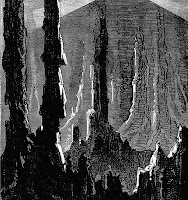
A Long Fusiform Object; Jules Ferat

1 - Entry

A natural cave mouth gives way to hewn stone; a calculated sea of stalagmites disguising the entryway from the outside, but failing to provide protection from one spelunking betwixt them. A stale smell - the smell of natural re-use of an artificial context, an ignorance to purpose - greets whomever enters.

2 - Pirates Pentangle

In the culvert to the south of this room, a skeleton sits atop a pile of silver - 1,100 pieces total. Atop his lap, he has a trapped lockbox (poison needle, Save vs Death), containing a further 500 gold pieces.

Five Giant Shrew (B42) mill about the space.

3 - Riven Room

Six rivulets are cut into the floor, running south-west to north-east. They are difficult to move across quickly - but a character moving carefully will have no issue. Nearer to the door, the rivulets are stained black.

4 - North Hall

An armored skeleton - its equipment of foreign, advanced make - is propped against the north wall at this point. Its armor is as Chain, but weighs as Leather; its sword is mundane gains +1 to hit, but not to damage. Additionally, he carries a key - this will open the doors to either room 9 or room 11, determined randomly.

5 - Tophet

Six pillars of flame blow downward from and into matching cylinders 10 feet into the room from each of the points of the hexagonal wall. In the center of the room, a south-pointing triangle bears burn marks in the center; a studious eye will note a human shaped disturbance in the center; where the scorches are less intense. Hidden under some ash in this portion of the room is a gold-plated amulet worth 300 gold pieces.

The flame pillars will not ignite anything placed within them, but will instead cause what is placed in them to melt like wax, regardless of its consistency or make.

Inlaid in each of the sconces is a thick carnelian worth 10 gp. If removed, the flame will turn to a strange white-blue color. In this new state, the flames will no longer melt what is placed under them - but instead will lay a curse on whatever is placed in them on a 2-in-6.

6 - Guarded Horde

Three small chests, each locked, line the walls. In them can be found 500 silver, 500 silver, and 200 gold plus 100 silver. Just beyond the door is a depression in the floor in which resides a Grey Ooze (B36). The ooze is difficult to see, as it appears part of the stone floor: mechanics of which are at the discretion of the referee as to how to spot it, lest a character misstep.

7 - Statue

In the alcove to the north-west is a statue - a gargoyle (inanimate) - sitting amid a set of long-leaf ferns: fiery red and orange in their coloration. The statue overflows, a viscous, algae-choked water leaks from it, protruding halfway through the room on the northern side. The room is quite humid.

8 - Sauna

A spindly fixture hangs from the ceiling in the center of the room, dangling into a pool of water. The spindle is hot to the touch and constantly causes the water to steam - though it never seems to draw empty.

The room is uncomfortable to be in while in armor - but any character who spends at least 3 turns in it is subjected to the effect of a Cure Disease spell, same as might be cast by a Cleric of appropriate level.

9 - Slime Room

Behind the locked doors lies a pile of gold - stretching across the arc of the north-west wall. The gold is false, however - a thin and fragile veneer over a fragile container. A character handling this false gold has a chance to break it - exposing them to the Green Slime (B36) which is contained within. Due to its limited quantity, however, the timetable under which a victim might themselves turn to slime is doubled.

10 - Victims Past

Against the south wall of this dead-end hangs a skeletal corpse, held together primarily by its clothing and chained to the corners - up, down, east, west - of the wall. It has nothing of value and show signs of burns.

11 - Reliquary

Atop a pedestal is a perfect emerald the size of a fist - it is worth 500 gold pieces. Piled at the feet of the pedestal are 300 silver and 200 gold pieces.


12 - Sanctuary Hall

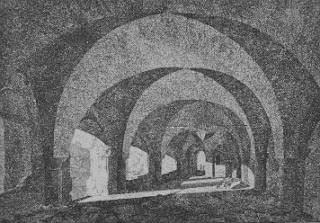
The Hall of Heidelberg Castle; Georg Primavesti and Peter Speeth - and Chandelier; Florence Huston

In the center of this wide hall is a steel candelabra - characterized by hanging razors which tinkle in the breeze if a door is opened, equalizing the pressure and humidity between this room and another. Any character which attempts to open the door to room 13 without deactivating a mechanism - which is accomplished by placing at least 50 pounds of weight on a touch-plate directly under the candelabra - will trigger a trap.

If triggered, the candelabra starts spinning violently, discharging razors in all directions. 2d3 characters within the room, but not under the candelabra, are randomly targeted - THAC0 18 - for 1d6+1 damage on hit.

13 - Hammer Home

On the east and west corners of the hexagonal space, each, are two large statues, sitting, with gems for eyes. The east statue's eyes are transparent opal; the west, iolite. From their eyes extend yellow and purple beams, respectively, which illuminate most of the floor: overlapping into a sick brown diamond in the center of the room. Two or three pillars - human-shaped - stand with looks of horror about them in the illuminated space.


  • A lawful character which enters into the yellow light, or a chaotic character which enters into the purple, must Save vs Paralysis or be turned to salt.
     
  • A neutral character which enters into either light must Save vs Spells or be turned ethereal - unable to enter daylight on fear of disintegrating, but otherwise retaining their faculties.
     
  • A character of any alignment entering into the brown space must Save vs Death or suffer accelerated decay - as a corpse - being devoted and turned to mud, then ash, over the course of 1d6 rounds.

Hovering in the brown light is a warhammer: its face an equilateral hexagon. The warhammer is magical - +1, +3 vs Spell Users of any variety - and may, 3 times daily, be called to cast the spell Move Earth (X18). If pried free, each of the eyes - regardless of color - is worth 250 gp.

Hammer Sledgehammer Mallet Tool; Steve Buissinne

Hall Traps

T1) At this point in the hall is a pit trap, 30 feet deep, 10 by 10 feet across. Any character stepping over it has a chance to trigger it - and any character falling in suffers 3d6 damage.

T2) Along the bend in this hall, circular structures - wreath like - of black twigs form a series of hoops - almost a tunnel - leading southward. It is a tight fit - only one may pass at a time. Any character passing through the tunnel has a chance to brush against the twigs - and any character which does so accidentally or intentionally must Save vs Poison (re-rolling the first failure if wearing plate). Immediately - either way - the touch site suffers a burning, tingling sensation: on failure, the character will fall unconscious after 1d4 rounds. An unconscious character will stop breathing for 1d4 turns: resulting in suffocation - but can be kept alive by CPR or other equivalent therapy or appropriate healing magic.


Public domain and open license images retrieved from Pixabay, OldBookIllustrations.com, and the National Gallery of Art and adapted for thematic use. Attributions in alt text.

Sunday, February 27, 2022

Appendix-NIMH

Awash with the like of Blippi, Veggie Tales, and Super Truck (to name a few items that have blared on our television in the last 24 hours), I had - on a night not too long ago - had enough of it and steeled myself to find a program, a show or film, that would keep the boys' interest but would also not feel like a punishment as it related to my own. Thinking back - then - to films that held my attention as a child, films that I remembered for their quality and for their critical acclaim: quality, first, as if a toddler me would like it, so likewise might a toddler they; but critically, second, because if reviewers liked it - then surely, they were adults (like I pretend to be) when they wrote their reviews. Thereafter - scanning through free-to-me streaming options, bypassing several gems that I would have had to pay for - I found myself pleasantly surprised to find a version, free-with-ads on the Tubi app, of Don Bluth's 1982 classic: The Secret of NIMH.

N-Spiration: The Secret of NIMH

The Secret of NIMH theatrical poster sourced from BlackGate.com

About the Film

The Secret of NIMH, released on July 16, 1982, based on the book, Mrs. Frisby and the Rats of NIMH, and starring a wide cast of characters including Elizabeth Hartman as Mrs. Brisby (renamed to avoid a lawsuit over the Frisbee disc toy owned by Wham-O Inc.), Dom DeLuise providing air support, Shannen Doherty and Wil Wheaton playing siblings, Peter Strauss, and John Carradine, follows the story of a mouse mother attempting to save her family from both illness and man. Specifically, one man - the farmer - who doesn't truthfully know of the plight going on beneath his field: but that's neither here nor there.

Apart from its financial disappointments - MGM having released it in 90% fewer theaters than the financiers had expected - and its critical acclaim (harboring 93% on Rotten Tomatoes, as of this writing, and an 85% audience score with over 5,000 rating; and with a double-positive rating from Siskel and Ebert following its release and its win of Best Animated Film at the 10th annual Saturn Awards in 1982) - The Secret of NIMH is likely most known for the absolutely and unmistakably phenomenal art and animation on the film - and the prodigious budget and effort required to get it there.

The goal of the studio in the production of The Secret of NIMH was to reproduce the golden era of Disney animation - though Disney had passed on producing the film. The primary protagonist - Mrs. Brisby - reportedly had 46 different color palettes, representing different lighting situations called for in the film; in addition, backlit animation with color gels produce unearthly glows and multiple passes on the camera creating translucent effects - lending an ethereal quality to many of the scenes. All in all - the movie draws you in and tells a complex story within a framework that a child will understand.

Riveted, indisputably!

Mine did, at least.

Why NIMH?

This commentary may contain spoilers. Swim at your own risk.

Why should I, as an OSR referee, watch The Secret of NIMH? Two reasons: swords and sorcery. This film contains every element of an OSR game - ranging across level bands and across class niches. The rats themselves live in a society reminiscent of Camelot - fighting with swords, knives, and even once with Gary's favorite: a pole arm! Not enough sorcery in your sword and sorcery? Bam - the leader of the rats is a freaking wizard.

Regarding the sorcery aspect - most of the mystical elements present in the film manifest themselves through the use of magic items or talismans: some of which can be identified as scientific; others clearly having no secular origin. The way that the magic is used - in this sense - is very reminiscent of magic in Mausritter: a charming, not-quite-OSR game I have not had the opportunity to play enough of but the authors of which, I would be surprised if they had not seen this movie and taken some inspiration.

Further - to expand on themes in addition to elements - the film opens on a wilderness crawl. The primary protagonist has to leave home, brave the dangers of the wild, to make it to a wizened sage - Mr. Ages - in search of relief from a sickness taken to her son. The physician prescribes a medical treatment: something that's important in the context to maintain the groundedness of the film. While none can claim that D&D, as a game, as ever truly been low magic, as magic is accessible essentially to every adventuring party - it's application is limited: a Cleric, in B/X, gains no spells until second level: and doesn't gain the ability to remove diseases until 5th. Is Mr. Ages a low level Cleric? Of course not - but the point is, like many settings and setting design goals set out by OSR referees, the world bears verisimilitude - believability: historical resemblance is not compromised by indiscriminate use of magic to solve problems. Mr. Ages - and Mrs. Brisby - are both entirely human (or... mouse... as may be) and the world they live in is full of dangers and problems that they must solve or endure through wit or through perseverance. 

In this, the characters become more relatable - while at the same time making a nod to the fantastic. When returning with the medicine, Mrs. Brisby is pursued by a house cat. It's a perfectly standard experience on a rural homestead - but when presented from the perspective of the mouse, the film does a brilliant job of making the house cat into a terrifying foe. The creatures name, even, is "Dragon" - ironic humor for the farmer; an apt title for the mice; and a touch of the fantastic for us - the viewers.

Why have you come?

On two occasions worth citing, The Secret of NIMH explores a rendition of the dungeon crawl: once - again - seeing the guidance of a sage, this time in the form of the Great Owl; and then later, in attempt to drug the cat, Dragon, to facilitate movements of the rats. The former entailing a wandering monster encounter and the latter entailing a trap, imprisonment, and perilous escape, both sequences embody experiences that fantasy adventuring parties encounter: experiences which a referee - novice or seasoned - may draw inspiration.

For Further Consumption

You mentioned early on in the review that the film is based on a book of similar title and story. Is the book worth reading? I honestly don't know - I have not read it. I can vouch that it has a 4.15 rating on Goodreads - as of this writing. But I can also vouch that the book does not contain the same mystical elements - as writer and producer Don Bluth added the mystical elements intentionally: one, to create a greater air of mystery; and two, to add a layer of spirituality and depth to the story that wasn't there in the version more geared towards an exclusively younger audience. Knowing what you know, I can guide only so far regarding the novelization.

There is a sequel, I think? And maybe a remake in the works? No. The Secret of NIMH 2: Timmy to the Rescue did not happen: much like Mad Max: Thunderdome did not happen - definitely not agonizingly spewing effluvium on the memory of the original. Didn't happen. 

Of the remake - I am aware of a television series in the work by Fox and a live action / CGI film in the works by original producer MGM: but we'll have to see what happens with either of those particular cash grabs expansions of the NIMH ecosystem. The Secret of NIMH was a passion project - a labor of love: as evidenced by the executive producers taking out mortgages on their own homes to fund finalization of the product: it will be a challenge for corporate direction to produce the same soul, the same art as pours freely from an empowered and impassioned creator or creative team.

In Conclusion

In my first N-Spiration post, I had a kind of tongue-in-cheek scale, rating the film on a scale against itself, implying that the scale should be based on that film due to its brilliance. Between then and now, however, I've had some time to think it over and I've come up with what I'd say is a better scale: one that more aptly reflects the objective of the series. And using that new scale, I rate The Secret of NIMH a solid 1. (It's OSR, remember? Lower numbers are better sometimes.) 

The Secret of NIMH, while not a traditional fantasy, hits all the bases to inspire a referee to run their own thing, to provide a challenge and let the players turn that challenge into an adventure. The combination of thematic elements, mysticism, and adventure - stacked alongside wilderness travel, "dungeon" delving, and problem solving (sometimes with wits, sometimes with swords, and other times with magic) plant this movie thoroughly in the camp of old school fantasy adventure gaming.

If you have not seen it; I recommend seeing it.

If you have not seen it in a while, I recommend seeing it again.

Delve on, readers - thank you for reading!


The Secret of NIMH and all imagery or clips taken therefrom or from promotional material therefor is property of Metro-Goldwyn-Mayer and is used for review purposes under US Code Title 17, Chapter 107.

Advanced Dungeons & Dragons and all imagery related to Advanced Dungeons & Dragons is property of Wizards of the Coast and is likewise referenced and used under US Code Title 17, Chapter 107 as a combination of review and parody.

The picture of my son is property of me - obviously - and the slide in of Grandpappa Gary... I got it from a meme.
No clue beyond that much.

Sunday, February 20, 2022

Vault of the Stag PDF!

Quick update for this week - I've added a PDF version to my Vault of the Stag adventure from a couple weeks back. The original post has been edited to add the link - but for folks who'd seen it once and may not be sitting on the page, F5ing for the alternative medium: I wanted to announce it here in case it was something to which you were looking forward.

Delve on, everyone!

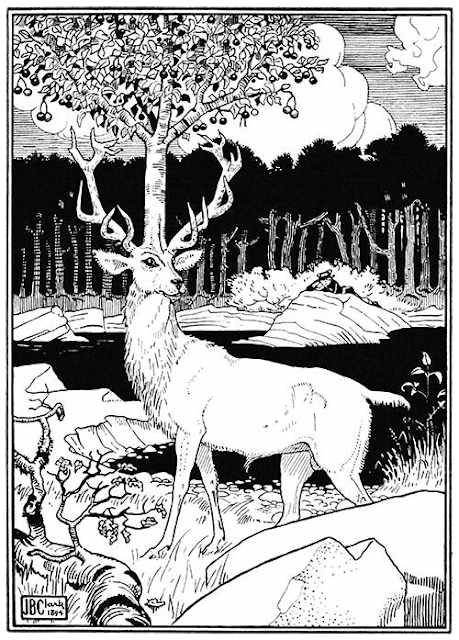
Noble Stag; Joseph Benwell Clark


Public domain image above retrieved from OldBookIllustrations.com and lightly cropped for use.

Saturday, January 29, 2022

Vault of the Stag

Scale: 10 ft.
Click HERE for a PDF version of this adventure!

Suitable for 1st to 2nd level characters.

A little keyhole icon means the door is locked.
A little "S" through the door means the door is secret.
The other icon - which is supposed to look like a muscly arm - indicates the door is stuck and must be forced open.

A - Atrium

A1 - Sprite Circle

The northern section of the large space, north of the entry stair, is occupied by 14 Sprite (B43), who are dancing in a circle, creating a ring of stalagmites: with each stalagmite growing almost imperceptibly with each Sprite step which touches it. Between them, the Sprites are carrying 6 gold pieces.

A2 - Fountain of Order

Against the wall of the south space is a semi-circular tiled space, contained by a three-foot stone wall. The bottom is tiled, as though a fountain, and 600 silver pieces lie strewn about within. A character which enters the fountain will feel water - its push, its chill - but will not get wet. That character must - upon leaving the fountain - Save vs Spells. On a failure, the character's alignment is changed one step towards Lawful. Characters already Lawful will feel clean, energized: those characters will not need to eat, nor feel hungry, for 1+1d6 days following the exposure. The silver coins radiate - to magical detection - a slight lawfulness: though it will fade in 1d4 days' time having been removed from the fountain.

W - West Halls

W1 - Statuary

Two statues, both facing north, stand in this room. They depict life-size elk: the antlers of one touch - and seem to pierce - the ceiling.

W2 - The Ballroom's Basement

Thick cob webs line the western portion of this room. In the eastern portion, a mosaic has been placed on the ceiling - a circular piece depicting the perspective of one hidden below a glass floor, looking up at a group of rustic ballroom dancers. 

W3 - The Vault

A fortune in jewelry is locked beneath three thick steel cages in this room.

  • To the south east, a sack with 700 silver pieces, an amulet worth 600 gp, and a pair of earrings (an antique style) worth 800 gp total.
  • To the south west, a matching pair of girdles - laced in platinum - worth 1,200 gp each, coupled with a lone headband festooned with green emeralds and fine chain (worth 1,500 gp).
  • To the north west - a Wand of Negation (X50) sits upright in an ebony stand. Beside it, a ring - simple exterior, bejeweled with a ruby; but encrusted on the interior with cut diamond: making it uncomfortable to don or doff. Its materials are worth 1,600 gp to a jeweler - perhaps more to a collector (or masochist).

Standing guard in the room are 5 Skeleton (B42) who attack on sight.

W4 - Privy

Fist-sized holes are bored into the floor along the east wall. They are deeper than the light can see. In the southern alcove, the floor is slightly sunken, with a drain in the center: again, seeming to fall into nothingness.

W5 - West Fane

Torn curtains - heavy and thick, but damaged as though in a melee - litter this space. There is likewise some broken furniture - but both have been collecting dust and cobwebs for some time.

W6 - The Root

A root-like structure, similar to antlers, hangs from the ceiling, hanging from which can be found seven hempen pouches. In four of the lower-hanging pouches can be found 100 sp each; in the three remaining pouches, hung higher in the structure, can be found 100 gp each: for a total coin count of 700.

For each pouch removed, however, there is a chance the branch will snap; alternatively the branch can be snapped with relative ease by a determined character. If a branch snaps in this manner, a trap is activated: releasing a paralytic, corrosive mist.

All characters in the room must Save vs Paralysis or be paralyzed for 1d3 turns. Every minute that a character is in the room thereafter - while the mist lingers - suffers 1 point of damage per minute: or 10 points of damage per turn. Characters exiting and re-entering the mist must save a second time or be paralyzed: though subsequent saves in this manner may re-roll their first failure.

A character removed from the mist does not immediately recover from the paralysis - but they will stop taking damage. Organic inventory - such as scrolls, leather, and the like - may be required to save or be destroyed if left in the mist. 

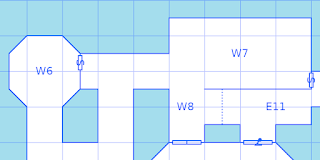
W7 - Huntsman's Hall

In the center of the room is a floor tile mosaic depicting a herd of deer. Along the north and south walls are seven pedestals, four to the north - three to the south. On six of the pedestals stand petrified, desiccated bodies - almost skeletal - wearing the garb of rangers, including dusty, decaying weapons characteristic of the woodland. Each of them holds a single gemstone in both hands. The gemstones are worth 60 gp each. On the last pedestal, there is a mess of bones: as though a skeleton had collapsed.

If an Elf or Halfling walks close to one of the corpse-rangers, it will raise its hands, offering the gemstone. When obliged (the gemstone being taken) the corpse will collapse in a heap of bone and man-leather, emanating a quiet but echoing groan while it does so.

W8 - Foyer

One can see into, but not access, E11 from this space through a wall of iron bars. There is a touch-plate near the bars - a character inspecting them or interacting with them may mistakenly step on it - which electrifies them: any character touching the bars at the time of the trigger suffers 1d8 points of damage.

E - East Halls

E1 - South Fane

Hanging above the door is a simple but elegant cobweb-coated chandelier. It is emblazoned with opals, seven of them, worth 10 gold pieces each.

E2 - Fellowship

In the center of this space, a chandelier appears to have separated from the ceiling, falling to the floor. It is damaged and there are sockets where gemstones might fit. There are five opals hidden in the south-west corner of the room, valued at 10 gp each, having been broken loose and rolled (been placed?) into natural rubble.

E3 - The Hunt King's Coffin

This room contains a central coffin - open: doors split side by side, as butterfly style - with a parched corpse inside. On the walls behind - south-east and south-west - there are portraits of a tall, pale figure - hair long and lank, pale likewise - wearing dark armor.

On close inspection, the parched corpse has petrified bones: examination of which, however, may trigger a trap. A character interacting with the corpse must - if the trap triggers - Save vs Paralysis or be caught as the doors of the coffin close, crushing them inside. A character crushed in this manner suffers 3d8 damage.

E4 - Spider Den

Tattered, dusty clothing are scattered on the floor. Four Crab Spiders (B43) have made their lair in the room. Specie totaling 10 sp and 34 cp can be found among the rags.

E5 - Knob Room

A pedestal stands in the room. Atop the pedestal is fixed a disc - three feet across, horizontal: that its plane is parallel to the floor. Atop the disc, a small platform is supported by a metal ring - independent of the disc - that has two solid rectangular protuberances on top - six inches by three - arranged side by side - as the doors to the north wall. On the disc is a black arrow, emblazoned, pointing north, but not directly at either door in the north wall: the disc will rotate, if a character attempts to turn it.

If the arrow on the disc is pointed at either of the two north doors, the handle on the target door will electrify: causing 1d4 points of shock damage to any who touch it, or 2d4 on a failed Save. If the disc is pointed at the south door, it will unlock.

E6 - North Fane

In the central area of this room, two stag-horn light fixtures hang from the ceiling. In the northern-most section, an altar with a statue of a six-legged stag atop it sits in a shallow pool of water. The water is mundane, but behind the statue can be found a loose brick: removing it will reveal a handle which, if turned, will cause the fountain to spin, facing into E7.

Before the stag altar is a band of 7 Acolytes (B30). The band is accompanied by a single Adept (Cleric, lvl 2) who has the Light spell memorized. The Adept has in his possession a Fire Opal (100 gp value) which he is convinced has some significance in the dungeon. It will not influence the stag altar, on which he is focused when encountered. 

E7 - Ringed Corridor

Ringing the south and west walls is a small rivulet, hewn into the floor, with a small grate along its center. Along the east wall is an inversion as such: a protuberance of equivalent height to the gutter's depth, rising from the floor. If a character steps on, places an item on, or otherwise applies sufficient pressure to this protuberance, it will sink down, releasing a swarm of flying hornets (B37). 

E8 - Priest's Passes

From within these two halls, the doors to E9 are obvious and simple to open. Along the walls to both are relief carvings of faces: worn with time. In E8i, two Fire Beetle (B31) are mulling about; in E8ii, four additional Fire Beetles (B31).

E9 - The Thunderhead Orb

A concentric octagon rises slightly in the center of this room - offset such that its points line the center of the edges of the room's walls. In the center of the room is an orb - held aloft by a glass pillar. The ceiling is domed and painted to resemble clouds. If characters step onto the central dais, the clouds seem to dim, as though a storm is coming.

The orb is worth 1,000 gold pieces and can be used as a crystal ball: however attempting to remove it from its pillar will activate a protective enchantment - striking the would-be thief with a bolt of electricity emanating from a random point in the ceiling. If this happens, the character touching the orb and 1d3-1 additional party members (hapless victims of chance, standing in the wrong place when the arc comes down) take 3d6 damage; a successful Save reducing the roll from 3d6 to 1d6.

E10 - Parishioners' Passes

A whistling can be heard in this space emanating from the direction of E9. If the door to E9 is unlocked, the whistling stops.

E11 - Skeletal Watchers

From this space, one can see into - but not access - W8 through a wall of iron bars. In the corner to the south-east, a handful of skeletons lie chained with manacles affixed to the wall at around waist height on a man. The skeletons will not be caught moving - however their skulls will, whenever gazed upon, be facing the gazer. Additionally, if a character is close to the secret door to W7, they will rattle gently - only once - in anticipation to see whether the party will find it or not.

The skeletons are harmless and cannot cause harm (nor help) to the party.

Saturday, January 8, 2022

Warlock Tower: The PDF!

Been having a bit of a rough go these last two weeks - no time for the blog - but not wanting to miss a week, I figure I'll post some content I just happen to have lying around: the PDF version of Warlock Tower, my submission to the original Prince of Nothing No-Artpunk Contest.

Warlock Tower, reviewed here, did not win, but did get an honorable mention here; so - for the No-Artpunk Companion there hinted, I did submit a revised manuscript - fixing some typos and adding some helpful bits that - when I was running the module, myself, in playtest - that I wished I had on hand rather than having to thumb through the book to find. Provided below is that file!

Deserted Tower; Decker - Old Book Illustrations.com
Warlock Tower

There... isn't a lot of art in here, CWR. True. The provided PDF is an exercise in brevity - I was trying to stay under the 20 page limit: that, plus the deadline, kind of forced my hand on the public domain art front. I may try to go back and find some to spice it up - but no promises. It's been hard enough to get this post out today - will try to have a podcast episode with a sort of "State of the Union" later on this month.

Are you going to finish your play through on the YouTube channel? I want to, but I don't know when I'm going to get to. Because of health-reasons, I'm losing a lot of time and having to cut back on my already anemic gaming schedule. Players from that game are welcome to look - or not look - in hopes that we find a time to play: and perhaps another platform to play on, as Astral is, it seems, going away.

Should I still buy the No Artpunk Vol. 1 adventure collection, even though the obvious best author - you - aren't in it? Absolutely. I have not had a chance to read through it myself, but I can vouch that - knowing it's PWYW, you have nothing to lose: and knowing what you pay benefits the Autism Research Institute, if you choose to pay, you're paying into a good cause.

Delve on, readers!

Saturday, January 1, 2022

Enter the Scorpion

Scorpion; Samuel Howitt

They say, deep in the wastes - among the rocks and sand, where no man may dwell - in the places where water is in scarcity and the sun, abundance: there can be found the hardiest of the half-races. In those places, the Girtablilu have made their lairs.

They say - far from the places where men dwell, where the wells flow over terraces and where the barley grows - at the ends of roads mortal feet wear out before reaching: there, the gods set their homes, made their palaces, kept their keeps: and along the way, set these Aqrabuamelu to hinder the way.

They say, in these places of dying, in the corners of the wilds, where the sons of angels once walked, but whose sandals have turned to dust - the generations and generations of their abandoned guardians, their orphan soldiers, hatched from hidden clutches buried beneath the rock and clay, swarm in their thousands.

Or, so they say.

Waykeepers of the First Gods

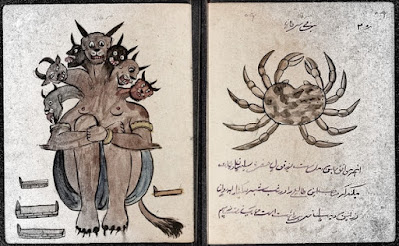
Scorpion Men are - as their name indicates - a fusion of man and giant scorpion. They have the upper body of a man mounted atop the body and tail of a desert scorpion. They speak a language derivative of the Wild, despite the origin of their species being steeped in Chaotic sorcery. 

Page 8, Persian Demons from a Book of Magic and Astrology

Encountering Scorpion Men

Scorpion Warrior
Armor Class: 6
No. Appearing: 2-20
Hit Dice: 3+3
Save As: Fighter 3
Move: 150' (50') Morale: 8
Attacks: 1 Weapon
and 1 Stinger
Treasure Type: A
Damage: As Weapon +1
1 + Poison
Alignment: Neutral
Frequency: Uncommon
Chance In Lair: 5%

When In Lair When encountered in lair, the No. Encountered represent warrior males; a second roll should be made for females – which are likewise capable, but not necessarily armed, in that they may not be expecting combat. There is a 2-in-6 chance they will be guarding eggs: in which case their Morale increases to 11.

Poison Stinger A character which is injured by the Stinger attack of any Scorpion Man must Save vs Death or perish. The effect takes between 1 and 4 turns; but if a second dose is administered (that is, a second sting occurs and a second save is failed, the time remaining is reduced to 1 to 4 rounds.

On the Organization and Tack of Scorpion Men 

  • 3-in-6 Scorpion Men - warriors, the rank-and-file - carry a morning star, shield, and crossbow. Zodiac Signs Symbol Transparent Background Scorpion; Pixabay user Agzam With shield equipped, their AC improves to 5.
  • 2-in-6 Scorpion Men -  lancers, the cavalry among the chimeric - carry composite longbows and spears, with which they are wont to charge: benefiting as using a lance.
  • 1-in-6 Scorpion Men - mutants, regressions - are hatched with the claws of a scorpion rather than the hands of a man: often with projecting antenna and occasionally mandibles in addition to their jaws. These creatures are sentient, albeit not as clever as their kindred - their intelligence corrupted by their instincts - but they benefit from two natural pincer attacks which do 1d6+1 damage each, which they use in lieu of a weapon and in addition to their normal Stinger attack.

Split Fire All Scorpion Men may - if equipped with ranged weapons - split fire: that is, move a portion of their movement, fire a ranged weapon, and then move the remainder of their movement afterwards, but still within the Missile phase.

Spoiler Alert!
The Deeper Lore section contains some notes to help a GM (me) to run the Scorpion Men in a way consistent with the archetype they are supposed to fill and some of the inspirations behind their creation. If you play in (or want to play in!) a game GM'ed by me, beyond this point will ruin some of the mystery for you for both Scorpion Men and for most of the sentient races: having some impact in the game world that isn't immediately available outside of player character discoveries.

Deeper Lore

The Scorpion Men are free peoples, with tribal affiliations determining the nature of their governance. However, they have a kinship with one another - a bond brought on by their shared origin. Scorpion Men are not a Vice Race: they bear no seed of Chaos - but they were mutated, chimerized by the ancient gods of Chaos to wage war on other celestial beings - the lords of Law and the natural world, alike.

In the ages that followed, they have been employed by various powers as guardians - some say that they guard the gates that hold the sun in the evening - in part due to their territorial nature and in part due to their rugged survivability. They are fiercely loyal to their own - but they are not intractable: with a good reaction and proper communication, they are apt to make powerful allies to any who have curried their favor. They are territorial with one another - although it is rare to find unrelated tribes in proximity to one another: and often, the borders are drawn and observed amicably.

Page 4, Persian Demons from a Book of Magic and Astrology

They have some suspicion of the gods and of Clerics. In the modern age, as mentioned, they are free - but the elders tell tales to the hatchlings of days wherein the gods enslaved them, ensorcelled them, sent them to battle for purposes alien to the Scorpion folk. The truth of it - many serve these powers unintentionally due to their penchant to protect their territory: having been placed there to block the movement of other races into a place beyond of which the Scorpion Men have no knowledge - others reside in forgotten places: the purpose of their seeded colony having been lost as the cosmic struggle moved on.


Public domain and open license artwork retrieved from OldBookIllustrations.com, from Pixabay, and from The Public Domain Review and adapted for thematic use. Attribution in alt text.

Frieren: Beyond Journey's End

N-Spiration - Frieren: Beyond Journey's End About Frieren The saga that is Frieren  started (and continues) as a serialized ...